

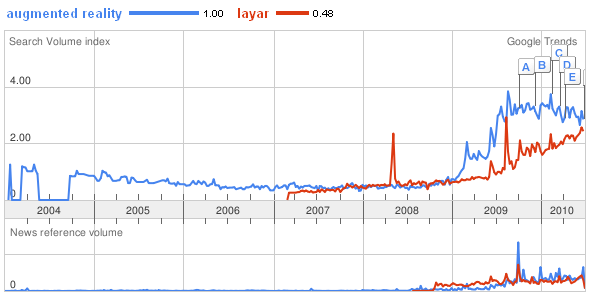
It was the early days of June when I first reported about Layar, the brain child of the small Dutch team behind SPRXMobile. Two weeks later it went public, followed by what can only be described as a media frenzy. One year later, Layar is quickly becoming synonymous to mobile AR*:
 Maarten Lens-FitzGerald, one of Layar’s founders and current general manager was kind enough to answer some of my questions in the following short interview. Many thanks to Claire Boonstra for giving a helping hand as well. I hope that in the coming months I’ll get to interview other entrepreneurs in the industry.
Can you shed light on how Layar came to be? What was SPRXMobile and how did you decide to create Layar?
Back in 2007, we (Raimo van der Klein, Maarten Lens-FitzGerald and Claire Boonstra) were part of the founding team of Mobile Monday Amsterdam. We started this initiative to connect people who shared their enthusiasm for mobile technological innovation.
Mobile Monday Amsterdam flourished and in 2008 we decided to set up a business together, launching SPRXMobile. The focus was on innovative mobile consulting: helping organizations discover and put the new world of mobile to good use. Several successful projects were completed for leading companies.
Working for other companies was enjoyable, however, working on your own projects is even better! There were several ideas that we worked on in the early part of 2009. One of the projects was called Layar…. It was kick-started by the launch of the compass enabled Android devices, the blog post “the Augmented Reality Hype Cycle” and inspired by Vernor Vinge‘s Rainbows End & the Japanese anime series Denno Coil. The core idea was the offering of content in separate layers on top of reality.
The launch of Layar on June 16th 2009 was very exciting as it was the first time we introduced our ‘baby’ to the word. When the media hype began it was unbelievable! We knew augmented reality was about to take off, but we hadn’t expected to be in the middle of the feeding frenzy. It’s such a kick to see your own product in the same blogs and magazines you have been reading for a long time (Wired, Engadget, Fast Company etc). And all were enthusiastic. It was the start of a great year!
What was the most exciting moment, professionally, for you in the last year? Was there a moment in the last year when you said to yourself “we’ve made it”?
There are several for me (Maarten), I guess I can’t choose 8-):
The first most exciting moment was during the Layar Next event in late summer of 2009. I was standing next to the stage and listening to SF author Bruce Sterling give his “At the Dawn of the Augmented Reality Industry” talk . During the talk he began to rant about what was to come for the Augmented Reality Industry. We hadn’t briefed him at all and just asked him to share whatever he felt like sharing. It was amazing to see how well he was able to catch the gist of the up and coming industry and predict its future.
The second most exciting moment was when I arrived at our new office for the first time on the first working day of this year. It was early morning and no one had arrived yet. The team had moved into the new place while I was on vacation, so I hadn’t experience the place ‘occupied’. The old office was just one room and now we had moved up into this nicely designed and big professional office space. Such a clear step forward.
The third exciting moment was the talk we did at Google Zeitgeist in front of leading CEO’s of the world including the inventor of the world wide web Tim Berners Lee. He not only listened but at the end of the talk also asked some great questions including giving some great advice. It is very humbling to get advice from the very the man who made your work possible.
The last most exciting moment was during my last trip to the US for the Augmented Reality Event. The second day I slipped out to go shopping at the big mall in San Jose. In the mall I went to different shops and booths from Sprint, Verizon and T-mobile and casually started talking with the sales people to see if they knew Layar without revealing that I was from the company. Not only did they all know about Layar, but they were also quite enthusiastic about it! I hadn’t expected such wide spread brand awareness.
There were lots of exciting moments, these were mine and I bet Claire and Raimo will have others. From the opening of the platform, launching the iPhone version, to reaching the 1,000,000 user mark or the 3,000 developer and the 1,000 layer mark. Or the global distribution deals with Samsung and others. All are good and many more to come. We haven’t made it yet, we’ve only just begun.
Even though Layar wasn’t the first to the market, the press seemed to be infatuated with it since day one (for example, http://techcrunch.com/2009/06/21/layars-augmented-reality-browser-literally-more-than-meets-the-eye/) , and had reported extensively about new version releases throughout the past year. How did you achieve such a feat? Can you reveal some of your trade secrets for the budding AR entrepreneurs out there?
We were lucky that the press picked Layar up. Looking back we know the first Layar video really made a difference. It captured the concept of augmented reality in the right way and helped people understand what augmented reality is and how it can be used. It was a great start.
For the rest of the year we had four principles that worked for us: sense, scale, open and pull.
Sense means that we don’t always understand everything but trust that on a deeper level we know what direction to take. The mobile industry moves swiftly and is very complex. We trust our instincts most of the time and are not the types for elaborate business planning. It’s no coincidence we are in the sensing business.
Scale means that we create systems that can grow. Augmented Reality is an economy of abundance. There is no limit. We host in the cloud, limitless scalability as the Lakers – Celtics effect showed us. We also don’t know what is relevant in Argentina or Tokyo. That’s why we don’t do content. Others make it, and make a good business when they sell their layer work and AR. We can’t talk to everyone to make a business. But together with the developers and publishers we can. And another one is that we knew the Layer catalog wouldn’t scale for the many, many layers and their content. You need a discovery mechanism to open up the augmented world. Like the EPG for TV, Google for the web etc. That’s why we launched Stream.
Open means that we share and give away as much as we can. The internet has great examples of openness like the protocols, websites like Wikipedia and software like Apache. This helps us see that to scale we need to be open. To last we need to be open, to give away and share the opportunity. We love the idea of infrastructure and its ideals. AR needs infrastructure and hopefully Layar can help by being open as much as we can.
Pull means that we don’t push. We don’t call people and try to sell our product. We don’t do anything that costs too much time and energy. We’d rather put the energy in a great product that attracts, that pulls everyone to us. Instead of spending money and a big marketing campaign we’d rather create a great feature that everyone will talk about and can be introduced with one blog post. John Hagel was a good inspiration for us for this.
For us this works, they are principles we work by and that are closely linked together.
What’s next for Layar? Where do you see Layar a year from now?
We have built a foundation for Layar these last months. A foundation with the Catalog, Stream and Floaticons. The catalog for all the developers to make great AR services and experiences and to build a business. Stream for the users to find what is fun and relevant. And floaticons for all to express themselves.
The coming year we will be growing this foundation and adding things like image recognition and more.
Google is neither at the moment, neither friend nor foe. They are a great service, we use them for mail and other services. And Goggles is a great product. Currently they are not a threat. Yes they do some compass AR in Goggles but that is automated search results. No developer built interactive & immersive AR experiences. Their image recognition is really fast and smart. This is good, it will be a great benchmark when we add that feature.
What we see is that Google doesn’t focus on the experience part of AR. They see it as a search interface. This all can change of course, but we don’t want to worry about things that aren’t there.
–
* True, the graph above is misleading – a substantial amount of Layar’s search volume is composed of Indonesians looking for something completely different. Yet, the peak in 2009 and steady rise since than can only be explained by the popularity of Layar. Other companies don’t enjoy the same growth in search volumes, which lacking download numbers, is our best estimate of popularity.
Filed under: Uncategorized | Tagged: Interview, Layar | 5 Comments »




 Games Alfresco