Augmented City: The Creator of Domestic Robocop Blows Your Mind Again

I know some of you already seen the following clip on other blogs, but when I contacted Keiichi Matsuda two weeks ago, he asked me to wait till the final version is ready. Luckily, the wait was shorter than expected.

Keiichi Matsuda, the creator of the now famous dystopian short clip Domestic Robocop, is at it again. In “Augmented City”, a project that got him nominated for the Royal Institute of British Architects (RIBA) Silver Medal award (and no, there’s no golden one), Matsuda pushes forward his belief that modern cities are more than concrete, metal and glass occupying a physical space but also the digital information that is produced and consumed by the city’s residents.

Or, in Matsuda’s own words:

Augmented City explores the social and spatial implications of an AR-supported future. ‘Users’ of the city can browse through channels of the augmented city, creating aggregated customised environments. Identity is constructed and broadcast, while local records and coupons litter the streets. The augmented city is an architectural construct modulated by the user, a liquid city of stratified layers that perceptually exists in the space between the self and the built environment. This subjective space allows us to re-evaluate current trends, and examine our future occupation of the augmented city.

AR coupons may be littering the streets in Matsuda’s vision, but it still looks amazing –

I crossed my eyes to see this clip, but if you go on and watch the clip on Youtube you’ll be able to pick a red-cyan version and use your favorite 3d glasses. Want to learn more? Check out Keiichi Matsuda’s thesis.

AR Door and LG 3D TV

Multiple forms of AR (marker and markerless) together in the same camera view.  Plus a little furry action for you animal types.  My only disappointment was that the AR is being used as an advertisement *for* LG 3D TV and won’t actually show up on it.

AR Door Moscow has Created Augmented Reality for LG

AR Door has spearheaded the creation and integration of augmented reality for LG advertising campaign in Russia. The campaign included the integration of augmented reality into the promo website, devoted to a release of a new LG 3D TV model.

Augmented reality is a term for a direct or indirect live view of a real-world environment, whose elements are augmented by virtual computer-generated imagery.

The web page (www.lg.com/ru/3d) incorporating augmented reality allows the users to enjoy a 3D world just right at their homes.

By visiting the web page the customers can flash the ad in front of a web camera. After the web cam recognizes the image, jungles appears just in front of the user, on the screen. The user can enjoy the colors of the fascinating scenery, watch parrots and a puma. One more feature is a possibility to take screenshots of your experience.

Face tracking technology tracks the movements of the head and superimposes 3D glasses and puma’s ears on the user’s face and head. The markerless technology of an augmented reality – D’Fusion – allows the camera to recognize not black-and-white images but colorful ones, people’s faces, bottles, etc. D’Fusion is currently admitted to be the most flawless AR technology.

Falkland Ghost Hunt

Augmented reality is meant to be location based.  Good to see the makers of the  Falkland Ghost Hunt remembering that.

Conquar – The Layar Based Strategy Game

Today my wife and kids were ignoring me so I hijacked my wife’s new iPhone.  I’d been curious to try the game on Layar called Conquar.  The idea sounded simple–take control of your city using troops.  Unfortunately, the game IS that simple.

The way the game works is this: when you create an account, you’re randomly put into a team and given around fourteen armies to conquer your enemies.  My favorite colors are blue or red, so therefore, I got stuck with yellow.  Boooo!  Then I used my fourteen armies to conquer the municipalities around St. Louis.  There are only five control points in St. Louis and I now own four of them.  Hazelwood, I’m coming for you next!

The game promises me more troops each day, so I can continue my smackdown of the Greater St. Louis area.  However, once I’ve beat the tar out of Hazelwood tomorrow, what else will I have to do?  I’m an old grognard who’s played countless strategy games, so you’re going to have to do better than one button war.  I expect to have armies to train, resources to manage, supply lines to protect, a wedding to plan, Gilder to frame!  Oh wait, got carried away there.

I recognize that AR gaming still has a long way to go, but if it wants to take off, it’s going to have to offer more than two minutes of fun.  Add some options, give me blood dammit!  The makers have posted that “Conquar Updates will soon follow!”  Here’s to hoping we see some soon.  Until then, if you’re in the St. Louis area and you log into Conquar, don’t forget pay homage to Emperor Carpenter.

Weekly Linkfest

Celebrating Ben Affleck’s 38th birthday, here’s this week’s linkfest:

Today’s video is of a project named “SMSlingshot” by the guys at VR/Urban (also check the link for its predecessor, the Spreadgun). As you can guess by its name, it’s a slingshot that throws short text messages at walls (aided by a powerful projector). The results are quite beautiful:

(via Beyond the Beyond)

That’s it, hope you enjoyed it, and see you at Ben’s party this evening.

Junaio 2010 Dev Contest Winner – archINFORM

I recently participated as a judge in the Junaio 2010 Dev Contest.  After a good debate, the panel of judges picked the winner — archINFORM.  The channel gives the user information about architectural structures in an AR view port.  Augmented reality fits the use of this channel because it’s an immediate need one might have while walking around, and sightseeing often involves picture taking so why not use your smartphone to learn more about those ancient buildings.

If you’re wanting to make in impact in Junaio, or with any AR app, try to consider why you’re using augmented reality in the first place.  archINFORM won because it was a natural extension of our everyday activities.  It added to the architectural database by making it visual.  Taking other popular applications and just linking them through Junaio, or other services, doesn’t lend itself to a useful product.

And I’m hoping Metaio decides to do another contest now that Glue is live.  I think the potential and creative applications could be quite interesting and I hope they give me a chance to judge again because I enjoyed the discussion with the other judges.

BlindType

I’m sure the implications for an air-typing interface are obvious.

Thanks @jelleprins for pointing this one out.

Logged In

I don’t much to say about the following video except that it’s named “Logged In” and I wish it was in English. On the other hand, it shows that AR can be an excellent tool for learning new languages. And I know it doesn’t meant to portray AR, but it sure looks like it:

[via Swiss Miss]

Augmenting TV

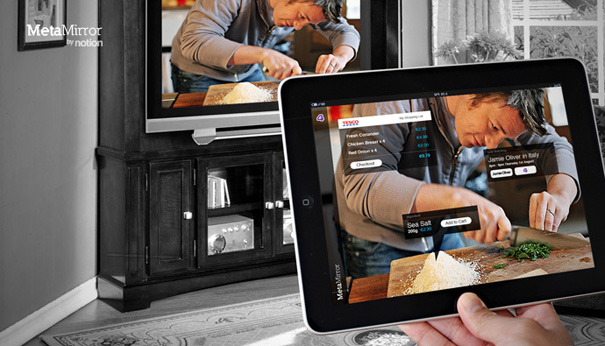
Recently two concept designs illustrating the use of augmented reality in order to enhance the plain old tv set, had come to my attention.
The first is a prototype from KDDI lab, presented at the NAB 2010 conference a couple of months ago. I couldn’t dig much information about it (here is some), though it seems to have the goal of personalizing advertisements in mind.

The other design is no where near reaching a prototype stage. Called the Meta-Mirror and imagined by Irish design studio Notion, it has less commercial agenda than the one by KDDI. It really strives to improve television. And with all the reality-tv shows out there, maybe augmented reality is the best way to do so. See more images of Meta-Mirror on Yanko Design.

Now Available on the App Store: SR Engine 2

My favorite independent augmented reality framework, Sein Kanemura’s SR Engine, has just reached the important version 2.0 milestone, freely available on the (Japanese) App Store. Moreover, an SDK was released, allowing developers to create their own image recognition based applications. Capable of identifying up to 150 images, one should be able to use SR Engine to create augmented reality applications for small galleries and venues.

As always, I’m pretty impressed with the UI design, fitting such a “futuristic” application. Mr. Kanemura seems to not only have excellent programming skills but a good eye for design.