This week will go down in history as the week vision-based AR mobile applications made their first move on the iPhone platform, and you’ll find plenty of those in the linkfest. Is this the (very welcomed) end for webcam based AR?
Ben&Jerry’s though had gone full-monty and lets you see augmented version of their ice cream tubs (see video below) via their Moo Vision app. Created by Circ.us and Patched Reality, it’s unfortunately only available in the US appstore so I’m unable to try it out.
However, I was able to try out ARSoccer but was fairly disappointed. This one, and a very similar minded Upsies (not yet available) let you kick a virtual ball. That’s assuming you have white floor and dark trousers. I actually enjoyed it more to bounce the ball off random furniture, but it still not worth the buck.
As promised, here’s Ben&Jerry’s Moo Vision. Looking cool, but what’s that thing about chickens being in my ice cream? I want my ice cream to be poultry free, if you don’t mind!
Augmented Reality is the best way to experience history.
My dream is to have a “time machine slider” that allows me, in any given location, to see how things looked at a certain point in history. My field of view would be overlaid (with perfect registration;) using old maps, drawings, old photos, recreations in the form of documentaries, or even big hollywood productions.
It could get really interesting when I slide the time machine slider forward to see how a certain city might look in the future.
***
Some folks are already trying to make this happen today. Just in time for the 4th of July. Checkout this fascinating initiative by a group of educators in Pennsylvania:
Our project, the Civil War Augmented Reality Project, is intended to
enhance the experiences of people visiting Civil War sites. It is also
intended to increase attendance and revenue for historic sites by
offering both “high” and “low” tech experiences to best reach the
majority of the population.
We feel that our project is fulfilling a need that educators, park
workers, technology enthusiasts, and Civil War enthusiasts have
discussed in the past: How can historic sites both raise educational
value and public interest in their institutions though technology,
while not alienating the non-technical history fans?
We have worked hard on the answer, and are interested in promoting our
creative solutions.
We would like to make clear that the project is not intended solely
for Pennsylvania. It is our hope that the project will expand to other
venues, as we feel that we have the ability to use our ideas to
enhance the experiences of all students at historic sites.
How is this going to work technically?
Jeff responds they’ll start by using Layar as the platform for the AR apps, and
they’ll probably use Google Earth in the binoculars installations. The
binocular installations will be self fabricated, and the AR
applications will be available to the public and of course an integral
part of the tablets they’ll be adapting for use.
The approach for funding this project is also interesting: micro-funding using Kickstarter.
I am looking forward to seeing more visuals about how this will look, but in the meantime, check out these articles and posts, and even a Facebook page.
The initiative is driven by 3 visionaries:
Jeff Mummert- Hershey High School and York College of Pennsylvania
Art Titzel- Hershey Middle School
Jay Vasellas- Red Lion Area High School and York College of Pennsylvania
It was the early days of June when I first reported about Layar, the brain child of the small Dutch team behind SPRXMobile. Two weeks later it went public, followed by what can only be described as a media frenzy. One year later, Layar is quickly becoming synonymous to mobile AR*:
Maarten Lens-FitzGerald, one of Layar’s founders and current general manager was kind enough to answer some of my questions in the following short interview. Many thanks to Claire Boonstra for giving a helping hand as well. I hope that in the coming months I’ll get to interview other entrepreneurs in the industry.
Can you shed light on how Layar came to be? What was SPRXMobile and how did you decide to create Layar?
Mobile Monday Amsterdam flourished and in 2008 we decided to set up a business together, launching SPRXMobile. The focus was on innovative mobile consulting: helping organizations discover and put the new world of mobile to good use. Several successful projects were completed for leading companies.
Working for other companies was enjoyable, however, working on your own projects is even better! There were several ideas that we worked on in the early part of 2009. One of the projects was called Layar…. It was kick-started by the launch of the compass enabled Android devices, the blog post “the Augmented Reality Hype Cycle” and inspired by Vernor Vinge‘s Rainbows End & the Japanese anime series Denno Coil. The core idea was the offering of content in separate layers on top of reality.
The launch of Layar on June 16th 2009 was very exciting as it was the first time we introduced our ‘baby’ to the word. When the media hype began it was unbelievable! We knew augmented reality was about to take off, but we hadn’t expected to be in the middle of the feeding frenzy. It’s such a kick to see your own product in the same blogs and magazines you have been reading for a long time (Wired, Engadget, Fast Company etc). And all were enthusiastic. It was the start of a great year!
What was the most exciting moment, professionally, for you in the last year? Was there a moment in the last year when you said to yourself “we’ve made it”?
There are several for me (Maarten), I guess I can’t choose 8-):
The first most exciting moment was during the Layar Next event in late summer of 2009. I was standing next to the stage and listening to SF author Bruce Sterling give his “At the Dawn of the Augmented Reality Industry” talk . During the talk he began to rant about what was to come for the Augmented Reality Industry. We hadn’t briefed him at all and just asked him to share whatever he felt like sharing. It was amazing to see how well he was able to catch the gist of the up and coming industry and predict its future.
The second most exciting moment was when I arrived at our new office for the first time on the first working day of this year. It was early morning and no one had arrived yet. The team had moved into the new place while I was on vacation, so I hadn’t experience the place ‘occupied’. The old office was just one room and now we had moved up into this nicely designed and big professional office space. Such a clear step forward.
The third exciting moment was the talk we did at Google Zeitgeist in front of leading CEO’s of the world including the inventor of the world wide web Tim Berners Lee. He not only listened but at the end of the talk also asked some great questions including giving some great advice. It is very humbling to get advice from the very the man who made your work possible.
The last most exciting moment was during my last trip to the US for the Augmented Reality Event. The second day I slipped out to go shopping at the big mall in San Jose. In the mall I went to different shops and booths from Sprint, Verizon and T-mobile and casually started talking with the sales people to see if they knew Layar without revealing that I was from the company. Not only did they all know about Layar, but they were also quite enthusiastic about it! I hadn’t expected such wide spread brand awareness.
There were lots of exciting moments, these were mine and I bet Claire and Raimo will have others. From the opening of the platform, launching the iPhone version, to reaching the 1,000,000 user mark or the 3,000 developer and the 1,000 layer mark. Or the global distribution deals with Samsung and others. All are good and many more to come. We haven’t made it yet, we’ve only just begun.
Even though Layar wasn’t the first to the market, the press seemed to be infatuated with it since day one (for example, http://techcrunch.com/2009/06/21/layars-augmented-reality-browser-literally-more-than-meets-the-eye/) , and had reported extensively about new version releases throughout the past year. How did you achieve such a feat? Can you reveal some of your trade secrets for the budding AR entrepreneurs out there?
We were lucky that the press picked Layar up. Looking back we know the first Layar video really made a difference. It captured the concept of augmented reality in the right way and helped people understand what augmented reality is and how it can be used. It was a great start.
For the rest of the year we had four principles that worked for us: sense, scale, open and pull.
Sense means that we don’t always understand everything but trust that on a deeper level we know what direction to take. The mobile industry moves swiftly and is very complex. We trust our instincts most of the time and are not the types for elaborate business planning. It’s no coincidence we are in the sensing business.
Scale means that we create systems that can grow. Augmented Reality is an economy of abundance. There is no limit. We host in the cloud, limitless scalability as the Lakers – Celtics effect showed us. We also don’t know what is relevant in Argentina or Tokyo. That’s why we don’t do content. Others make it, and make a good business when they sell their layer work and AR. We can’t talk to everyone to make a business. But together with the developers and publishers we can. And another one is that we knew the Layer catalog wouldn’t scale for the many, many layers and their content. You need a discovery mechanism to open up the augmented world. Like the EPG for TV, Google for the web etc. That’s why we launched Stream.
Open means that we share and give away as much as we can. The internet has great examples of openness like the protocols, websites like Wikipedia and software like Apache. This helps us see that to scale we need to be open. To last we need to be open, to give away and share the opportunity. We love the idea of infrastructure and its ideals. AR needs infrastructure and hopefully Layar can help by being open as much as we can.
Pull means that we don’t push. We don’t call people and try to sell our product. We don’t do anything that costs too much time and energy. We’d rather put the energy in a great product that attracts, that pulls everyone to us. Instead of spending money and a big marketing campaign we’d rather create a great feature that everyone will talk about and can be introduced with one blog post. John Hagel was a good inspiration for us for this.
For us this works, they are principles we work by and that are closely linked together.
What’s next for Layar? Where do you see Layar a year from now?
We have built a foundation for Layar these last months. A foundation with the Catalog, Stream and Floaticons. The catalog for all the developers to make great AR services and experiences and to build a business. Stream for the users to find what is fun and relevant. And floaticons for all to express themselves.
The coming year we will be growing this foundation and adding things like image recognition and more.
Finally, are you considering Google as a friend or a foe? Is Google Goggles a threat to the young industry?
Google is neither at the moment, neither friend nor foe. They are a great service, we use them for mail and other services. And Goggles is a great product. Currently they are not a threat. Yes they do some compass AR in Goggles but that is automated search results. No developer built interactive & immersive AR experiences. Their image recognition is really fast and smart. This is good, it will be a great benchmark when we add that feature.
What we see is that Google doesn’t focus on the experience part of AR. They see it as a search interface. This all can change of course, but we don’t want to worry about things that aren’t there.
–
* True, the graph above is misleading – a substantial amount of Layar’s search volume is composed of Indonesians looking for something completely different. Yet, the peak in 2009 and steady rise since than can only be explained by the popularity of Layar. Other companies don’t enjoy the same growth in search volumes, which lacking download numbers, is our best estimate of popularity.
With the live video access on the iPhone OS 4.0, Metaio is looking to make a splash with its Glue technology in the Junaio AR browser. They would like to show how the iPhone can do more than GPS AR browsing with both image processing and their indoor LLA marker tracking.
LLA Markers
The LLA markers are designed for indoor spaces when GPS becomes unusable. By attaching the latitude, longitude and altitude to a unique pattern, the iPhone can reposition itself without having access to satellites. Since the compass and gyroscope still work, you can point your phone away from the LLA marker and get navigation to the next POI.
This case shows how AR can be superior to map based location using the LLA marker technology. In underground malls when GPS becomes useless, AR can help bridge the gap. I’ve spent considerable time in Japan and often have been lost once I strolled far from my starting location. I would have to go up to the surface to get my barrings occasionally. If they installed LLA markers, it would allow the iPhone to become a useful navigator.
Junaio Glue
In addition to indoor GPS locations, Metaio has improved AR by adding live optical image processing. By uploading a tracking image to the Junaio servers, anyone can create an optical image that 3D content and information can be attached. To check out the technology, download Junaio and view this Glue comic character to see how it works.
This image processing along with a standard browser opens up a wealth of possibilities for Junaio. Now content providers can be more creative with their applications, utilizing visual clues along with GPS and directional ones.
Here are a few ideas that might spur your interest:
1) Using available 3D content on the web, turn your run-of-the-mill picture book into a 3D pop-up with your iPhone. Just upload each page as a marker and attach the image to it.
2) Create an augmented menu based on the logo of your restaurant. Or just have it link to your webpage. Make the world your Internet.
3) Location based treasure hunts using actual pictures of locations to find the next clue.
4) Turn your face into a business card.
5) Turn your logo into a charity event. Every time someone checks your logo using Junaio and it pulls the image or link from your server, give them a chance to donate, or make a small donation on their behalf.
The story Bruce Sterling posted up last week on his Wired blog blew my mind. It shouldn’t have really. But I guess I’ve been considering augmented reality and its commercial uses to be official and sanctioned. This kind of unofficial gonzo-view of reality could go a long way.
First, if you’re too lazy to click the link and check out the article, the leak in your hometown gang have made an augmented reality view that shows the oil leak on your smartphone when you point it at any BP logo, assuming you have the proper layer pulled up.
Mark Skwarek, one of the creators, sent me an email about the project as I was writing up this post. Here’s some of the progress they’ve made and other places talking about it.
This project itself seems simple and is quite ingenious. But why stop at poking fun at the world’s current kick toy? Pointing your smartphone at random objects and getting an individual person’s POV visual could be quite mind expanding.
An unofficial game of object-association could make great interactive art, political rhetoric, or dystopic reinforcing world-view; depending on its implementation. Wouldn’t you like to point your smartphone at everyday objects and find out how your favorite artists or celebrities view the world? Seeing how YoYo Ma, or the Dalai Lama or Bruce Campbell (the guy from the Evil Dead series) view the world could be liberating. Or since our own Bruce Sterling is the Prophet of AR, one of the AR browsers could do a “Bruce Layer” and show us what kind of world he sees when he’s looking around.
Maybe if Glenn Beck was your thing, you’d have a Nazi symbol pop-up when you pointed it at an Obama sticker. Or if you were a former Bush-hater, you could see a Stalin-esque version of the W with your smartphone. Propaganda could be all encompassing, blotting out all but the sanctioned viewpoints.
I’m absolutely certain I wouldn’t want to see what Lady Gaga has in mind for the world. Well. I might take a peak for a few minutes. Just out of curiosity. Not like I’m a fan or anything. Just curious.
And maybe that’s what a gonzo-reality could bring to AR. Instead of a mirror reflecting all of our beliefs into an ever-increasing sine wave, we might be privy to alternate views to our own. Maybe even trying out how someone else sees the world.
Maybe.
Or maybe we couldn’t handle their viewpoint. The overstimulating rush would make our realities spin around us until we puked it back out, losing all those alternate nutrients our world views could have used to grow.
After a month long hiatus, it’s back! The weekly linkfest is here, with a fresh batch of links:
Top headline of the week obviously goes to Qualcomm, which will launch a free vision based AR framework for Android this fall. In order to encourage developers to use their SDK, Qualcomm holds a contest for best use of the framework, first prize is $125000. I have to get myself an Android phone and start working on that AR Farmville concept! Who’s with me?
Video of the week shows a social hacking feat which will probably become a common practice as AR goes mainstream. Mark Skwarek and Joseph Hocking created “The leak in your home town”, an augmented reality application for the iPhone, which displays a virtual oil spill whenever you set the phone’s camera on a BP logo. Don’t expect to see it on the AppStore anytime soon. (via Beyond the Beyond):
The Ballet Font Project combines ballet with augmented reality. I assume they’ll have big screens showing the combined real time dance with the foot drawn fonts. The project is a rare cross breed between geekdom and high-end culture.
Used watch batteries and infrared LEDs to create a 2D motion tracking system. We taped these little devices to ballet dancers and had then perform moves which formed letters, which will be used in a headline font called “Ligne”.
This video shows a few letters being performed where we’ve used to the tracking data to overlay FX. The stroke width is controlled by the speed of movement. We’ll be doing a live demonstration at the Armory in Portland, Oregon on Thursday, July 1, 2010. Participants will be able to use the tracking devices to do real time augmented reality.
This project is the brainchild of Weiden + Kennedy’s WK12. Oregon Ballet Theatre contributed the choreography and dancing talent. I developed three versions of software called “Chireo” (chirography + choreography). “capture” did the initial motion and video capture. “augment” let us clean up the data and export the font and rendered videos. “live” is the real time motion tracking / augmented reality software we’ll be using at the demo. Todd Greco here at Fashionbuddha helped on the visual FX in the “augment” and “live” versions.
The object recognition portion of augmented reality is a little like that hand-held label printer that you got when you were a kid and then went crazy putting tags on everything in your room. Did you really need to put a tag on your table that said, “Table”? Nah. But it felt good doing it.
High-end object recognition (and I’m including facial) is really a key component to ubiquitous AR. Well, and those pesky glasses, but we won’t talk about them today.
So back to object recognition. For our computers to understand the world enough to create seamless reality interfaces, they’re going to have to understand what a chair is, where it is when they see it and what it’s used for. This understanding will be useful for us humans, but it will be even more useful for robotics in the future.
With easy access to information, labeled in a computer friendly way, robots can learn to use our environment better than before. And I’m not even talking about high-end robotics either. A couple of cameras on a Roomba could help it know when to vacuum the floor and when to stay put because a party is going on. We use unattended vehicles to transfer parts around our Toyota plants. Allowing these simple vehicles to know when a box has been left in the way and to quietly move around would make them work better.
And who knows, maybe in the far-flung future when Turing level robots become possible, they’ll educate themselves on the wider world by taking long journeys and absorbing the trash-tags left by their human overlords.
And for fun, here’s a picture and video of a robot.
Addicted to Farmville? Have a green thumb but no garden? Envy real farmers but got allergies?
The guys from TU Munich have the perfect solution for you:
Augmented Farmville could be one heck of a layer for Layar/Junaio/Wikitude once better positioning is available. Think of the gold rush to get a virtual plot in major cities, imagine Times Square as a flower bed! Using real meteorological data to those virtual farms would add another interesting and educational twist. It may be the most stupid idea I have ever featured in this blog, but then again, nobody would guess that a farm simulator will be one of the most successful games in 2010.
Coming back from my vacation, I had to catch up with a lot of AR related news. One topic though was so prevalent that I had to write about it in my coming back post. Obviously, I’m talking about the world cup in soccer. No other sports event gained such an attention from the AR community, and here are the results (don’t worry the last few ones are quite good):
Zakumi in FLARToolkit
The good: It seems to be created by a single programmer. Cheers for the initiative.
The god-awful bad: The music. I rather hear vuvuzelas than this one hit wonder.
Kappa’s “We Are One”
The good: The music is better than the previous video.
The bad: It’s in Chinese, so it’s hard for me to tell, but I think you need to download an application to play with it. Hello? This is 2010s, not prehistoric 2009!
Where: http://2010.kappa.com.cn/
Sony Ericsson World Cup Game
The good: You get to be a world famous soccer player while hitting soccer balls with your head in this game created by Total Immersion’s partner CherryPicks.
The bad: World famous soccer players are not necessarily handsome.
Where: http://www.sonyericsson.com.hk/fifa-game/
The world cup in a shopping mall
The good: Nice game, showing there are still some innovative things to do with a marker on a piece of paper. Made by another partner of TI – InterAct 3d.
The bad: Couldn’t they have the same application accessible through a webcam?
Junaio’s virtual soccer field overlay
The good: A brave attempt by Metaio to show game statistics for fans in the stadium in an unconventional way.
The bad: You have to be in South Africa to see it, and no videos are available. I’m a bit skeptic.
More info: http://augmentedblog.wordpress.com/2010/06/24/kick-it-like-augmented-reality/ where you can read about another application assisting you to find a good joint to see the next soccer match.
Zugara’s AR game in a banner
The good: Really cool creative, you need to “head in” corner kicks in this AD for AT&T.
The bad: AT&T. And people looking at you from behind while you’re jerking your head around.
Where: http://www.espn.com
KickBall AR
The good: Much better than AR Boomerang, this is the only mobile application on this list.
The bad: Only available for Samsung’s Bada operating system and the fact that Tom already wrote about it.
If I’ve missed anything (surely there’s a Layar layer for the games, no?), please feel free to add a comment.
So how AR is changing the world cup? Well it’s not, but for my first post in nearly three weeks, I had to try a title inspired by the linkbait generator. Anyhow, the usual “Weekly Linkfest” will return next week and as usual be sure to follow me on Twitter.


 The approach for funding this project is also interesting: micro-funding using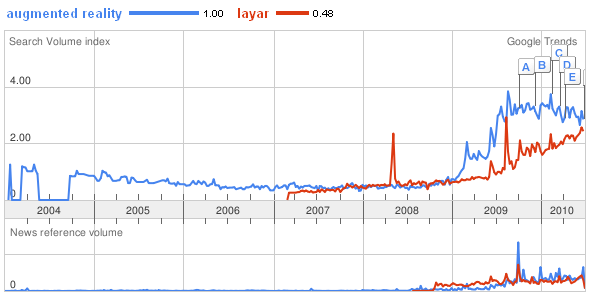




 Games Alfresco