Paint the Town Red with iRiS

The iRiS (Intuitive/iPhone Remote Interaction System) allows you to paint a multi-media facade on your favorite building.  Assuming it’s hooked up with a psychedelic projector.   But hey, we’re talking art here, not convenience.

The gamer in me wants it to be a game of Tetris on that building, but I’m sure that’s the most obvious way to utilize it.

The beauty of this is that its projected luminance can be seen by anyone, regardless if they have a smartphone or not.  But those with one get a remote controlled Lite-Bright building to play upon, making the others envious.  It’s easy to imagine this kind of art in an AR space and modifiable by anyone, though not everyone has an artist’s eye.  To each his own.

[Via Interactive Media Blog]

AR – Not for the Faint Hearted

Here’s a fun video showing of the results of a paper by some students from Imperial College, London back in 2008.
The abstract says:

Accurate estimation and tracking of dynamic tissue deformation is important to motion compensation, intra-operative surgical guidance and navigation in minimally invasive surgery. Current approaches to tissue deformation tracking are generally based on machine vision techniques for natural scenes which are not well suited to MIS because tissue deformation cannot be easily modeled by using ad hoc representations. Such techniques do not deal well with inter-reflection changes and may be susceptible to instrument occlusion. The purpose of this paper is to present an online learning based feature tracking method suitable for in vivo applications.

In other words, they are augmenting a live beating heart, muhahaha!

Soft Tissue Tracking for Minimally Invasive Surgery Learning Local Deformation Online. Peter Mountney and Guang-Zhong Yang

Weekly Linkfest

As expected, this linkfest is full of ARE2010 stuff:

This week’s video is not from ARE2010, but cool nonetheless. EXMAR is a conceptual periscope-like device that attaches to your mobile phone and lets you see an augmented view of your surrounding without pointing directly at anything. It’s great for minimizing hand strain, looking behind you and admittedly for perverts. Created by students at Korea’s KAIST institute, the related paper was submitted to ISMAR10 but is not available online as far as I can tell

Have a great week, see you back on the 20th (unless my flight will be canceled again).

Jesse Schell – Rethinking Vision

Jesse Schell gave what can only be described as a “kick-ass” keynote in ARE2010. In less than 30 minutes he gave me so many points to think about when considering augmented reality in 2020, that I couldn’t help but watch his presentation again, even though the video quality is less than perfect.

I will do great injustice to Schell by trying to summarize his talk, and you should really see it yourself, especially if you think that AR is about labeling things and will undoubtedly have a positive influence on our lives.

http://qik.com/video/7097759

On a side note let me again apologize for not attending ARE2010. My transatlantic flight to Atlanta was canceled due to some technical problem and Delta wouldn’t put me on another flight heading to the US for another 24 hours. Considering the connection involved, this would have meant getting to attend only that last couple of hours of the event, so I’ve decided to forgo the all idea.
Assuming my rescheduled flight will leave has planned, I’ll be in San Francisco next week and the week after that in Washington DC, if anyone feels like meeting up.

Vicariously at ARE2010

So, it seems that fate (also called Delta Airlines) decided that I should not attend the augmented reality event. Here are some alternatives you may want to check out for online cover of the event:

and i’m pretty sure that Ori will post here some news whence he’ll have the time.
Are you there and reporting about the event? Please tell!

Let Me Be Your Voice in ARE 2010

Not going to the Augmented Reality Event, this Wednesday? Too bad, but don’t despair. I’ll be there to cover what may become a milestone event in the history of AR.
Have question to any of the speakers or exhibitors on site? Just write a comment or send me a tweet – @augmented. Which reminds me, not bringing my laptop, I’ll be mostly updating on twitter via my iPhone. Be sure to follow me there.

Weekly Linkfest

The last weekly linkfest before the augmented reality event, and the last one in the next couple of weeks. Here’s what happened this week in the world of augmented reality:

This week’s video is a video presentation for QderoPateo’s Ouidoo, the articulated naturality device. I don’t know if it’s official, but seeing this video I understand why the avoid using the term augmented reality. A much better term is surrealism:

Have a great week, see you in ARE2010!

Augmented Reality for Autism

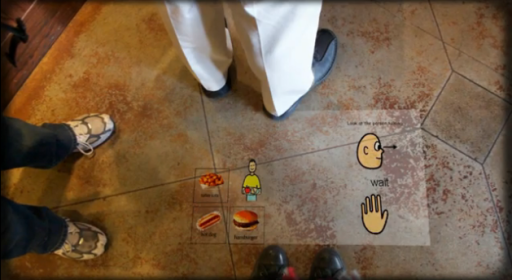
I have very little experience with people on the Autistic spectrum, but designer Timothy Byrne of Western Washington University has a brother with an autistic disorder, a fact the propelled him to invent “Sixthsense for Autism”. Building upon MIT’s Pranav Mistry’s SixthSense technology, this conceptual project tries to provide its user social cues for everyday situations. Here’s for example standing in line while using the device:

In the following video Byrne explains the motivations behind his design and show some other uses:

Visit the West Washington University’s channel on Youtube for more possible uses of Sixthsense, such as aiding those with impaired memory, in the classroom, for construction, and while driving or traveling.

[via Yanko Design]

Looking for an Augmented Reality Casual Game

Looking at the list of best selling applications for the iPhone, I started thinking (usually a dangerous habit). On the one hand, augmented reality wants to be mobile, and the best avenue for mobile AR we currently have are smart phones. On the other hand, we often imagine augmented reality (and surely AR games) as immersive experiences – if you haven’t seen it yet, checkout Roku’s reward.

The thing is, I believe that currently “mobile” and “immersion” are conflicting goals. Our mobile platforms are way too limited to enable immersion:

  • Battery capacity is very restricted
  • Screen size is quite small
  • Processing power and sensor accuracy are low (but I expect these issues to be alleviated soon)

Even more importantly, most mobile game players are not “gamers”. They don’t have a day to spend in a quest around the city. Users require simple but challenging games which can be played during brakes, while waiting in line or while riding the bus. This also limits us to games that don’t require us to carry much additional resources to be played, such as a boards.

As augmented reality enthusiasts we can ignore those problems, and just wait for them to go away once head-up-displays, powered by fuel cells, become wildly available. But this is a counter-productive approach, and still targets gamers. There is another approach – casual games. They fit the character of most smart phone owners and play nicely on the current available hardware. Most importantly, casual games are amongst the most purchased applications on the various app stores (here’s WSJ covering the phenomenon called Angry Birds).

We need to explore casual augmented reality games. Smart phones are on the brink of making such games plausible (if they aren’t already) but we still have to tackle the hardest problem – designing a compelling gameplay. Obviously, games that only use the camera’s input as a backdrop to a game, such as Firefigther 360, won’t cut it.

I asked on twitter what could such a game be, and skry suggested: “On your daily walk/run, some of the course offers a round of DDR, hopscotch, or calisthenics”. Frogger across real roads is another interesting proposition. What do you think? Will there be an AR equivalent of Tetris, Sokoban and Angry Birds?

To get your creative juices flowing I’ve attached two casual AR games that I really like, though both are not based on smart phones. The first is Carcade, a game you can play while riding a train by students at Berlin University of the Arts. The other is Candy Wars by students of the Augmented Environments lab at Georgia Tech (though it’s cheating a little bit, since it requires additional objects).

Three Reasons Why 3D TV and Movies Will Help Augmented Reality

While we augmented reality aficionados would like to believe that AR has hit its stride, the nascent technology is no where near the level of 3D movies and TVs.  This all may change in the future, but for now the 3D movement far outweighs AR.

This isn’t so bad as I believe, and will try to explain, how the change to 3D TVs and movies will help augmented reality:

1) Augmented reality is just 3D unhinged from a screen

The first and most obvious reason is that augmented reality by its nature exists in a three dimensional space (though in its current iteration we often see 2D sprites hovering in the air.)  So products like 3D movies, TVs, and games will help drive interest in bringing an immersive 3D experience like augmented reality to consumers, as opposed to the 3D view within a flat screen that current 3D offers.  Why be stuck with a screen when you can enhance the whole space around you?
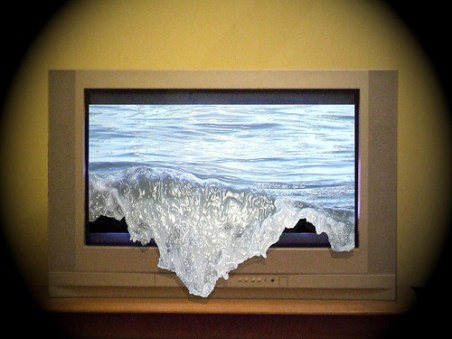
Image from Skooal on Flicker – http://www.flickr.com/photos/skooal/322346446/

2) Why not augmented plays?

I’m having a hard time imagining what an augmented reality movie would look like.  It seems extraneous to add that space in the theater to the story telling medium because that space is a part of your life rather than the story in the screen.

Plays on the other hand could benefit greatly from augmented reality.  What 3D is doing for the movies, I could see AR doing for plays.  Theater typically breaks the fourth wall during its performances, letting the audience in the secret or involving them, even if its just through thunderous applause.

So what if every seat had AR glasses (they could be a little bulky for a two hour experience right?) and the players interacted with this 3D immersive medium?  The type of material presented in that format could be wildly expanded and new forms of storytelling could emerge.

(Picture from Armida!)

3) 3D Glasses –> AR Glasses

Let’s be real.  Ten years ago, someone with a PDA (Personal Digital Assistant for those that don’t remember the 90s) was considered pretty nerdy.  Wearing one on your belt was the equivalent of the pocket protector.

Flash forward to 2010 and one of the big concerns for AR glasses is the style.  Does anyone remember the early versions of the Blackberry?  I felt like I was wearing a frisbee on my hip or that I had a side-holster with a six shooter in it.  If it’s functional and not too bulky (i.e. – neck ache) then it’ll be a hit.

The 3D glasses we start buying for our TVs and games will help bridge that fashion gap.  Who cares what you look like when you’re used to wearing them at home in front of the TV?  Just convince Lady Gaga to wear a pair of bulky AR glasses as a fashion statement and Vuzix will be trying to make them bigger (which brings me to the thought that Lady Gaga is probably just dying to get freaky with some AR.)