Live From ISMAR 08: Augmented Reality Sensors and Sensor Fusion

The last day of ISMAR ’08 is upon us, and the day opens by stimulating our senses with a session about sensors.

Gabriele Bleser starts this session with a talk about Using the marginalised particle filter for real-time visual-inertial sensor fusion

She starts by showing a short clip with an erratic camera motion that makes everyone dizzie…it actually proves an important capability that she studied which creates less jitter and less requirements imposed on the camera.

She explains the basics of particle filter and the use of inertial measurement.  In the past researchers studied standard particle filter. This is the first study using the a marginalised particle filter.

Testing using the new technique (non linear state space model with linear Gaussian substructure for real time visual inertial pose estimation) with 100 particles resulted in increased robustness against rapid motions.

To prove: Gabriele shows the rapid camera movements once again…

Well, we have to suffer now so that in the future users won’t have to. Kudos Gabriele.

~~~

Next is Daniel Pustka with Dynamic Gyroscope Fusion in Ubiquitous Tracking Environments. This is part of Gudrun Klinker’s journey towards Ubi-AR.

What you need for ubiquitous tracking is automatic discovery of tracking infrastructure, and shield applications from tracking details.

Gyroscopes are very interesting to use (low latency, high update rate, always available), but they have drawbacks (drift, only  for rotation) and are only usable when fused with other sensors.

Daniel and team have proved that the ubiquitous tracking tool set consisting of spatial relationship graphs and patterns is very useful to analyze tracking setups including gyroscopes. It allows a Ubitrack system to automatically infer occasions for gyroscope fusion in dynamically changing tracking situations.

~~~

Jeroen Hol presents Relative Pose Calibration of a Spherical Camera and an IMU

This study builds on the idea that by combining vision and inertial sensors  you get accurate real time position and orientation in a robust and fast motion, and this is very suitable for AR applications. However, calibration is the essential point for this to work.

An easy to use algorithm has been developed and yields results with real data.

Ron Azuma asks: When the image is captured in high motion does it create blur?

Jeroen answers that it can be addressed by changing some parameters.

~~~

Last for this session is Wee Teck Fong from NUS to discuss A Differential GPS Carrier Phase Technique for Precision Outdoor AR Tracking.

The solution that Fong presents provides good accuracy with low jitter, drift and low computational load – and no resolution ambiguities. It works well for outdoor AR apps. With just one GPS you get an accuracy of about 10 meters plus you get high jitter of the tracking. Differential GPS using 2 GPS receivers (low cost 25mm sized) improves the accuracy of tracking. Fong and team have taken it a steps further with an advanced computational model that delivers higher precision for outdoor AR tracking. Fong claims that with a more expensive receiver he can achieve a less than 1mm accuracy, but you can’t use this technique anywhere. An infrastructure of stationary GPS stations transmitting wirelessly could provide a wide constant coverage for this technique.

Fong concludes with a positive note regarding the upcoming European update to the GPS system dubbed Galileo (in 5 years) were things will get significantly better.

===============

From ISMAR ’08 Program

  • Using the marginalised particle filter for real-time visual-inertial sensor fusion
    Gabriele Bleser, Didier Stricker
  • Dynamic Gyroscope Fusion in Ubiquitous Tracking Environments
    Daniel Pustka, Gudrun Klinker
  • Relative Pose Calibration of a Spherical Camera and an IMU
    Jeroen Hol, Thomas Schoen, Fredrik Gustafsson
  • A Differential GPS Carrier Phase Technique for Precision Outdoor AR Tracking
    Wee Teck Fong, S. K. Ong, A. Y. C. Nee

Live from ISMAR ’08: The Gods of Augmented Reality About the Next 10 Years

Welcome to the climax of ISMAR ’08. On stage the 9 “gods” of the augmented reality community. And they are siting in a panel to muse about the next 10 years of augmented reality.

Dieter Schmalstieg took on the unenviable job of moderating this crowd of big wigs. See if he can curb them down to 3 minutes each.

Here is a blow-by-blow coverage of their thoughts.

Ron Azuma (HRL)

The only way for AR to succeed is when we insert AR into our daily lives – it has to be available all the time (like Thad Starner from GA Tech which always wears his computer)
Ron asks – What if we succeed? what are the social ramifications? those who have thought about it are science fiction writers…such as Vernor Vinge (have you read Rainbows End and Synthetic Serendipity.)

Reinhold Behringer (Leeds)

AR is at the threshold of broad applications.
Cameras, GPS, bandwidth have improved immensely – split into lo-fi AR, approximate registration, low end hardware. and also hi end AR, live see through displays, etc.
What’s missing is APIs, common frameworks, ARML descriptor (standardization)

Mark Billinghurst (HitLab NZ)

Mobility (now) – It took 10 years to go from backpack to palm
Ubiquity (5+ years) – how will AR devices work with other devices (TV, home theater, …),
Sociability – it took us 10 years to go from 2 to 4 to 8 users . When will we have massive scale?
Next is AR 2.0 with massive user generated content and a major shift from technology to user interaction

Steve Feiner – Columbia

AR means “The world = your user interface”
What will it take to make this possible?
Backpacks are ridiculous; handheld devices will look ridiculous 5 years from now – so don’t write off eyewear.
A big one is dynamic global databases for identification/tracking of real world objects. Tracking could be viewed as “just” search (granted a new kind of search.)
There is more to AR than registration; AR presentations need to be designed (AR layouts).

Gudrun Klinker – TU Munchen

|ntegrating AR with ubiquitous. We are interfacing with reality, with our senses and others are mental. We need those lenses to connect to our “senses” (not just visually – it could also be sound, etc). Combining the virtual with the real – where is the information? and can we see it? How do we communicate with the stationary world? We need to connect with the room we are in and hear the “story”. The devices at least need to talk to each other.
We also need to think about “augmented” building, they do not evolve as fast as cell phones. Another aspect is how are we going to survive “this thing”. We need much more usability studies and connect it with real world applications. The ultimate test (I challenge you to show it in next year’s competition) is a navigation system for runners. It’s easy to do it for cars – but may be harder for people.

Nassir Navab –  TU Munchen

Medical augmented reality  – showing fascinating videos of medical overlays [add videos]

The simplest idea is getting into the operation room – combining X Ray and optics as part of the common operating workflow.

Next is fusion of pre/intra operative functional and anatomical imaging; patient motion tracking and deformable registration; adaptive, intuitive and interactive visualization; Integration into surgical workflow
Finally we need to focus on changing the culture of surgeons (e.g. training with AR simulation).

Haruo Takemura – Osaka University

Showing a table comparing the pros and cons of hardware platforms: e.g. mobile have potential benefits vs HMD (but also drawbacks – such as processing power); desktop is cheap and powerful but not mobile (tethered).
Cell phones have another issue – they are tied to the carriers which is problematic for developers.

Bruce Thomas – UniSA

We are extremely interdisciplinary – and should keep it up.
However with so many of these it’s hard to develop and evaluate. And by the way innovation is difficult to articulate.
We are in a “Neat vs. Scruffy” situation – the bottom line is that a smaller self-contained pieces of research is easier to get in front of the community – and get results.

Questions floating:
is high end or low end AR the goal?
is ubiquity in AR realistic or wishful thinking?
are we innovative/.
Does augmented reality need to make more money to survive?
Platforms: Don’t write off eyewear?
Social: what if we succeed with AR?
What is the position of ISMAR in the scientific community?

A controvertial question from the audience to the panel: How many of you have subject matter expert working in your office on a daily basis? (few hands) How many of you have artists working a daily basis? (even fewer hands) How many of your research have reached the real world? (once again – few hands)

A question from the audience about the future of HMD. Mark takes the mic and asks the audience:

How many of you would wear a head mounted display? (5 hands)

How many of you would wear a head mounted display that looks like a normal glasses? (75% of the audience raise hands)

Dieter asks the panel members to conclude with one sentence each (no semi columns…)

Ron: I want to refer to the comment that the cell phone is too seductive. We should make it indispensable so users won’t want to give it up – just like a cell phone.

Mark: We need to make sure that children, grandparents, in Africa and everywhere – could use AR

Steve: You ain’t seen nothing yet; look at the progress we have made in the last 10 years! No one can predict what will happen.

Gudrun: We have to be visionary and on the other hand. We need to be realistic and make sure RA doesn’t end up like AI…don’t build hopes in areas where people shouldn’t have them…don’t let AR get burned…

Nassir: Next event we should include designers and experts from other disciplines; and create solutions that go beyond the fashion

Haruo: Maybe combining information like Googles with devices

Bruce: I want you to have fun and be passionate about what you do! We can change the world!

Applause, and that’s a wrap.

Live from ISMAR ’08: Tracking – Latest and Greatest in Augmented Reality

After a quick liquid adjustment, and a coffee fix – we are back with the next session of ISMAR ’08, tackling a major topic in augmented reality: Tracking.

Youngmin Park is first on stage with Multiple 3D Object Tracking. His first demonstration is mind blowing. He shows an application that tracks multiple 3D objects, which have never been done before – and is quite essential for an AR application.

The approach combines the benefits of multiple approaches while avoiding their drawbacks:

  • Match input image against only a subset of keyframes
  • Track features lying on the visible objects over consecutive frames
  • Two sets of matches are combined to estimate the object 3d poses by propagating errors

Conclusion: Multiple objects are tracked in interactive frame rate and is not affected by the number of objects.

Don’t miss the demo.

~~~

Next two talks with Daniel Wagner from Graz university about his favorite topic Robust and Unobtrusive Marker Tracking on Mobile Phones.

Why AR on cell phones? there are more than a billion phones out there and everyone knows how to use them (which is unusual for new hardware).

A key argument, Daniel is making: Marker tracking and natural feature tracking are complementary. But we need a more robust tracking for phones, and create less obtrusive markers.

The goal: Less obtrusive markers. Here are 3 new marker designs:

The frame markers (the frame provides the marker while the inner area is used to present human readable information.

The split marker (somewhat inspired by Sony’s by the eye of judgment) we use barcode split, with a similar thinking to the frame marker.

A third marker is a Dot marker. It covers only 1% of the overall area (assuming it’s uniquely textured – such as a map).

Incremental tracking using optical flow:

These requirements are driven from industrial needs: “more beautiful markers” and of course making them more robust.

~~~

Daniel continues with the next discussion about Natural feature tracking on mobile phones.

Compared with marker tracking, natural feature tracking is less robust, more knowledge about the scene, more memory, better cameras, more computational load…

To make things worse, mobile phones have less memory, with less processing power (and no floating point computation), and a low camera resolution…

The result is that a high end cell phone runs x10 slower than a PC, and it’s not going to improve soon, because the battery power is limiting the advancement of this capabilities.

So what to do?

We looked at two approaches:

  • SIFT (one of the best object recognition engines – though slow) and –
  • Ferns (state of the art for fast pose tracking – but is very memory intensive)

So both approaches wont work for cell phones…

The solution: combine the best of both worlds into what they call: PhonySift (Modified SIFT for phones). And then complementing it with PhonyFern – detecting dominant orientation and predicting where the feature will be in the next frame.

Conclusion: both approaches did eventually work on mobile phones in an acceptable fashion. The combined strength made it work, and now both Fern and Sift work at similar speeds and memory usages.

================

From ISMAR ’08 Program:

  • Multiple 3D Object Tracking for Augmented Reality
    Youngmin Park, Vincent Lepetit, Woontack Woo
  • Robust and Unobtrusive Marker Tracking on Mobile Phones
    Daniel Wagner, Tobias Langlotz, Dieter Schmalstieg
  • Pose Tracking from Natural Features on Mobile Phones
    Daniel Wagner, Gerhard Reitmayr, Alessandro Mulloni, Tom Drummond, Dieter Schmalstieg

Live from ISMAR ’08: Near-Eye Displays – a Look into the Christmas Ball

The third day of ISMAR ’08, the world’s best augmented reality event, is unfolding with what we expect to be an eye popping keynote (pun intended) by Rolf R. Hainich, author of The End of Hardware.

He is introduced as an independent research and started to work on AR in the early ’90s – so he could be considered as a pioneer…

A question on everyone’s mind is: Why Christmas ball and not a Crystal ball?

Rolf jumps on stage and starts with a quick answer: Christmas balls can help produce concave mirrors – useful for near eye displays.

First near eye display was created in 1968 by Ivan Sutherland; in 1993 an HMD for out of cockpit view was built in a Tornado simulator. In 2008, we see multiple products such as NVIS, Zeiss HOE glasses, Lumus, Microvision, but Rolf doesn’t consider them as true products for consumers.

Rolf ,defined the requirements for a near eye display back in 1994. It included: Eye tracker, camera based position sensing, dynamic image generator, registration, mask display, holographic optics. And don’t forget no screws, handles, straps ,etc…

He then presents several visions of the future of human machine interaction which he dubs 3D operating system.Then he briefly touches on the importance of sound, economy and ecology – and how near eye displays could save so much hardware, power, and help protect the environment.

But it requires significant investment. This investment will come from home and office applications (because of economies of scale- other markets such as military, medical, etc – will remain niche markets.

The next argument relates to the technology: Rolf gives examples of products such as memory, displays, cell phones, cameras which experienced dramatic improvements and miniaturization over the last years. And here is the plug for his famous joke: Today, I could tape cell phones on my eyes and they would be lighter than the glasses I use to wear 10 years ago…

Now, he schemes through different optional optical designs with mirrors, deflectors, scanners, eye tracker chips, etc (which you can review in his book The End of Hardware) These design could support a potential killer app – eye operated cell phone…

Microvision website is promoting such a concept (not a product), mostly to get the attention of phone manufacturers, according to Rolf.

Rolf, then tackles mask displays, a thorny issue for AR engineers and suggests it can achieve greater results than you would expect.

Eye Tracking is necessary to adjust the display based on where the eye is pointing. It’s once thing that AR didn’t inherit from VR. But help could come from a different disciplines – computer mouse which have become pretty good at tracking motion.

Other considerations such as Aperture, focus adjustment (should be mechanical), eye controller, are all solvable in Rolf’s book.

Squint and Touch – we usually look where we want to touch, so by following the eye we could simplify the user interface significantly.

Confused? Rolf is just getting started and dives effortlessly into lasers, describing what exists and what needs to be done. It should be pretty simple to use. And if it’s not enough, holographic displays could do the job. Rolf has the formulas. It’s just a matter of building it.

he now takes a step back and looking at the social impact of this new technology: when everybody “wears” anybody can be observed. The big brother raises its ugly head. Privacy is undermined, Copyright issues get out of control. But…resistance is futile.

Rolf wraps up with a quick rewind and fast forward describing the technology ages: PC emerged in the 80’s, AR in the 2020’s, and chip implants (Matrix style) will rule in the 2050.

Question: It didn’t look like the end of hardware…

Rolf: it’s the end of the conventional hardware – we will still have hardware but it could be 1000 times lighter.

Tom Drummond (from the audience): there is still quite a lot of work to get these displays done and there is still some consumer resistance to put on these head up displays…

Rolf: People wear glasses even for the disco – it’s a matter of fashion and of making it light – with the right functionality.

==================

From the ISMAR ’08 Program:

Speaker: Rolf R. Hainich, Hainich&Partner, Berlin

We first have a look at the development of AR in the recent 15 years and its current state. Given recent advances in computing and micro system technologies, it is hardly conceivable why AR technology should not finally be entering into mass market applications, the only way to amortize the development of such a complex technology. Nevertheless, achieving a ‘critical mass’ of working detail solutions for a complete product will still be a paramount effort, especially concerning hardware. Addressing this central issue, the current status of hardware technologies is reviewed, including micro systems, micro mechanics and special optics, the requirements and components needed for a complete system, and possible solutions providing successful applications that could catalyze the evolution towards full fledged, imperceptible, private near eye display and sensorial interface systems, allowing for the everyday use of virtual objects and devices greatly exceeding the capabilities of any physical archetypes.

What do Games of 2043 Look Like?

We interrupt this program (“ISMAR ’08) to bring you this breaking news from the Austin Game Developer Conference (via Gamasutra): Futurist and author Bruce Sterling delivered the Tuesday keynote speech where he was tasked to imagine the next 35 years in the game industry:

Then what do the games of 2043 look like? “I think you would call [them] ‘augmented reality’ but we don’t,” Sterling continued. “We think that reality is real — you can have a lot of fun with [an overlaid] game interface.” To Sterling, the games of the future scale from personal “body games” to global games and space games and everything in between — including “neighborhood games”.

Sterling wasn’t all flowers, he continued with a dark prophecy, which I totally agree with:

“Stagnation in the creative side of the industry will hamper their evolution.”

That’s exactly what augmented reality is missing today. The technology is reaching a good-enough stage; the buzz has been built to a more-than-reasonable level; and yet no augmented reality game has broken into the main stream: gameplay, fun, killer-app – you name it, but who’s got it?

Live from ISMAR ’08: Latest and Greatest in Augmented Reality Applications

It’s getting late in the second day of ISMAR ’08 and things are heating up…the current session is about my favorite topic: Augmented Reality applications.

Unfortunately, I missed the first talk (had a brilliant interview with Mark Bullinghurst) by Raphael Grasset about the Design of a Mixed-Reality Book: Is It Still a Real Book?

I will do my best to catch up.

Next, Tsutomu Miyashita and Peter Meier (Metaio) are on stage to present an exciting project that games alfresco covered in our Museum roundup: An Augmented Reality Museum Guide a result of a partnership between Louvre-DNP Museum lab and Metaio.

Miyashita introduces the project and describes the two main principles of this application are Works appreciation and guidance.

Peter describes the technology requirements:

  • guide the user through the exhibition and provide added value to the exhibitions
  • integrate with an audio guide service
  • no markers or large area trackin – only optical and mobile trackers

Technology used was Metaio’s Unifeye SDK, with a special program developed for the museum guide. Additional standard tools (such as Maia) were used for the modeling. All the 3d models were loaded on the mobile device. The location recognition was performed based on the approach introduced by Reitmayr and Drummond: Robust model based outdoor augmented reality (ISMAR 2006)

600 people experienced the “work appreciation” and 300 people the guidance application.

The visitors responses ranged from “what’s going on?” to “this is amazing!”.

In web terms, the AR application created a higher level of “stickiness”. Users came back to see the art work and many took pictures of the exhibits. The computer graphics definitely captured the attention of users. It especially appealed to young visitors.

The guidance application got high marks : ” I knew where I had to go”, but on the flip side, the device was too heavy…

In conclusion, in this broad exposure of augmented reality to a wide audience, the reaction was mostly positive. it was a “good” surprise from the new experience. Because this technology is so new to visitors, there is a need to keep making it more and more intuitive.

~~~

Third and last for this session is John Quarles discussing A Mixed Reality System for Enabling Collocated After Action Review (AAMVID)

Augmented reality is a great too for Training.

Case in point: Anesthesia education – keeping the patient asleep through anesthetic substance.

How cold we use AR to help educate the students on this task?

After action review is used in the military for ages: discussing after performing a task what happened? how did I do? what can I do better?

AR can provide two functions: review a fault test + provide directed instruction repetition.

With playback controls on a magic lens, the student can review her own actions, see the expert actions in the same situation, while viewing extra information about how the machine works (e.g. flow of liquids in tubes) – which is essentially real time abstract simulation of the machine.

The result of a study with testers showed that users prefer Expert Tutorial Mode which collocates expert log with realtime interaction.

Educators, on the other hand, can Identify trends in the class and modify the course accordingly.
Using “Gaze mapping” the educator can see where many students are pointing their magic lens and unearth an issue that requires a different teaching method. In addition, educators can see statistics of student interactions.

Did students prefer the “magic lens” or a desktop?

Desktop was good for personal review (afterward) which the Magic lens was better for external review.

The conclusion is that an after action review using AR works. Plus it’s a novel assessment tool for educators.

And the punch line: John Quarles would have killed to have such an After action review to help him practice for this talk…:-)

=====================

From ISMAR ’08 Program:

Applications

  • Design of a Mixed-Reality Book: Is It Still a Real Book?
    Raphael Grasset, Andreas Duenser, Mark Billinghurst
  • An Augmented Reality Museum Guide
    Tsutomu Miyashita, Peter Georg Meier, Tomoya Tachikawa, Stephanie Orlic, Tobias Eble, Volker Scholz, Andreas Gapel, Oliver Gerl, Stanimir Arnaudov, Sebastian Lieberknecht
  • A Mixed Reality System for Enabling Collocated After Action Review
    John Quarles, Samsun Lampotang, Ira Fischler, Paul Fishwick, Benjamin Lok

Live from ISMAR ’08: The dARk side of Physical Gaming

Welcome to the late evening keynote of the second day of ISMAR ’08 in Cambridge.

The keynote speaker is Diarmid Campbell, from Sony Computer Entertainment Europe (London), and heads its research on camera gaming. And we are covering it in real time.

Diarmid comes on stage. the crowed is going crazy…

The talk: Out of the lab and into the living room

What a camera game? Simply put, you see yourself in the camera and add graphics on top.

The trouble with the brain: it fixes things you see (example of a checkerboard, a black square in the light has the same color as a white square in the dark.)

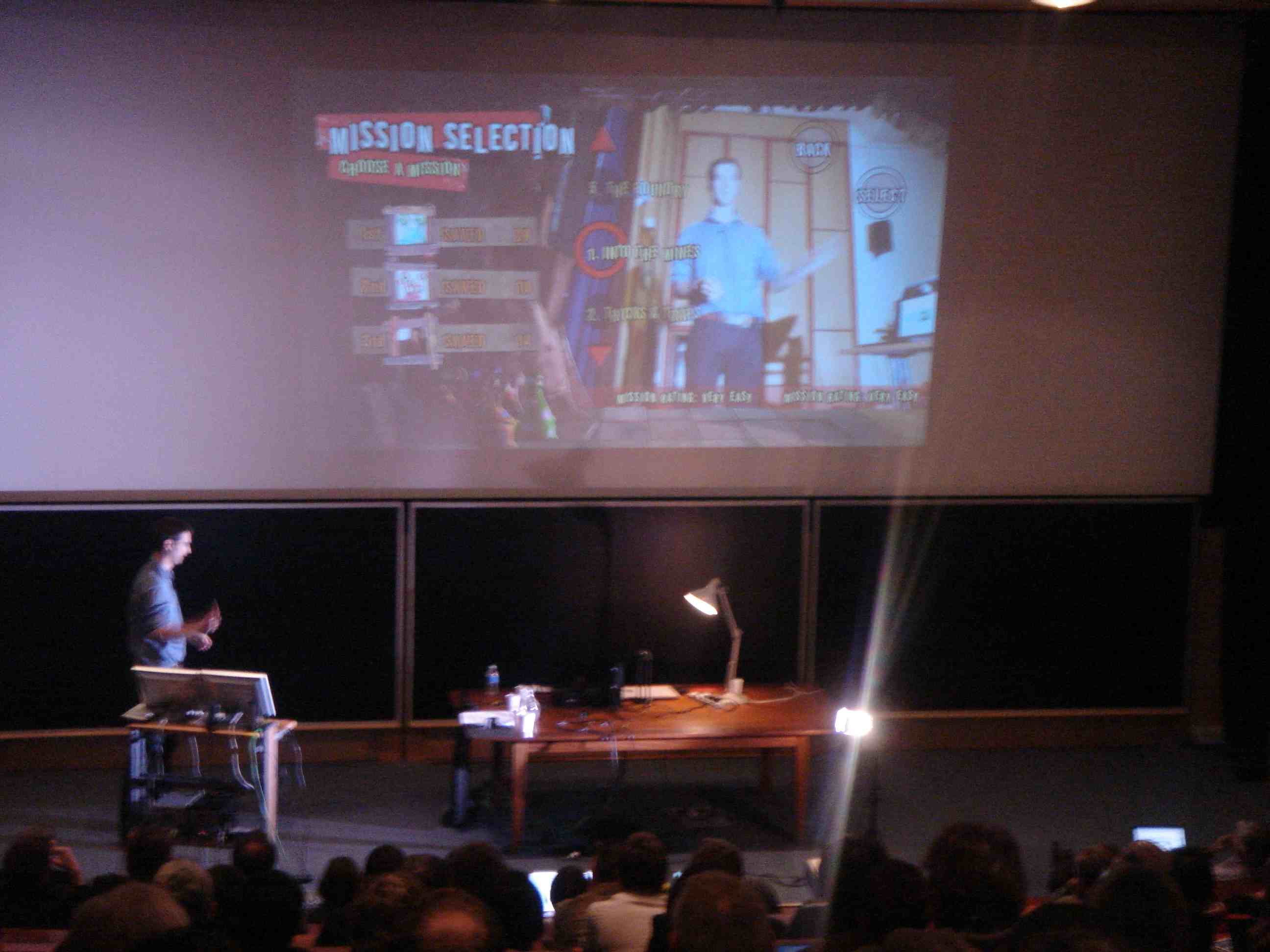
Background subtraction is the first thing you try to do. Using this technique, Diarmid superimposes him self in real time on top of…the ’70 super band ABBA…

User interface motion buttons – use virtual buttons that the user activates. The response is not as robust, but it’s more responsive.

Example of EyeToy Kinetic

Next is a demonstration of vector buttons and optical flow.

You have to keep the control on the side – otherwise the player’s body will activate it unintentionally.

It turns out Sony decided not to use this control…not just yet.

A similar control was actually published in Creature Adventures available online. Diarmid struggles with it. The crowed goes wild. Diarmid: “You get the idea…”

Good input device characteristics: Many degrees of freedom, non-abstract (player action=game action), robust and responsive.

Camera games have been accused in the past for not having depth (too repetitive). There are 2 game mechanics: skill based (shoot the bad guy) and puzzle based. This could become shallow – unless you deliver on the responsiveness and robustness.

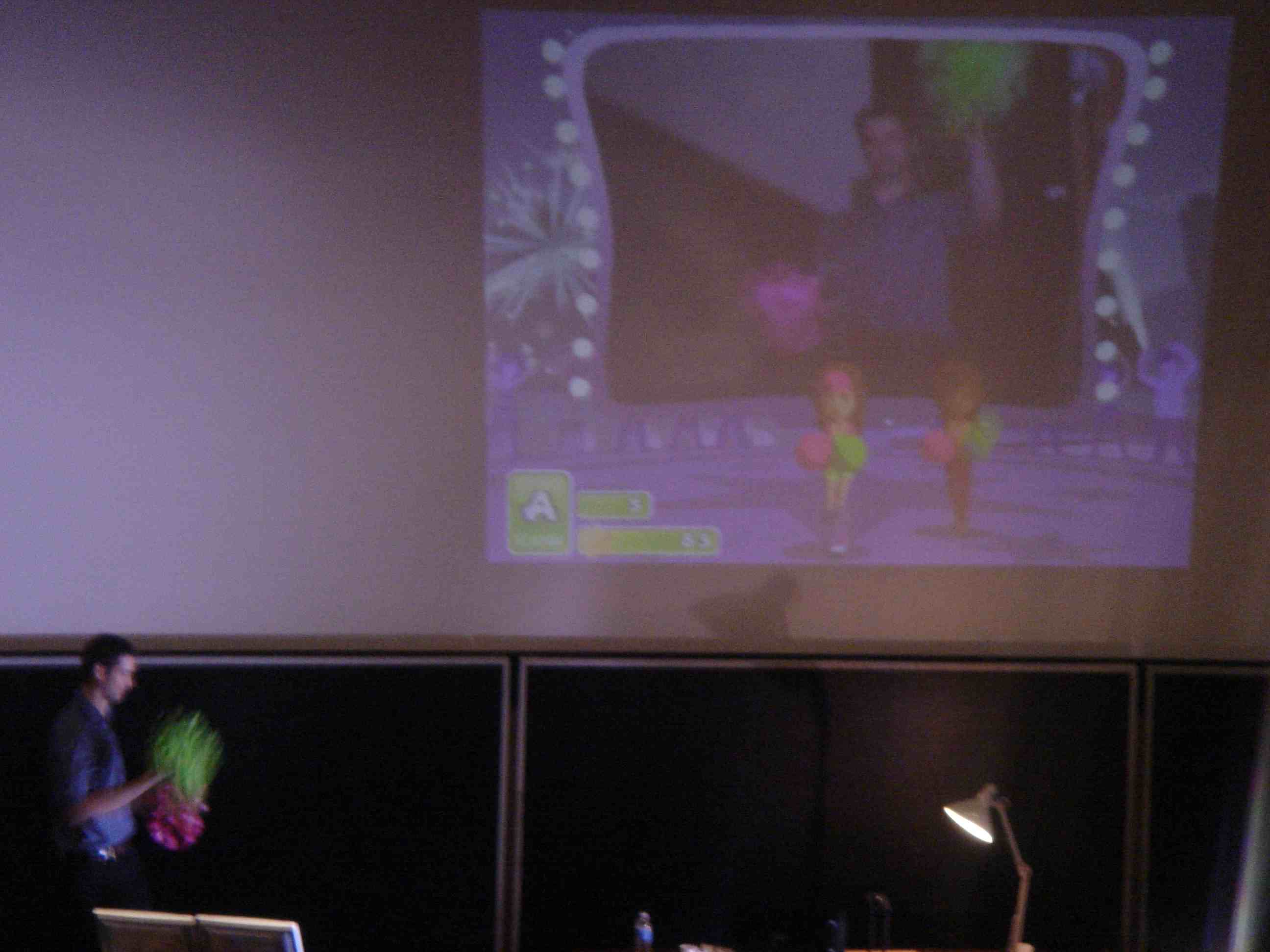
To demonstrate color tracking, Diarmid dives into the next demo (to the pleasure of the audience…). For this demo he holds 2 cheerleader pompoms…

“It’s like a dance dance revolution game, so I also have to sing and occasionally shout out party…”

The crowd is on the floor.

See for yourself –

We are on to drawing games, Sketch Tech. He draws a cow that is supposed to land on a banana shaped moon. He succeeds!

Using a face detector from Japan, here is a Head Tracking game: a green ball hangs from his mouth (a pendulum) and with circular moves of his head he rotates it, while trying to balance it…

Eye of judgment, a game that came out last year (bought out by Sony) relied on a marker based augmented reality technology. It is similar to a memory game, with a camera and a computer, and cards.

We are starting to wrap up and Diarmid summarizes, credits Pierre for setting up all the hardware, and opens the floor for questions.

Question: How do you make the game interesting when you’re doing similar gestures over and over again…

Diarmid: When the game is robust and responsive – you’ll be surprised how long you can play the game and try to be better.

Blair MacIntyre (from the audience): Robust and learn-able is what makes the game fun over time.

Question: Is there anything more you can tell us about the depth camera? Will it be available soon to consumers?

Diarmid: No.

The crowed bursts into loughs.

Blair (jumps in from the audience) There is a company called 3dv in Israel which offers such a camera. It’s not cheap or as good as discussed before, but you can get it.

Q: What’s special about camera games beyond novelty?

Diarmid: The 2 novel aspects of camera games are that it allows you to see yourself, and you can avoid the controller. Camera games are also great for multi-players.

Q: Is there a dream game you’d like to see?

Diarmid: Wow, that’s hard…I worked on a game before Sony called The Thing based on Carpenter’s movie. It was all about trust. The camera suddenly opens up the ability to play with that. When people see each other, the person to person interaction is very interesting and hasn’t been explored in games.

Q: will we see camera games on PSP?

Diarmid: there is a game in development, and I don’t know if I can talk about it…

Q: when I look in the mirror I am not so comfortable with what I see…how do you handle that?

Diarmid:  We flip the image. It’s hard to handle a ball, when just looking at the mirror.

And that’s a wrap! Standing ovation.

~~~

After party shots…


Exclusive! HitLab NZ Releases an Augmented Reality Authoring Tool for Non Programmers

I am excited. I have in my hands a flier I just received from Mark Billinghurst (one of the AR gods at ISMAR ’08)

This flier includes the URL for a totally new augmented reality authoring tool developed by HITLab New Zealand. What’s really new about this too is that it targets non programmers (as in you and me).

BuildAR is a software application that enables you to create simple augmented reality scenes on your desktop.

BuildAR provides a graphical user interface that simplifies the process of authoring AR scenes, allowing you to experience augmented reality first hand on your desktop computer. All you need is a computer, a webcam and some printed patterns.

Mark says I am the first one to receive the flier – hence the exclusive news.

Without further ado (I haven’t even tried it myself yet…), here is the URL: http://www.hitlabnz.org/wiki/BuildAR

I promised Mark that by tonight (as clocked in Honolulu) the entire world will have tried it.

Don’t let me be wrong…

Tell us, does it work? do you like it? want more of these?

Live from ISMAR ’08: Augmented Reality Layouts

Caffeine levels are set after the well deserved coffee break, and we are back to discuss AR layouts.

Onstage Steven Feiner introducing the speakers of this session.

First presenter is Nate Hagbi which is touching on an unusual topic that often  is seen as a given: In-Place Augmented Reality: A new way for storing and distributing augmented reality content.

In the past AR was used mostly by “AR Experts”. The main limiation for spearing it was mostly hardware related. We have come a long way since and AR can be done nowadays on a cell phone.

Existing encoding methods such as Artag, Artoolkit, Studierstube, MXRtoolkit as not human readable and require to store additional information in a back-end database.

Take the example of AR advertising for the Willington Zoo tried by Satchi and Satchi (2007).

This is a pretty complex approach which requires publishing printed material, creating a database for the additional AR info and querying database before presenting

In place Augmented reality is a vision based method for extracting content all encapsulated in the image itself.

The process includes: Using our visual language to encode the content in the image. The visualization is done as in a normal AR application.

The secret sauce of this method is the visual language used to encoding the AR information.

There are multiple benefits to this approach: the content is human readable and it avoids the need for an AR database, and for any user maintenance of the system. This approach also works with no network communication.

A disadvantage is that there is a limit of the amount of info which can be encoded in an image. Nate describes this as a trade off.

I am also asking myself, as a distributor of AR applications, what if I  want to change AR data on the fly? Nate suggests that in such a case a hybrid approach could be used: some of the info is extracted from the encoded image. Additional image coding could point to dynamic material from the network (e.g. updated weather or episodic content).

~~~

Second presenter is Kohei Tanaka which will unveils An Information Layout Method for an Optical See-through Head Mounted Display Focusing on the Viewability

The idea in short is to place virtual information on the AR screen in a way that always maintains a viewable contrast.

The amusing example demonstrates a case where this approach ca help dramatically: you are having tea with a friend, wearing your favorite see-through AR HMD. An alert generated the AR system tries to warn me about a train I need to catch, but due to the bright alert on top of a bright background – I miss the alert, and as a consequence miss the train…

Kohei’s approach, makes sure that the alert is displayed in a part of the image where the contrast is good enough to make me aware of the alert. Next time, I will not miss the train…

Question: Is in it annoying for users that the images on screen constantly change position…?

Kohei responds that it requires further research…

~~~

Last in this session is Stephen Peterson from Linkoping University with a talk about Label Segregation by Remapping Stereoscopic Depth in Far-Field Augmented Reality.

The domain: Air Traffic control. A profession that requires to maintain multiple sources of information and combine them into a single context cognitively.

Can Augmented Reality help?

The main challenge is labeling: how do you avoid clutter of labels that could quickly confuse the Air traffic controller?

The conclusion: Remapping stereoscopic depth of overlapping labels in far field AR improves the performance. In other words – when you need to display numerous labels on a screen that might overlap with each other – use the depth of the view and display the labels in different 3d layers.

================

From ISMAR ’08 Program:

Layout

  • In-Place Augmented Reality
    Nate Hagbi, Oriel Bergig, Jihad El-Sana, Klara Kedem, Mark Billinghurst
  • An Information Layout Method for an Optical See-through Head Mounted Display Focusing on the Viewability
    Kohei Tanaka, Yasue Kishino, Masakazu Miyamae, Tsutomu Terada, Shojiro Nishio
  • Label Segregation by Remapping Stereoscopic Depth in Far-Field Augmented Reality
    Stephen Peterson, Magnus Axholt, Stephen Ellis

Live from ISMAR ’08: Augmented Reality – What Users Are Saying

Everyone is back from lunch and the afternoon session is on: User studies in augmented reality.

First on stage is Benjamin Avery to talk (with an animated Australian accent) about User Evaluation of See-Through Vision for Mobile Outdoor Augmented Reality. This

The study took users outdoors in various scenarios to test the performance of AR vision using see through displays. Then, they compared it with a second group that watched the video through a desktop computer

[link to paper, videos, images to come]

The result demonstrates complex trade-off between AR and desktop visualizations. AR system provided increased accuracy in locating specific points in the scene. AR visualization was quite simple, beating the desktop in tracking and in better visualization.

Stay tuned for the demo (which was hauled all the way from Australia to Cambridge)!

~~~

Next on stage is Cindy Robertson from Georgia Tech (Honorable mention in ISMAR 2007) and she discusses An Evaluation of Graphical Context in Registered AR, Non-Registered AR, and Heads-Up Displays.

How are users affected when there are many registration errors  or in other words when when tracking is not perfect? Can the user handle it better if a graphics context is provided?

They tested it with a set of tasks encompassing placing virtual Lego blocks with groups using Registered AR, Non-Registered AR, and Heads-Up Displays.

Following an exhaustive analysis of the resulted data they uncovered the following insights:

  • Head movement and memorization increased performance
  • Head movement affected perceived mental workload and frustration
  • When you have graphics obstructing your view, and switching between it and real world is frustrating
  • HUD-visible case was surprisingly faster than the other cases. But people hated it…

Final conclusion: Registered outperformed both the non-registered AR and graphics displayed on a HUD. Non-registered AR does not offer any significant improvement.

Future plans are to test home-like scenarios and impose more complex tasks.

~~~

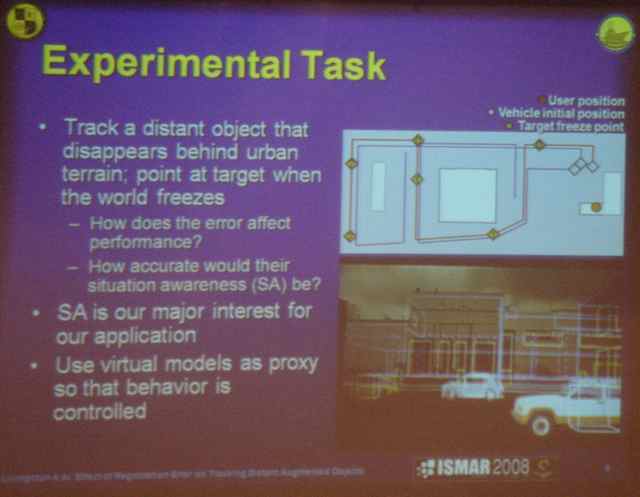
On stage Mark Livingston is getting ready to talk about The Effect of Registration Error on Tracking Distant Augmented Objects.

A basic assumption is that registration errors limits performance of users in AR. “We wanted to measure the sources (such errors are noise, latency, position and orientation error) and see the affect on the user – and then be able to write requirements for future systems.”

For this study, they used the nVisorST.

The tasks were trying to measure the users ability to understand behaviors and situational awareness in the AR application: following a target (car) when buildings stand in between.

Conclusions are straight forward though somewhat surprising:

  • Latency has significant effect on performance and response time – was the worse.
  • Noise was disliked but did not have significant impact on performance
  • Orientation error fifn’t have significant effect
  • Weather had significant impact on results: darker weather delivered improved performances. Brightness was a major distraction.

===============

From the ISMAR Program

User Studies (from ISMAR ’08 program)

  • User Evaluation of See-Through Vision for Mobile Outdoor Augmented Reality
    Benjamin Avery, Bruce H. Thomas, Wayne Piekarski
  • An Evaluation of Graphical Context in Registered AR, Non-Registered AR, and Heads-Up Displays
    Cindy Robertson, Blair MacIntyre, Bruce Walker
  • The Effect of Registration Error on Tracking Distant Augmented Objects
    Mark A. Livingston, Zhuming Ai