Fool Your Friends with Augmentizer

Augmentizer, a free app for the iPhone, has the most amazing image recogn=ition algorithm. It can identify places, people, food and random object with little to no latency.

Alas, the algorithm works only on April fools day, since it requires the iPhone owner to press on one of six hidden buttons for it to work.

Loading Screen on Augmented Goggles

Before you freak out and demand to know where to order one–it’s a concept video.  But watching it makes me feel like a terminator booting up.  I just hope they haven’t installed Vista on my OS.

Win $5000 developing a Junaio App

I’m usually not in the habit of posting press releases, but I imagine that some of our readers will find the next news byte from Metaio interesting:

Attention Developers: win $5,000!

With junaio’s open API, developers can create state of the art augmented reality applications. You don’t need any experience in programming for embedded systems. Challenge your imagination and contribute to junaio’s exciting world with AR Mashups, multiplayer games and scavenger hunts, interactive, indoor and outdoor exhibitions, tours with animated 3D characters or location independent gaming. All you need to do as a developer is to register for an API key and start challenging your creativity.

You can not only win $5,000 but we will also invite the winner to our metaio Technology Fair to visit with us and to attend the world-famous Oktoberfest in Munich.

All you need to do:

  • Register as a developer here.
  • Become creative and set up your own channel before June 16, 2010
  • The 5 channels with the most subscribers on June 16 will be shortlisted and an independent jury will select a winner

If you enter the competition and like to have your layer channel published over here just leave a comment or tweet me @augmented.

Weekly Linkfest

Anybody feels like sponsoring an AR blogger trip to an AR event?
There were plenty of interesting AR links to share this week, but only seven won a place in this week’s linkfest:

This week’s quote comes from that talk with Paige Sez:

As we’ve talked about it before, it’s amazing that marketing and advertising are helping push forward AR, and it’s great. It’s fantastic. But it’s also the worst possible thing that could ever happen because it is such a singular way of looking at an overall ubiquitous computing experience. There are other ways.

And as promised, this week’s video is a demo of LookTel, it looks fantastic, and shows that there are some things that an old Windows phone still does better than a new shiny iPhone (well, at least till June):

Have a great week!

Augmented Reality in Heavy Rain

Heavy Rain is an interactive drama video game developed by Quantic Dream for the PlayStation 3.  One of the characters in the game, Norman Jayden, uses “Added Reality Glasses” to rapidly investigate crime scenes, analyze evidence, or just waste time.  The following videos show examples of the ARI in the game.

Main Trailer (2 minutes)

Wasting Time (2 minutes)

The Augmented Office (4 minutes)

Augmented Reality Comes To World of Warcraft

Okay, probably most of you have read the title and said, so what.  World of Warcraft is a game, and definitely not reality.  Though don’t tell that to the 11.5 million players worldwide.

These “boss-kill” videos are common for the high-end guilds in WoW.  They use the videos as a recruiting tool for good players.  If you think WoW is just a marriage killing RPG then you’re wrong.  At the bleeding edge of the game, guilds compete to be the first at completing new content – i.e. boss-mobs.  These combats are intricate battles of coordination between twenty-five gamers using a host of dedicated UI mods and voice-chat programs to defeat the game.  The top guilds are rewarded with sponsorships and top guildleaders translate their leadership into real jobs (a prominant Everquest guild leader got a job with Blizzard because of his exploits.)  World of Warcraft is, in otherwords, a competitive sport.

So that’s the context of the video.  The important augmented reality aspect comes around the minute and a half mark in the form of six colored discs on the virtual ground.  The purpose of the colored discs is to show certain players exactly where to stand in the game.  This is akin to wide receivers running correct routes so the quarterback can throw them the ball.

Most likely, a program like this will eventually be banned from use because it will trivialize battles and give guilds that use it an advantage over others.  Just like any sport, a level playing field is important to keep top competitors interested.

World of Warcraft’s basis in virtual reality makes inclusion of “augmented” reality easy to pull off.  The computer already has a complete knowledge of the world (because it has to draw it) and the screen provides the augmented graphics on the virtual world.

What other sports or competition could benefit from using augmented reality in this form?  Could marching band competitions use the local spatial awareness of AR to tighten their formations?  Or dance groups?  Projection based AR could provide a rapid trainer for coordinating large groups.

But it’s going to be a long time before augmented reality gets banned as an unfair advantage in a sport or competition.

Holographic Augmented Reality Concept

I wish the real products were as cool as the concepts.  In due time…

Eye-Tracking Will Be The New Click-Throughs

Part of the Internet economy is built upon the “click-through” or CTR (Click Through Rate.)  The CTR attempts to measure customer interest in a particular product.  If a person finds the banner ad interesting enough, they will select it and be sent to that site, hopefully to purchase a product (or Conversion Rate.)  Thus the effect of the advertising can be measured and billed.

Even the layout of a site can affect the conversion rate.  Or in the case of Bing, Microsoft’s new search engine, the color blue can be worth $80 million in additional usage.  Website optimization rearranges the layout to achieve fung shui for dollars.  What is measured can be improved.

These products, like Google’s search engine, are worth more than just the product itself.  And they get first crack at the wealth of information flowing through their servers.  Using the misspelled words on Google search, they created the most robust spell-checker on the planet, in every conceivable language.

Using the information of what you click, they can run experiments to see what works best.  Collaborative filtering makes recommendations to users based on what other users like.  The data exhaust of websites can be as valuable as the product itself.

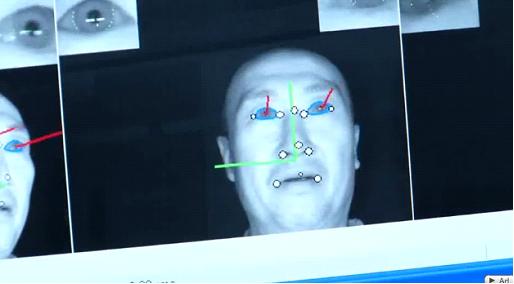
As augmented reality products use eye-tracking to achieve a realistic virtual overlay like in the recent GM augmented windshield, they are getting more information than just how to align the graphics.  Eye-tracking adds a new dimension to the data exhaust.  As any professional poker player will tell you, the eyes are the window to the soul, and to the tell.  Someone holding pocket kings might look down at their chips the moment they see their cards in anticipation of seeing a bigger pile later.  Players wear glasses for a reason.  The eyes can give away important information.
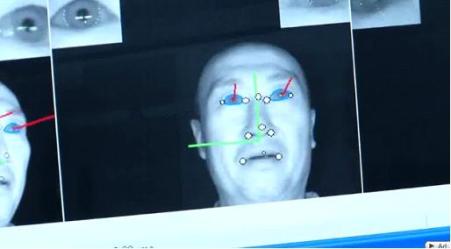
Studies on select groups of people using eye-tracking have given broad generalizations (read the before-mentioned link for more details):

1.Headlines draw eyes before pictures.

2. People scan the first couple words of a headline.

3. People scan the left side of a list of headlines.

4. Your headline must grab attention in less than 1 second.

5. Smaller type promotes closer reading.

6. Navigation at the top of the page works best.

7. Short paragraphs encourage reading.

8. Introductory paragraphs enjoy high readership.

9. Ad placement in the top and left positions works best.

10. People notice ads placed close to popular content.

11. People read text ads more than graphic ads.

12. Multimedia works better than text for unfamiliar or conceptual information.

Imagine what can be learned when the eye-tracking is always on and always sending data back to the home servers.  Contextual filtering will “pigeon-hole” you into a type of viewer and give you a website more suited to your style of reading.  Web design will customize based on your changing eye sight.  Older viewers that linger over the words will get larger fonts so reading isn’t so strained.  Colorful pictures will attract younger viewers so advertisements will be changed to align with them.

And that GM Augmented Windshield?  If their sensors can identify advertising along the side of the road in the form of signs and billboards, then can they collect the data on what works and what doesn’t and sell that to ad agencies.

Like I said, the data exhaust can be more valuable than the data itself.  And eye-tracking will prove to be more valuable because its an unconscious reaction.  Just be careful where you’re looking.

Weekly Linkfest

Yesterday we celebrated the vernal equinox, today we celebrate yet another weekly linkfest:

Well yes, looking back at it, this was quite a dry week. Anyway, here’s a couple of weeks old video I just waited for the opportunity to put up in the weekly linkfest. It’s AR in a shoebox, created by Kenneth Bogert, aPhD student from Georgia. You can read more about it over here.

Avez vous une joyeuse semaine de la langue française! (yeah, probably screwed the translation up, sorry int13 guys!)

Going to the Augmented Museum

Simple, useful and probably feasible (though not on the iPhone) AR application in the following concept video by Tate Strickland an American graphic design student: