A group of students at Technische Universitat Munchen, under the direction of Gudrun Klinker, created this augmented reality racing game. The setup is similar to the AR Drone game in that it uses a real vehicle, however, using the illusions of AR, they turned their LEGO Mindstorm robots into cars.
The students had two (analog) radio cameras and mounted each on one Lego Mindstorm Robot. With this constellation the player was presented the view on the world from a robot’s perspective. The students also placed markers on top of the robots which were being used to calculate the pose of each camera in relation to a common coordinate system (using one ceiling mounted camera). With this pose, the view of the virtual camera was matched to the real camera’s view. The students augmented the real camera images with virtual graphics such as the race course and some special items (speedup, rockets, etc). The goal was to drive as fast as possible four laps or to hunt down the other player before he can finish the race.
The calibration of the tracking system and the tracking itself was done using Ubitrack and its MarkerTracker Component developed at our chair.
We think because of some aspects this game is very special:
– The game is a twoplayer game, so you share the same virtual (and real) world between the two players.
– There are no markers in the camera view of the player since the cameras for showing the graphics and doing the tracking are not the same.
– The (real) robots are being overlayed with car models in the camera images so you do not get the the impression of playing against Lego robots. (O.K. sometimes you can see the robot due to a lag in the tracking or since it is not overlayed completely)
– And best: It was playable and is not only a concept :-)
Good job Christian Waechter, Eva Artinger and Markus Duschl. I think you’ll have a career in augmented reality.
Augmented reality has come a long way in a years time. Last year I got excited by research projects and gimmicky AR webcam advertising, but that quickly faded on the tenth plus iteration. It wasn’t until July that we starting having real AR products in the form of apps. Nearly a year later and still early in the development of the AR ecosystem, we’re seeing a more diverse use of the technology and that has me excited again. So I want to take a moment to go over ten cool things going on right now in augmented reality.
1. Battle of the AR Browsers
Wikitude, Layar, Tonchidot, Junaio, TagWhat and others hope to be the standard for the AR browser market. Layar has recently upped the ante with an AR content store and TagWhat takes it in a new direction by combining lessons learned with Foursquare and Twitter. I suspect one of the big boys like Google, Twitter or Facebook will eventually either create their own or co-opt the ideas from these early browsers into their current products. I’m not sure which horse to bet on in this race, but in the end we customers are the winners.
Using an Eye-Trek video headset, the guy at Tailormadetoys made a pair of AR glasses. I love the DIY culture and while they’re not see-through, I think all the right parts to make one are out there. This post from Team Hack-a-Day proves that the DIY makers are getting close, so why can’t one of the big makers get it done?
3. The AR phone – Ouidoo
The specs on this Ouidoo QderoPateo smartphone are in the WTF!? zone. While the phone won’t be out until the fall, the company claims it’ll have a 26-core CPU capable of 8-gigaflop floating point operations and include 512MB RAM, 4GB ROM, 28GB of built-in storage, microSD expansion, Bluetooth, WiFi, GPS, built-in 3D map, accelerometer, digital compass, 5-megapixel camera with flash, 220 hours of standby battery life, and a sharp 3.5-inch 800 x 480 screen. Whew.
While I’m not completely believing the hype, and it could end up being vaporware, it certainly looks promising. Though it’ll have to work hard to compete with the likes of the iPhone and Droid.
Bionic eyes and augmented reality. It’s like peanut better and chocolate! Rob Spence is putting a camera into his eye to make movies with (and because its just plain cool.) And he’s also interested in combining augmented reality with his eye camera. They’ve come up with a promotional AR eyeborg t-shirt in the meantime.
Bruce Sterling, Will Wright, Marco Tempest, and the list goes on. It pains me to say that I won’t be able to make the inaugural event. I had a work conflict with that week, so I have to bow out of hosting the panel on AR glasses. But for the rest of you, I hope you’ll be able to make it. With AR on the rise and viable business options a-plenty, it’s a good time to network and see what everyone is doing with the nascent technology. This is the “can’t miss” AR event of the year.
Our favorite interviewer Tish Shute and longtime commenter Thomas Wrobel have been sheparding the AR Wave project and collaborating with people all over the globe. While it’s still too early to tell, this could end up being one of the most important AR developments out there if they can truly create an open source way of using AR. As they’ve been telling everyone, they’re trying to make a system that:
* Anyone can make content
* Anyone can make a browser
* Anyone can run a server
7. iPhone OS4.0
It almost pains me to get excited about an iPhone update that promises video access to make real AR work on that smartphone. We got fooled last September with the OS3.1. I’m hoping we don’t get fooled again (unless you’re the Who.)
I’m not even entirely sure if haptic floors fit into the augmented reality spectrum, but it’s so crazy weird and true, that I had to include it. I seriously doubt we’ll be seeing a commercial product anytime soon though (or ever.)
9. AR Drone
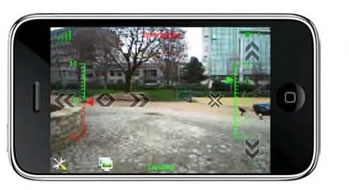
While the news on the AR drone is a stale few months old, I still think it warrants inclusion because it was a great product. The hovercraft alone was worth the price of admission, but the AR added a creative twist to it. I have no idea if it sold well, but it sure did capture the imaginations of a lot of geeks.
10. You choose!
Let us know what you think is the coolest thing going in augmented reality right now. Whether it’s a product only hinted at or one currently residing on your smartphone, we’d like to hear it. So let us know here at Games Alfresco in the comment section!
It was only a matter of time. Virtual goods make up a $1.4 Billion (that’s with a ‘B’ folks) business and the demand is growing. We have Chinese gold farmers and Farmville exclusive goods, so augmented goods can’t be far behind.
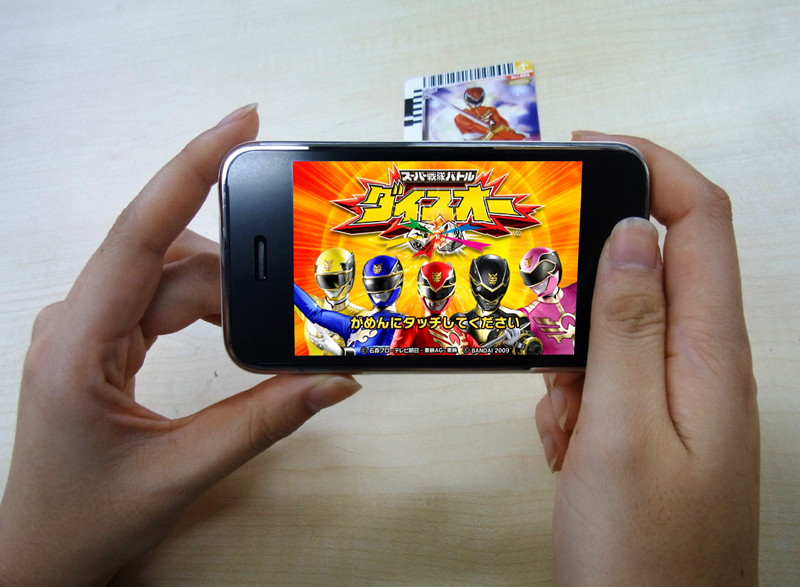
Right now augmented goods are tied to purchased toys as an “add-on.” Metaio has teamed up with Bandai Co. to create AR extensions to their real world collectible cards.
I believe the next step will be adding augmented only items that exist in certain locations as a reward. Combine foursquare and Pokemon and you have a potent combination. Hit all fifteen Starbucks in your area and you unlock a “Coffee Critter” that shows up on your smartphone when you’re in the store (and you get a discount on the Double Latte Supreme.) Are you listening TagWhat, Layar, Junaio and the rest?
And keep in mind augmented goods as status symbols don’t count unless other people can see them. Other patrons should be able to see your critter following you or floating above your head just like a non-combat pet in World of Warcraft. Trust me, people will go to unbelievable lengths to earn a baby dragon or talking penguin. Value is all about scarcity and that works even in the virtual or augmented world.
Heavy Rain is an interactive drama video game developed by Quantic Dream for the PlayStation 3. One of the characters in the game, Norman Jayden, uses “Added Reality Glasses” to rapidly investigate crime scenes, analyze evidence, or just waste time. The following videos show examples of the ARI in the game.
Okay, probably most of you have read the title and said, so what. World of Warcraft is a game, and definitely not reality. Though don’t tell that to the 11.5 million players worldwide.
These “boss-kill” videos are common for the high-end guilds in WoW. They use the videos as a recruiting tool for good players. If you think WoW is just a marriage killing RPG then you’re wrong. At the bleeding edge of the game, guilds compete to be the first at completing new content – i.e. boss-mobs. These combats are intricate battles of coordination between twenty-five gamers using a host of dedicated UI mods and voice-chat programs to defeat the game. The top guilds are rewarded with sponsorships and top guildleaders translate their leadership into real jobs (a prominant Everquest guild leader got a job with Blizzard because of his exploits.) World of Warcraft is, in otherwords, a competitive sport.
So that’s the context of the video. The important augmented reality aspect comes around the minute and a half mark in the form of six colored discs on the virtual ground. The purpose of the colored discs is to show certain players exactly where to stand in the game. This is akin to wide receivers running correct routes so the quarterback can throw them the ball.
Most likely, a program like this will eventually be banned from use because it will trivialize battles and give guilds that use it an advantage over others. Just like any sport, a level playing field is important to keep top competitors interested.
World of Warcraft’s basis in virtual reality makes inclusion of “augmented” reality easy to pull off. The computer already has a complete knowledge of the world (because it has to draw it) and the screen provides the augmented graphics on the virtual world.
What other sports or competition could benefit from using augmented reality in this form? Could marching band competitions use the local spatial awareness of AR to tighten their formations? Or dance groups? Projection based AR could provide a rapid trainer for coordinating large groups.
But it’s going to be a long time before augmented reality gets banned as an unfair advantage in a sport or competition.
The biggest news about the movie Avatar has been the 3D experience and the way its blown the doors off the previous records. The movie has garnered huge success because it pushed the boundaries of technology and told an interesting story.
I loved the movie and the way 3D helped give more perspective to the enviroment. My own Star Trek loving mother didn’t even realize the Na’vi were CGI. She thought they were people in blue suits (really… I’m not joking.) And though storytelling will become important to later advanced augmented reality applications, it’s not what I wanted to point out.
James Cameron is part art-dude and part tech-geek. He waited for years for the technology to ripen enough to do the movie the way he wanted. One of the innovations that he created for the movie was the Fusion camera for the live-action sequences. Normally, scenes are filmed before a green screen and then the CGI is added afterwards. The actors play a game of make-believe and the director has to guess at how the enviroment will unfold around them. CGI movies tend view flatly because the emotions are added later by the special effects guys and not the actors on the scene. Cameron has changed all that.
The Fusion camera system is an augmented reality viewport into the CGI world. When Cameron was filming the actors, he was able to direct them and see the results. When he looks through his camera, he can see them interacting with the world Pandora as the nine foot Na’vi and help them tell the story. The camera itself wasn’t even a real camera in the sense that it filmed the action. The camera allowed Cameron to see the action being recorded by multiple sensors and cameras. Once the action was recorded, he could go back and reshoot the action from a different perspective, even with the actors gone.
Facial expression was another hurdle they had to jump to make the movie work. So they added little cameras hanging on people’s heads to capture their range of facial expressions and then tweaked algorithms to get them to react correctly. Even now we can pull off this trick.
Together these systems are similar to an immersive augmented reality world. While we don’t have the HMDs, complete camera access and processing power to pull off the world of Pandora now, time and continued improvement will make lesser versions possible.
If you look at the Fusion camera system, the camera is essentially the HMD display, albeit a large and bulky one. Multiple cameras, RFIDs and tracking markers help the computer understand the world, and complex and powerful computers put all the pieces together. I can only imagine that this system could be turned into a mind-blowing game in an empty warehouse with the proper HMDs.
Essentially, the movie Avatar teaches us that augmented reality has sky-high practical possibilities. All the components of his Fusion system can be ported to the commercial world (not now, but in three or four years) and used to make complex and believable environments overlaid our own world.
In the future, you too can be a nine-foot tall blue Na’vi and you won’t even have to have your soul sucked through a fiber-optic tree.
In January, flying Augmented Reality Drones stole the show at the Consumer Electronics Show: a quadricopter controlled with an iPhone, that unleashes augmented reality games. What a knock out.
Now it’s time for the land-based vehicles to show what they’ve made of.
Seac02 just published an SDK for developing augmented reality games for the WowWee Rovio.
Vodpod videos no longer available.
The PC-based software (dubbed LinceoVR ) not only allows you to control the mobile-webcam Rovio , but can also recognize markers dropped in the perimeter, and overlay on top animated 3d models of enemy robots, weapons of augmented destruction, and more.
In fact, Andrea Carignano’s (Seac02 CEO) big idea is to empower young (and young at heart) out there to create their own augmented reality games.
Andrea explains:
“The Rovio is quite popular with several thousands of customers and a strong following among the tech community worldwide. This one of the reason we have chosen Rovio; the second reason is that you can use it even in an apartment or a really small room.
The LinceoVR (AR enabling) software will be available next week for €25 and the SDK will ship in 2 months and allow any user to create her own new simple game, share on the internet, launch in a browser, start the plugin and control the drone from anywhere in the world. Nice.
This summer, Phedhex, posted a concept video showcasing what augmented reality, or spatial computing, could do. The video was well thought out and I enjoyed it.
In the second video, he uses hand gestures to show how we can use augmented reality to purchase furniture in our homes and verify it for decor and size. The idea has been around with smartphone apps from Metaio, but Phedhex supersizes the idea and gives us a glimpse into an immersive version we’d see with a HMD. The production value of the video makes me think Phedhex should be doing a regular series on AR because it shows a tangible business case for increased investment into the fledgling technology.
I’m a big geek when it comes to the behind-the-scenes number crunching stuff that makes augmented reality happen. How it all works is a fascinating look at dynamic systems in concert. The two videos below show how on the fly modeling of objects can help create a fully interactive world with occlusion, shadows and other 3D illusions needed to created reality out of pixels.
The first comes from the Australian Center for Visual Technologies (ACVT) with a program called Jiim. It allows in-situ modeling of the enviroment by picking up points and then allowing the user, in real-time, to draw in the world with those points as reference. The resulting physics demonstration is quite impressive from throwing balls to killing moles.
The second video shows use of the MRToolKit to model a Chinese dragon figure in real-time and then interact with it. The results aren’t as impressive as the Jimm ACVT video, but still, it’s nice to have options.
Having played around with a few AR systems like Metaio’s Unifeye, I can say that the programs in these videos look easier to interact with than what I’ve used before. Instead of programming numbers and coordinate systems, the user can mouse click the world into existence. Imagine if groups of people collectively worked on drawing in a city to create a general playground for augmented reality. Just add some sweet HMDs and a SDK to create games and AR would be unleashed.
In a strange Frankenstein stitched together way, this augmented reality product is both a piece of textile covering and a game of rock-paper-scissors. If that doesn’t make any sense to you then watch the video and see the site for more details.








 Games Alfresco