Metaio Announcing Mobile Augmented Reality Platform – Junaio

junaio_screen

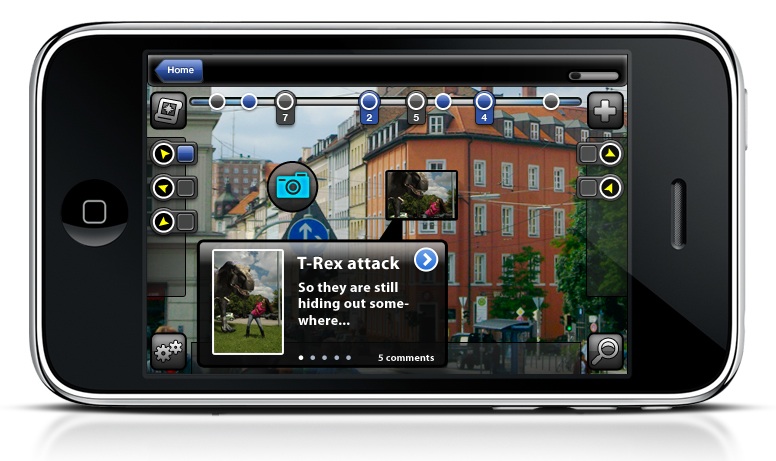
Metaio, Inc. Will Launch Its Mobile Augmented Reality Platform junaio On November 2nd San Francisco, September 18th 2009 – Today, metaio officially announced the launch date of junaio, its mobile augmented reality platform. On November 2nd, the leading company in augmented reality will release a first version exclusively for the iPhone. More features will be released soon after, including capabilities on the Android and Symbian platforms. junaio will change the way we create, access and share information. By combining innovative online and mobile technologies, junaio will allow users to see location-based content through the display of a mobile device. Users can leave traces, messages or objects and visually interact with their friends or anyone else in the world. Already existing web services can be enhanced and completely new ways of interaction can be created. Whether it is social networks, multimedia content or game concepts – virtually anything can be embedded in the real world and connected to a certain place. “The possibilities are endless, we are taking the Internet outside to the real world,” says Thomas Alt, Chief Executive Officer of metaio. Seeing location-based multimedia content through the display of your mobile device is only one part of the story. “Mobile augmented reality is all about the user´s orientation. But to deliver a really useful and robust application, you have to be user oriented,” says Peter Meier, Chief Technology Officer. metaio is defining a new dimension in mobile augmented reality through incorporation of features that will allow better usability and social interaction. junaio is the result of more than six years application development in augmented reality and months of research and usability tests for mobile applications. So get ready for the ultimate Outernet experience!

For more information and updates, please refer to: www.junaio.com

More Augmented Business Cards

A couple of months ago, the ARSphere was gushing over James Alliban’s augmented business card (the one with the pixelated talking 3d face).

That nice little creative work led Alliban to recently launch Augmatic, a company that provides augmented reality services, and yes, among them is a personalized augmented business card.

Of course, Alliban is not the only one in the augmented business-cards-business. We have previously featured Toxin Labs. This week sees another implementation, by one Burton Posey, which can only be described as cute (of course, you can choose a more menacing avatar):

Says Posey:

This is an idea I’d been kicking around in my head since February. I wanted to find a way that a company could deliver a catchy identity for themselves. Avatars, be it the Mii’s on the Nintendo Wii, or an Xbox Live Avatar, have become extensions of the people who use them.

You can try his implementation over here. I wonder if any of the guys at ISMAR 09 is going to have augmented business cards.

Concept Glasses to Photoshop Reality

Good magazine has apparently asked some interviewees to imagine that will improve their daily life. The two ladies in the video below, Freya Estreller and Natasha Case, came up with Photoshop Glasses. A first step to improving the world may be seeing how much better it could be:

If you happen to think that’s a far fetched idea, you are probably right. However, we already saw head tracking software that puts on virtual masks on faces. So maybe in your next job interview, if the interviewer just looks a tad like your ex-boyfriend, all you’ll need to do is wear some dorky glasses, and see him as Optimus Prime.

via Red Tory

Augmented Reality? I’m Loving It

Or used to, I’m currently in the trough of disillusionment. But never mind that, here’s how McDonald’s Italy chose to promote their new hamburger. Giving new meaning to Bruce Sterling claim that current AR is a bit cheesy.

Try it here.
Previously – Find Nearest McDonald’s via AR and Augmented Burger King.

Why Int13 Got in Bed with Total Immersion

Yesterday, Total Immersion (TI) and Int13 – both French augmented reality companies – announced a strategic partnership, in which Int13 would help TI cover a major gap in its product line: Mobile Augmented Reality.

A French kiss or a Russian bear hug?

Instead of guessing, we went out to speak with Stéphane Cocquereaumont, president and lead developer at In13, the mobile games boutique studio behind an AR game legend: Kweekies (“when is it coming out?”).

Ori: Congratulations Stéphane! This must be a big shift for Int13.

Stéphane: Thanks. We started discussions with TI back in April, so we knew where this was going for some time now.

Ori: What was TI’s motivation to approach Int13?

Stéphane: TI approached us because their clients kept asking for “360” solutions. While TI is strong with large installations, live shows, and PC based experiences – their mobile AR line needed a boost.

Ori: …and what about Int13? You had it going as an independent studio with Kweekies, first on Nokia and then on the iPhone.

Stéphane: We have been flooded with requests from marketing agencies about mobile AR campaigns. At first we tried to adress those requests, but we soon realized managing their expectations in terms of delays, pricing and capabilities of the tech posed a huge overhead, and was distracting us from our goals.

Ori: So, you decided to “outsource” the headache and focus on your product?

Stéphane: Exactly. TI will work with the marketing agencies and other players asking for quick mobile AR applications. We will offer them our tech embedded in a nice and clean SDK with a Lua API, easy to use but with limited flexibility.

Ori: You make TI happy, yet keep the full power to yourself. Make sense. What can you reveal about the business terms?

Stéphane: For TI this partnership means they have a working mobile AR SDK, with worldwide exclusive rights for two years. They pay an annual license fee, plus royalties on all the projects they deliver with our tech.

This should be a win-win partnership.

Ori (note to self): […more of a French kiss than a Russian bear hug.]

Stéphane: We’ve also made a deal with another french company, the project will be shown during CES in January 2010; very exciting project but I can’t say anything about it for now.

Ori: Thanks for teasing us. Can’t wait to see it.

Stéphane: We’re also discussing with device makers, we’ve been to Korea last month, and we’ll release our first AR game very soon (September or October) in Korea. The game will first be available on the SKT network, on Samsung devices.

Ori: Wow. You’re unstoppable.

Stéphane: Wait, there’s more – we’ll soon publish a preview video of ARDefender; it’s a simple game to help players discovers the capabilities of AR.

Ori: Fantastic. And when will we be able to finally play the legendary Kweekies?

Stéphane: Kweekies is delayed…too many other projects on the plate for our small team. We still intend to release it by Christmas – though we can’t promise…
Ori: Awww…that’s a downer…any good news to close with a positive note?

Stéphane: Yes, I got something for you – we’ll soon reveal a new demo of ARWiz 2, the next iteration of our AR tech, faster and much more robust.

Ori: That’s a great comeback. Thanks for sharing the story behind the scenes, Stéphane.

And all the best for Int13 and TI in your new (in bed) relationship.

Reblog this post [with Zemanta]

Total Immersion Brings Augmented Reality to TomorowCity Todaytomorrow

Total Immersion (TI) may not be at the center of the Augmented Reality (AR) browsers frenzy these days – but when it comes to delivering AR on a large scale – it’s still the 800 pound gorilla.

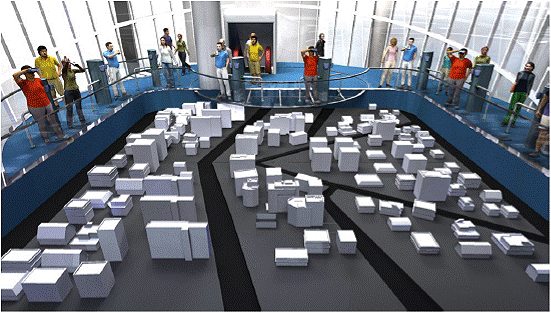
Nicolas Bapst, responsible for Product Marketing for Amusement Parks at TI – recently shared with me their latest achievements: a totally new kind of interactive 3D live show and an AR goggles experience The Networked City developed for TomorrowCity in South Korea .

The 3D live show is based on TI’s 3D Live Show technology (naming coincidence?):

…a very innovative and interactive screen movie production…This show introduces the U-city in a spectacular method and the audience can participate directly in the story performance.

With the new offering from Total Immersion, spectators share the stage with virtual live performers, playing a guessing game around what’s real and what’s not.

3D interactive 1 TI

3D interactive show 2 TI

See the hilarious video on TI’s site

The 3D live show is not all TI had up its sleeve for the U-city. A second project, involving augmented reality (AR) goggles is: the Networked City

The networked city TITo the naked eye, the exhibit looks like a bare bones model of a city. But when visitors put on the special AR goggles a whole new world unfolds – as graphics overlaid on the city model.

How does this new world looks like?

Can’t say…no video of the exhibit was released so far.

Until then, you’ll have to travel to South Korea to see for yourself…

Reblog this post [with Zemanta]

Weekly Linkfest

Actually, it was a relatively quiet week in the ARSphere. Here are some links to news bits that I haven’t had the time to cover over here:

In the mobile AR front:

  • Kooaba is an iPhone application that much like Snaptell (or Nokia’s “Point and Find”) lets you take a picture of a product and get information about it. Now they venture into the realm of AR browsers, but since they fail to show their image-based browser working on a real iPhone, I’ll remain skeptic for now.
  • Cyborg is an AR application that helps you find the cheapest gas station around. Yes, they could do that with a simple map, but that’s like having a web 2.0 site without rounded corners.
  • And if you live in Hong Kong, forget about gas prices, just use this application to find the nearest train.

And in other news:

This week video comes from Techcrunch’s favorite Tonchidot, makers of the Sekai Camera. Apparently their application was finally submitted to the iPhone’s appstore, and we may soon compare it to other AR browsers. The next video is indeed in Japanese, but starting from 0:45 you can easily understand what’s going on, even if you are not a native Japanese speaker. It certainly has some Japanese flair to it:

Have a nice week!

Follow Friday – AR Favorites in Twitter (part two)

Continuing my endeavor from last week, here are some more recommended accounts to follow on Twitter if you are interested in augmented reality. As promised, today I’m going to focus on mobile augmented reality companies. But first, let me just add two more guys that I absentmindedly missed last time.

  • @chrisgrayson – Chris is the only advertisement guy I’m willing to follow. Many times he finds interesting AR oriented links long before anyone else. Moreover, he is very concise, and won’t spam you with mundane links, so there’s no reason not to follow him.
  • @thomaskcarpente – Thomas Carpenter is of course the guy behind The Future Digital Life. He’s new on Twitter, but if his blog is any sign, you wouldn’t want to miss following him on Twitter.

And now, without further ado, mobile augmented reality accounts:

  • @Wikitude – The official account for the Austrian trailblazers Mobilizy. It’s really all about Wikitude, and a bit spammy, but there’s no better source for news about this application. Advanced users – check out Mark Kramer’s account, Mobilizy’s human experience lead.
  • @LayarMobile – Probably the world’s most famous mobile AR application, Layar is also the most followed account on this list. Mainly about Layar, but sometimes tweets about the external ARSphere. Advanced users – chekout Raimo van der Klein’s account, Layar’s CEO.
  • @acrossair – makers of London’s tube finder AR app (and NY subway, and so on…), and recently their own AR browser.
  • @srengine – One of the few AR applications that is based on image recognition. Partly in Japanese, but you are more likely to see English over its Twitter account than on its official blog.
  • @GeoVector – One of the first players in the field of mobile augmented reality. When their World Surfer browser like application for the iPhone is approved by Apple they may become a strong player in the western hemisphere.
  • @symbiancoderDavid Caabeiro’s account, one of the developers at Sequence Point Software, makers of ARound, your best option for Symbian based AR.
  • @Robotvision – The AR browser we wrote about here. Only one tweet to date, so advanced users should follow Tim Sears, the guy behind it.
  • @sekaicamera – Tonchidot’s Sekai Camera, The AR sensation from Japan. Only five tweets till now, but should warm up as they prepare to launch soon.

Obviously, this list is not comprehensive, and I’ve probably missed some accounts. If you know of any account that should be added to this list (does Gamaray have one?), please leave a comment, or better yet tweet me. As always, you can follow me on twitter at @augmented.

Augmented Reality is Rounded Corners

Earlier today, Thomas Carpenter posted this video and asked whether the augmented reality mode adds anything to the application.

The answer is probably not. In my opinion we are seeing AR evolving into a cool feature for location based services, much like rounded corners was the cool thing to have if you were a web 2.0 application. Yes, in some applications, like Layar and Wikitude, augmented reality is currently a major feature, but in the long run its the location-oriented content they should focus on, not on how to present it.

Having augmented reality as just another cool feature is not a bad thing. It can actually be the thing that saves it from following the same path that virtual reality went by. Obviously, the hardware today is not good enough for terminator-vision grade of AR. However, having augmented reality play a low-key role for now may keep it around till we’ll have the right hardware.

Or maybe I’m just reading too much into a Youtube video. Oh, that reminds me – the application is called WorkSnug, and you can find more about it here.

Apple Announces iPhone 3.1 with Semi Support for Augmented Reality

Horray. Apple announced today in their Music Event, that the new iPhone operating system3.1 is here (should be available in the next couple of hours).

What’s so great about it?

We were the first to publish the upcoming news when the Beta SDK 3.1 came out in mid July in our post: Has Augmented Reality Arrived to the iPhone?

Simply put – it offers a new API that allows to overlay graphics on a live video stream.

This is great news for Augmented reality (AR) browser applications such as Layar and Wikitude (for more examples see right side bar). Although similar applications have sneaked into the app store before – I am sure it’s great to finally be legit on the store.

However, 3.1 provides only semi support for AR apps.

When you want to align graphics with real world things (like markers or other objects) – you need to be able to analyze the live video stream off of the iPhone camera. This functionality is only available as a private API on the iPhone (even with 3.1). It’s technically possible, but Apple may not allow such an app on the App store.

By the way, when I say “support” I do not mean by any means that Apple provides AR capabilities on the iPhone. Some folks in the press got that impression from the flood of headlines announcing support for AR on the iPhone…
To clarify, AR companies still need to do the heavy lifting such as AR detection and tracking; bearing the ripe fruits of many years of research and development.

So AR is not yet totally legit on the iPhone. But we are getting closer.

Thank you Apple!