Would You Kill for These Android Augmented Reality Apps?

Tom Spring from PC World put together a nice collection of Android apps for T-Mobile’s G1.

The lion’s share of these apps is compelling thanks to their novel use of camera, GPS, communication capabilities – or all combined.

Tom listed 15 Android “killer apps”. I pick 4 apps which could inspire the augmented reality world.

You will judge if they “kill”, Bill.

1. BreadCrumbz

First step towards user generated Geo tags

BreadCrumbz is a different kind of navigation application.

Navigate-by-Pictures: Navigate your route using pictures instead of a map (there’s also a map, if you like).

Users Create Routes: Easily record routes using your smartphone. Share them with your friends, share them with the world.

2. CitySlikkers

Attempting a real-world social network

City Slikkers is a Pervasive Game (alternatively Location Based Game) which takes place in the real-existing city. It is designed to connect a large number of players through-out the world and change the way the surroundings are seen. The central idea behind the concept is to give people the opportunity to symbolically interfere with the everyday urban environment and come into contact with previously unknown people.

3. ShopSavvy

Using the oldest Marker technology: barcode

ShopSavvy™ is a shopping assistant developed exclusively for Google’s Android mobile phone platform and is one of T-Mobile’s featured applications in their 2008 US and UK launch. Users can scan the bar code of any product using their phone’s built-in camera. ShopSavvy will then search for the best prices online and through the inventories of nearby, local stores using the phone’s built-in GPS. ShopSavvy won Google’s Android Developer Challenge and is available in Google’s Android Market.

4. Get a Life

Getting folks out of the house is a good thing

Locate your friends and family– LifeAware gives you the ability to create your own network of friends and family members and locate them. Unlike other location services, LifeAware will provide you with their last known location, providing insight even if their phone is off or out of range.

Establish safety zones for family members – Create geographical zones and setup notifications for when a family member enters or leaves the defined zone. Setup a zone to be notified when Johnny arrives or leaves school, or when a loved one arrives at their destination when taking a trip.

Tag locations for yourself or for sharing– Tag locations you visit, or find on the map and share with the members of your network.

Send locations– Send your current location or location of your choosing to friends in your network, or to any email address. Send the favorite meeting place to friend and have them meet you.

Now, you be the judge!

To BeAR or not to BeAR?

Thomas Baekdal put together a nice post about PlayStation Eye Camera Games.

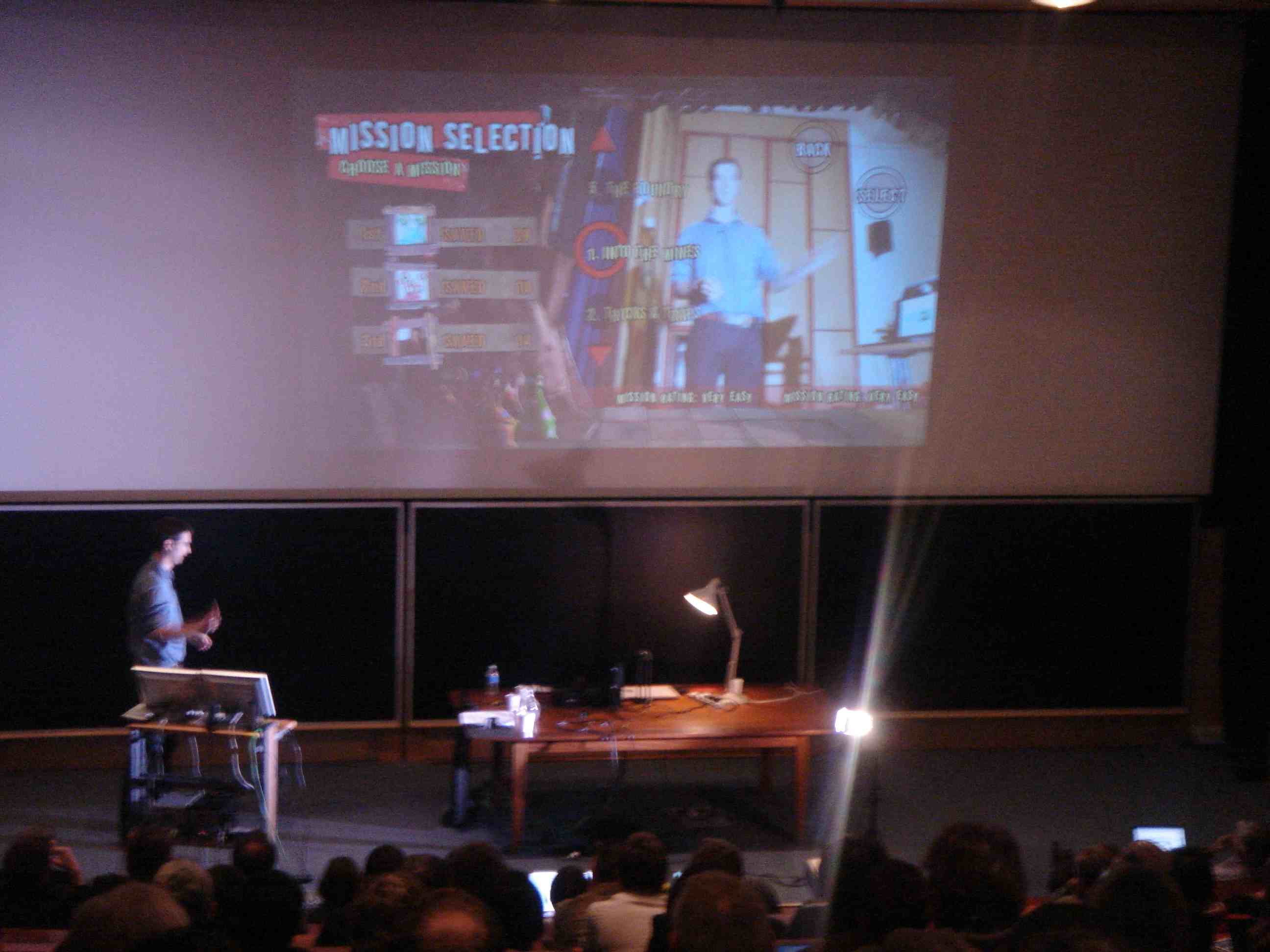
These are the kind of games Diarmid Campbell demonstrated live on stage while delivering the unforgettable keynote at ISMAR 2008 last week.

Purists would rant it’s not augmented reality: If a game takes place on screen, the fact that you interact with it using hand movements (even when you see yourself in the background) doesn’t qualify it as AR. It’s still “just” a camera game.

Yeah, I know – but if the experience is captivating and survives the novelty stage – does it matter how you call it?

The best type of fun is when technology gets invisible.

How would you call these games?

What do Games of 2043 Look Like?

We interrupt this program (“ISMAR ’08) to bring you this breaking news from the Austin Game Developer Conference (via Gamasutra): Futurist and author Bruce Sterling delivered the Tuesday keynote speech where he was tasked to imagine the next 35 years in the game industry:

Then what do the games of 2043 look like? “I think you would call [them] ‘augmented reality’ but we don’t,” Sterling continued. “We think that reality is real — you can have a lot of fun with [an overlaid] game interface.” To Sterling, the games of the future scale from personal “body games” to global games and space games and everything in between — including “neighborhood games”.

Sterling wasn’t all flowers, he continued with a dark prophecy, which I totally agree with:

“Stagnation in the creative side of the industry will hamper their evolution.”

That’s exactly what augmented reality is missing today. The technology is reaching a good-enough stage; the buzz has been built to a more-than-reasonable level; and yet no augmented reality game has broken into the main stream: gameplay, fun, killer-app – you name it, but who’s got it?

Live from ISMAR ’08: The dARk side of Physical Gaming

Welcome to the late evening keynote of the second day of ISMAR ’08 in Cambridge.

The keynote speaker is Diarmid Campbell, from Sony Computer Entertainment Europe (London), and heads its research on camera gaming. And we are covering it in real time.

Diarmid comes on stage. the crowed is going crazy…

The talk: Out of the lab and into the living room

What a camera game? Simply put, you see yourself in the camera and add graphics on top.

The trouble with the brain: it fixes things you see (example of a checkerboard, a black square in the light has the same color as a white square in the dark.)

Background subtraction is the first thing you try to do. Using this technique, Diarmid superimposes him self in real time on top of…the ’70 super band ABBA…

User interface motion buttons – use virtual buttons that the user activates. The response is not as robust, but it’s more responsive.

Example of EyeToy Kinetic

Next is a demonstration of vector buttons and optical flow.

You have to keep the control on the side – otherwise the player’s body will activate it unintentionally.

It turns out Sony decided not to use this control…not just yet.

A similar control was actually published in Creature Adventures available online. Diarmid struggles with it. The crowed goes wild. Diarmid: “You get the idea…”

Good input device characteristics: Many degrees of freedom, non-abstract (player action=game action), robust and responsive.

Camera games have been accused in the past for not having depth (too repetitive). There are 2 game mechanics: skill based (shoot the bad guy) and puzzle based. This could become shallow – unless you deliver on the responsiveness and robustness.

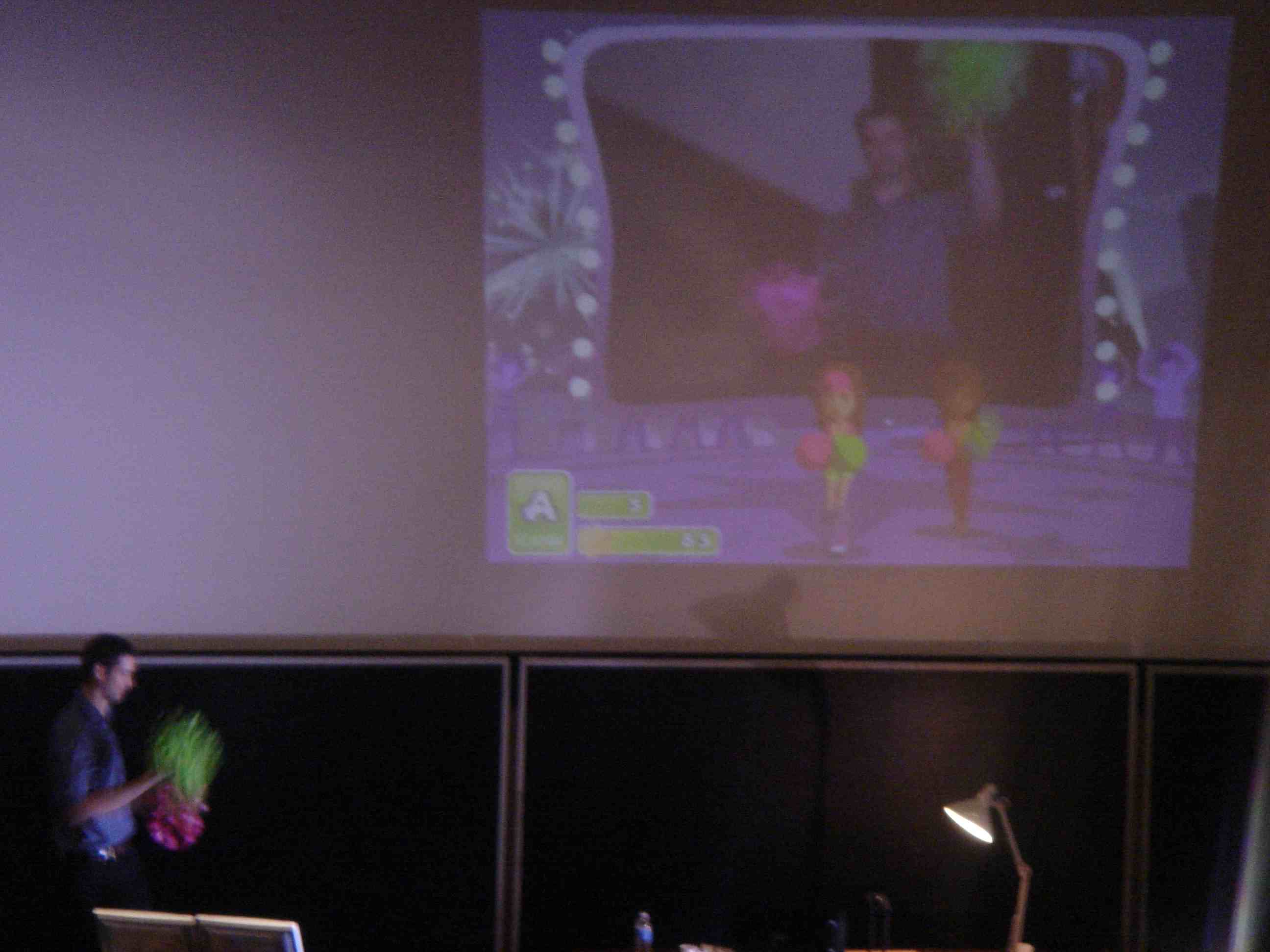
To demonstrate color tracking, Diarmid dives into the next demo (to the pleasure of the audience…). For this demo he holds 2 cheerleader pompoms…

“It’s like a dance dance revolution game, so I also have to sing and occasionally shout out party…”

The crowd is on the floor.

See for yourself –

We are on to drawing games, Sketch Tech. He draws a cow that is supposed to land on a banana shaped moon. He succeeds!

Using a face detector from Japan, here is a Head Tracking game: a green ball hangs from his mouth (a pendulum) and with circular moves of his head he rotates it, while trying to balance it…

Eye of judgment, a game that came out last year (bought out by Sony) relied on a marker based augmented reality technology. It is similar to a memory game, with a camera and a computer, and cards.

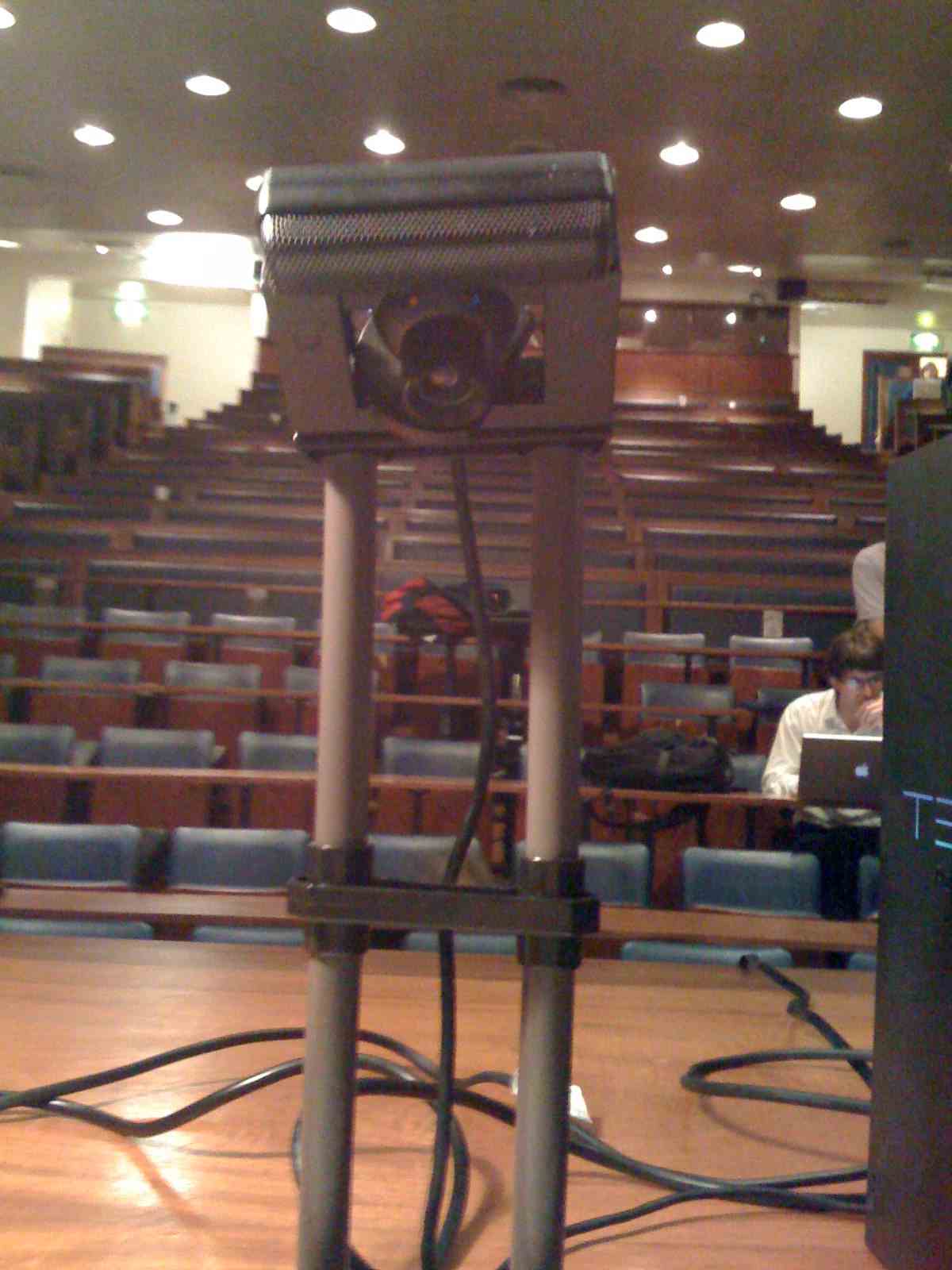
We are starting to wrap up and Diarmid summarizes, credits Pierre for setting up all the hardware, and opens the floor for questions.

Question: How do you make the game interesting when you’re doing similar gestures over and over again…

Diarmid: When the game is robust and responsive – you’ll be surprised how long you can play the game and try to be better.

Blair MacIntyre (from the audience): Robust and learn-able is what makes the game fun over time.

Question: Is there anything more you can tell us about the depth camera? Will it be available soon to consumers?

Diarmid: No.

The crowed bursts into loughs.

Blair (jumps in from the audience) There is a company called 3dv in Israel which offers such a camera. It’s not cheap or as good as discussed before, but you can get it.

Q: What’s special about camera games beyond novelty?

Diarmid: The 2 novel aspects of camera games are that it allows you to see yourself, and you can avoid the controller. Camera games are also great for multi-players.

Q: Is there a dream game you’d like to see?

Diarmid: Wow, that’s hard…I worked on a game before Sony called The Thing based on Carpenter’s movie. It was all about trust. The camera suddenly opens up the ability to play with that. When people see each other, the person to person interaction is very interesting and hasn’t been explored in games.

Q: will we see camera games on PSP?

Diarmid: there is a game in development, and I don’t know if I can talk about it…

Q: when I look in the mirror I am not so comfortable with what I see…how do you handle that?

Diarmid:  We flip the image. It’s hard to handle a ball, when just looking at the mirror.

And that’s a wrap! Standing ovation.

~~~

After party shots…


Will Wright: Augmented Reality – Way Forward For Mobile Gaming

Captured in an interview with Pocket Gamer (Thanks!) in London via Kotaku:

“I can imagine mobile platforms evolving…in that they interact with the world around us in a way that changes our perceptions in a really interesting way”, said Wright, “Games could increase our awareness of our immediate environment, rather than distract us from it”.

Will Wright is by far my idol in the gaming world. He’s the smartest and the funniest, and he single handedly invents new game genres (SimCity, The Sims, Spore).

If you wonder why or how, give yourself 20 minutes off and watch his speech at TED


Is Will joining the Augmented Reality revolution?

(Can you say “mega idol”?…)

I want my iPhone augmented too!

The buzz continues.

As the coolest gadget around, the iphone is raising a lot of interest in the augmented reality community. This was once again confirmed in an interview with Stéphane Cocquereaumont, President and Lead developer at Int13, a mobile games developer:

“The iPhone is in fact our main target, the next demo we’ll publish will be on this device, this is probably the best device to do mobile AR today, even if its camera is far from perfect.”

Stéphane conversed with me following a post of Int13’s demo on the augmented reality games facebook group titled: “Augmented Reality on mobile devices that just works” 

He added:

“Our AR library should work easily on devices such as Intel’s MID [which is coming out this summer – games alfresco]…but we’re more interested in Smartphones…”

Games alfresco: How central do you see augmented reality in your company’s future?

Stéphane: “We plan to continue working on our AR technology and improve it, we’re especially interested in markerless tracking.”

And here is what I really liked in this interview:

“But our main objective is to create cool games and sell them”

Int13 is among the first pure game developers to dive into the AR space.

“if our current AR projects reveal themselves to be commercially successful then AR could become central for us.”

Cautious optimism, always a good trait for a game developer.

Thanks Stéphane and France from Int13 for sharing your experiences and plans!


Don’t you want your iPhone augmented too?

Want your own augmented reality Geisha?

Geisha Tokyo Entertainment Inc. announced a new augmented reality game. They call it Dennoh Figure ARis or Cyber Figure Alice (which only works in japanese thanks to the interchangeability of L and R in Japanese). Thanks Akki from Asiajin for bringing it to the western world. It is scheduled to hit Japan this fall.

Is it a breakthrough?
From a technical perspective we have seen similar implementations on the market – many covered in this blog’s demo category (see left sidebar). It’s based on the widely used marker AR technology (that is ‘widely’ within the narrow AR community).

What’s new about it is the theme chosen for this game: a high-school-graduate-in-training-geisha. This is a departure from the infant oriented magic books and wiz cubes, yet it doesn’t dwell with extreme practicality as the Fix-Your-Own-Car applications.

Enter the world of augmented reality for grown ups: here you can peep, poke (using the supplied cyber sticks), and peep at your own geisha.
The publisher describes her (according to Google’s translation of the product’s site) as “rich in the sensitivity of your desktop to make sure spectacular”. You may rephrase based on your own taste.

Now who will take it outdoors?

What if you could experience this non-intrusive interactivity with real people on the street?

Top 10 augmented reality demos that will revolutionize video games

Augmented Reality (AR) has the potential to do something parents can’t: free gamers from their couches and usher them into the real world, to play.

***UPDATE***if you find this interesting – check out the recent post Top AR Games of All Time.

Here is my countdown of the top 10 best AR demos poised to revolutionize video games:

10. Human Pac Man

When Dr. Adrian David Cheok (NUS) wanted to create an exciting augmented reality game, he chose to remake the first video game to ever introduce a character – the legendary Pac Man. Cheok literally stepped into Pacman’s shoes in this first-person-shooter-like real world game.

9. Come Out & Play

In 2006 the Come Out & Play Festival turned New York City into a playground for a weekend, then did the same for the city of Amsterdam in 2007. Hundreds of players gathered to play dozens different Big Games across each city.

None of the games played in the festival made it to my top ten list – individually. They fell short of stretching the interactivity between real and virtual. But as a group – they reminded us that playing games outdoors can be fun, and technology can make it even funner.

8. Second Life Avatar Enters the Real World

Tobias Lang and Blair MacIntyre (GA Tech) give us an extraordinary glance at what happens when the virtual world “leaks” into the real world. No, they didn’t use a green screen as you can see behind the scenes. Is it a hint for some of us to ditch Second Life and augment our First…?

7. WIFI ARMY FPS

The world is the battlefield, your phone is your weapon. Players organize in 2 teams armed with cell phones with the goal to locate and take pictures of their opponents. The phone compares captured pictures against a database of player faces and awards points for correct hits. Peter Whatanitch of W2Pi (creator of the game) explains how it will work. It could become quite an experience as staged in the Lumix Battle commercial.

6. Shadow Monsters

Phil Worthington is an artist that injects coolness into augmented reality.

“Magical monsters appear from shadows cast by the hands of participants, reacting to gestures with sound and animation. Wolf like creatures, birds and a rastafarian are among the characters that speak and squeek as imaginary mouths open and close. Shadow Monsters is an intuitive and magical experience for young and old alike to play with body posture for creating crazy narratives.”

5. AR Grafitti by DAIM

Artist DAIM creates virtual 3D graffiti floating in space in his latest art project “Tagged in Motion” of NextWall .
What if everyone could overlay reality with their own virtual creation?

4. CARCADE: In-Car Video Game

Andreas Nicolas Fischer and team suggest to take advantage of the fast changing scenery experienced by car passengers – and turn it into a video game (remember Gondry’s Star Guitar Video Clip?). Could be a great way to pass time. I’d call it: “Are we there yet..?”

3. Total Immersion at Demo ’07

Probably the most commercially successful company that specializes in augmented reality, Total Immersion delivers the best live demos in this domain – with a French accent. They have also featured in CES 2008 keynote by Intel’s CEO Ottelini.

2. Roku’s Reward

This concept* video shows the potential of augmented reality utilizing today’s technology:
  • A handheld camera device,
  • live video overlaid with 3D graphics,
  • computer recognition – identifying real life objects,
  • positioning and acceleration sensors,
  • virtual objects interacting with reality,

…wrapped up in a fantasy narrative make up this yet-to-be-developed game.
*According to Phil Stenton (HP Labs, UK): “Roku remains a demo film. We haven’t signed up with anyone to create the game yet.”

…And the top demo is…

1. Rainbows End by Vernor Vinge

Though delivered in words only, this “demo” paints the farthest vision for augmented reality so far. Everything else you’ll see on this topic will look like excuses: “sorry, we don’t have that technology yet…”
Yes, but do you have the imagination?

“There was something familiar about this prey. It was young and clever looking … a newborn from Juan’s own design! And that meant its Mommy would be nearby. Juan said, “You know, I don’t think –”
“The Problem Is, None Of You Think Nearly Enough.” The sound was premium external, like sticking your head inside an old-time boom box. Too late, they saw that the tree trunks behind them grew from yard-long claws. Mommy. Drool fell in ten-inch blobs from high above.
This was Juan’s design scaled up to the max.”
Read it on Google Books.
Didn’t make the list…
* You may ask how come I left out another classic remake: AR Quake. Well, this remake is indeed played outdoors, but let me ask you this: does it add much to the original experience of that first person shooter?
* How come I am ignoring what some call “the future of books” such as EyeMagic Book or WizQubes? Is it really that different than manipulating 3D characters on the computer screen?
* Daniel Wagner, a major force behind recent AR innovation, may be disappointed that his pioneering handheld AR game the Invisible Train didn’t make it. No hurt feelings; it’s a great proof of concept, but isn’t it more fun to play with the *visible* train?
* Other educational oriented games such as MIT’s Environmental Detective or U-WIS’s MadCity Mystery certainly beat learning in a classroom – but aren’t they indistinguishable from traditional low tech scavenger hunts?

Can you beat this list? I want to hear from you.