Hitchcock’s Rear Window reimagined in Augmented Reality

Rear Window is the thesis project of artists Mike Lawrie and Jon Friis for the New Media program of the School of Image Arts at Ryerson University (Canada). It’s a re-imagining of the classic Hitchcock film where viewers will take the part of the film’s protagonist.

The installation takes the form of a telescope, installed near a window in the gallery space. Participants are invited to take the role of Jeff in the film, observing and scrutinizing the neighbours and neighbourhood of the gallery. However, the image through the telescope does not wholly coincide with what is seen by the naked eye. Instead, utilizing augmented reality techniques, portions of the image are replaced. Specifically, windows of neighbouring buildings become silver screens, presenting participants with footage from Hollywood films which utilize the Rear Window cliché.

Now, I’m too much a techie to understand their motivation in creating such an installation, but I do like the idea. Read more about it on Mike Lawrie’s site.

Augmented Reality Confronts Witness Apathy

When someone falls down and begins grabbing at their chest. How many people would stop and try to help them? Psychology experiments show that most will walk by, hoping the next person will stop and help the struggling person. Witness apathy in the face of need is wired into our brains and difficult to overcome.

An interactive billboard campaign in the Netherlands hopes to break the cycle of apathy by putting people into the fake event using augmented reality and then giving them tips on what to do.  The billboards are in Rotterdam and Amsterdam.

I wonder if future image context recognition apps will be able to shake people out of their mob think and let them know to take an action?  Or maybe they’ll just turn their AR glasses to standby instead.

Weekly Linkfest

This week saw the realization of two conferences dedicated to augmented reality – the AR Conference and the European AR Business Conference. Sadly, no videos from the two are currently available online. But here several other things that are available online:

Quote of the week is taken from Chris Grayson well thought reply to my sensationalist post asking whether augmented reality has already peaked (follow link for full reply):

Think what a single hype cycle for “video” would look like. Then consider TV, online video, outdoor billboards, mobile phone displays, that is to say — moving images are a very big idea. Different implementations are adopted in different ways at different rates… AR is also a very big idea that has many manifestations.

And this week’s video is a commercial to augmented reality head up display called the “Stark HUD”. Unfortunately you will not be able them anytime soon, since they are part of an elaborated campaign promoting the release of “Iron Man 2”, which also includes a web application that lets you try on iron man’s mask.

that’s it for now, have a great week!

The Future of AR Browsers

Swiss augmented reality company kooaba and ETH Zurich have joined forces to create a rather impressive augmented reality browser prototype, which I’ll refer to as the Koo (since it lacks any official name). Unlike existing browsers out there, the Koo doesn’t rely on GPS and compass readings to decide what’s in front of it, but rather on image recognition techniques.

The object (be it a book or a whole building) is identified on kooaba’s servers and is tracked live on the phone itself. And it doesn’t require a custom made mobile phone to work, any modern phone that allows access to its live video stream should suffice (literally, the Nexus One). The result looks amazing, though we should be careful to judge according to a demo video:

Head over to kooaba’s site to read more about the Koo and to see another video of it in work.

The Feed – Novel and Concept Video

Back in early fall of 2009, with help from Bruce Sterling, I put together a list of augmented reality novels. I’ve added a few since the original, but further additions have been sparse (at least until I can find a publisher for my own.)

So this concept video based on the novel Feed by MT Anderson was a pleasant surprise.  And though it uses the tired trope of ubiquitous advertising invading every aspect of our lives (of course, its not a prediction, but commentary on the state of our lives), it has a dab of plot for a one minute video.  Think of it as flash fiction for the reading impaired.

If you’re interested in the novel, which I’ll probably take a crack at reading, here’s the jist from the Great Wiki:

Feed (2002) is a dystopian novel of the postcyberpunk genre by M. T. (Matthew Tobin) Anderson. The story revolves around a teenage boy and his relationship with a girl with a vastly different world perspective. They live within a futuristic world where technology has merged electronics and telecommunications with the human mind, something which plays a major role in the novel. The book is a dark satire about corporate power, consumerisminformation technology, and data mining in society. Their lives revolve around advertising, and the knowledge and will that the Feed not only provides them with information on demand but manipulates their decision-making in realtime.

The story depicts a future in which the Internet has evolved into the “Feednet”; a computer network to which the brains of American citizens are directly connected by means of an implanted computer chip called a “Feed”, which about 73 percent of Americans have set in their brain. Privacy has become a thing of the past; Corporations are free to monitor and manipulate citizens’ thoughts, people’s thoughts are interrupted by the mental equivalent of pop-up ads, sometimes to a debilitating degree, and the government can even subpoena one’s memories. The corporations and conglomerates responsible for the feed participate in data mining by monitoring the purchases and interests of those with the feed, and using this information to fit individuals into consumer profiles. People can “M-Chat” one another (a form of evolved Instant Messaging) on closed channels, effectively creating a form of telepathy. In addition, the Feed chip is implanted at such an early age that it actually takes over the running of many brain functions as the child matures. As a result, certain sites on the Feednet allow users to go “In Mal”; deliberately cause their feed chips to malfunction, causing physical and mental sensations similar to some illegal drugs.

Has Augmented Reality Peaked?

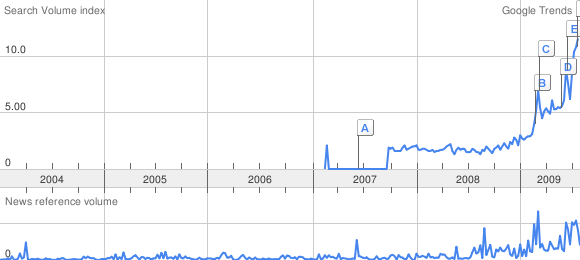
Sorry for the attention grabbing title, but remember how we all celebrated when augmented reality passed virtual reality on Google trends, showing an exponential growth rate?

Well, it sure looked promising back last September, but since then, the interest in AR has stopped increasing, at least when measured is search volumes and news references

The current trend is even more obvious when compare with Foursquare (in red in the graph below), which really does show exponential growth:


so, what’s going on? there are a couple of possible explanations:
(a) Augmented reality has peaked. I can’t really believe that’s the case.
(b) Google trends was never an adequate tool to measure the popularity of augmented reality. Other measures, such as investments, acquisitions and actual downloads are much better indicators. All of those show positive trends.
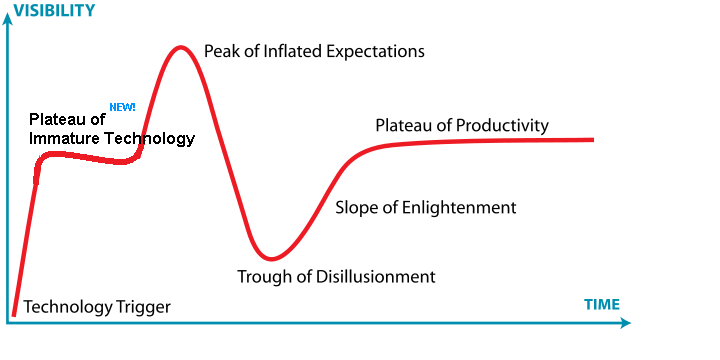
(c) We have entered a new, uncharted area in Gartner’s hype cycle, one that I call the Plateau of immature technology. Simply put, the iPhone is not the optimal AR device, and it’s not even the best currently out there. However, most of us limit ourselves to developing AR applications on the iPhone (or even worse, in Flash), and thus the solution space is really limited. We see the same ideas rehashed time after time (though, some pleasant surprises do happen), and people loose interest. The trend line seems pretty constant (for now) because there are still some users who discover AR for the first time.

If you’ll ask me, augmented reality is not dying, but stalling, waiting for a breakthrough either technological or conceptual that will bring new type of applications to the market (much like Foursquare was for location based services). Would it come for one of the incumbents companies, a giant like Google, or maybe a stealthy startup? only time will tell.

Augmented Rave

Who knew augmented reality markers were the new glowstick? Psychedelic jellyfish, oh my!

Augmented Reality Flash Mob

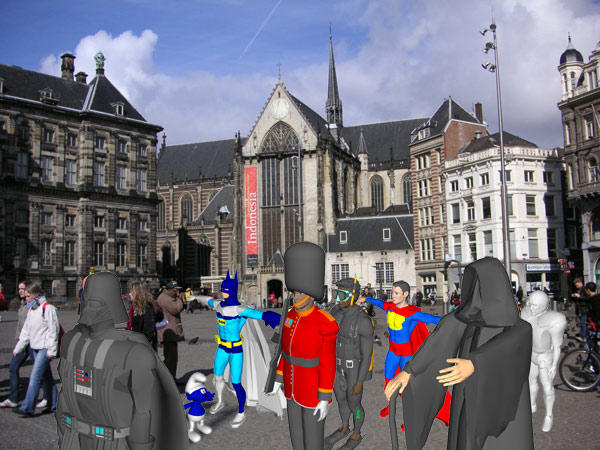
If you happen to be in Amsterdam this Saturday (either because you live there or can’t get back home because your flight is canceled), you may want to check out the first AR flash mob. It turns out that in an augmented flash mob, the mob consists of virtual characters bounded to markers:

Sander Veenhof who is behind this interesting event hopes that tourists will opt to take pictures with the virtual characters rather then with the usual “live sculptures”. I personally doubt it, but if you want to take part in this experiment, the precise location and timing can be found here.

Weekly Linkfest

For me, this week’s highlight was seeing Natal demoed live (cool!) and some more advanced features Microsoft is pushing into Photosynth (even cooler!).
Here some other interesting things that happened this week:

This post was slightly delayed because I couldn’t find any appropriate video to put here. So here’s an old one that I find pretty cool and never have posted over here before. I thought of dedicating a whole post for it, but since it’s been lying in my inbox since January, it will have to do with being the weekly video. From the University of Adelaide, magic:

Have a good week and stay away from erupting volcanoes!

Collectibles and Augmented Reality

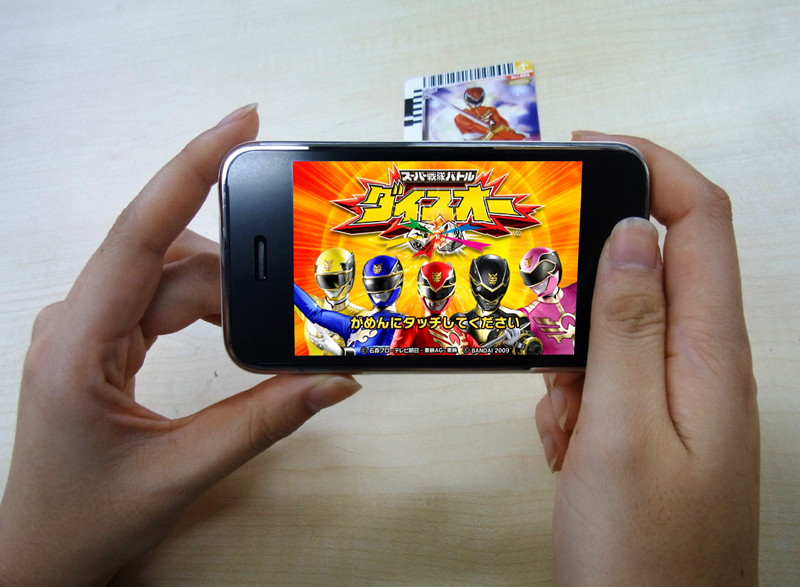
It was only a matter of time.  Virtual goods make up a $1.4 Billion (that’s with a ‘B’ folks) business and the demand is growing.  We have Chinese gold farmers and Farmville exclusive goods, so augmented goods can’t be far behind.

Right now augmented goods are tied to purchased toys as an “add-on.”  Metaio has teamed up with Bandai Co. to create AR extensions to their real world collectible cards.

I believe the next step will be adding augmented only items that exist in certain locations as a reward.  Combine foursquare and Pokemon and you have a potent combination.  Hit all fifteen Starbucks in your area and you unlock a “Coffee Critter” that shows up on your smartphone when you’re in the store (and you get a discount on the Double Latte Supreme.)  Are you listening TagWhat, Layar, Junaio and the rest?

And keep in mind augmented goods as status symbols don’t count unless other people can see them.  Other patrons should be able to see your critter following you or floating above your head just like a non-combat pet in World of Warcraft.  Trust me, people will go to unbelievable lengths to earn a baby dragon or talking penguin.  Value is all about scarcity and that works even in the virtual or augmented world.