Weekly Linkfest

Sorry for being late, here’s this week’s augmented reality (short) linkfest:

This week’s video is of a kid playing air AR guitar, a promotion to some Disney product, I think. On the bright side, it’s the first time I see augmentation of the torso (and not the head). Via Development Memo For Ourselves

Have a great week!

Layar launches world’s first Augmented Reality content store

Press release by Layar:

Amsterdam, April 28th 2010.

Today Layar introduces a new revenue stream in Augmented Reality. Publishers on the Layar platform now have the possibility to offer priced Augmented Reality experiences on multiple mobile platforms such as iPhone and Android. The content store is seamlessly integrated into the Layar Reality Browser, which is already used on more than 1.6 million mobile devices globally.
The Layar Payment Platform is setup to support multiple payment providers and multiple currencies, ready to serve the different local markets. Layar deals with legal, administrative and tax rules enabling the publisher to focus on their core activities: creating valuable experiences. The first payment provider is PayPal, supporting payments to residents of United States, United Kingdom, Canada and Australia. More countries, currencies, payment methods and payment providers will be added regularly.

Any publisher ready to start exploring the medium and monetizing their content can go to http://www.layar.com/create.

The first publishers to seize the opportunity include among others:
* Berlitz City Guides: Berlitz helps people experience the city’s highlights: the best attractions, coziest restaurants, most comfortable hotels, coolest places to shop and most fashionable nightlife.
* Mouse Reality for Disney World and Disneyland: Helps find and navigate all attractions, shows, shops, dinning, transportation, and more in Disneyland and Disney World.
* Eyetours: Explore Puerto Rico’s natural beauty and rich cultural heritage through exclusive video content of historical sites, museums, restaurants, parks and more.
* UK sold prices: Find out for what price that house was sold.
Raimo van der Klein, CEO of Layar: “We have built a great future proof platform that will make Augmented Reality a flourishing marketplace for content, services and goods. Seeing the current interest from especially the retail, tourism and gaming industry we are sure this will fuel the growth of the Augmented Reality medium even further.”
Hubert Haarmann, Director eBusiness of Berlitz: “For Berlitz Publishing this is a great opportunity to forge ahead in the new medium of Augmented Reality using Layar. It helps us sell products successfully, now and in the future.”
Publishers can start selling their content without upfront investments. Layar facilitates payments between the end-user and the publisher. Publishers receive 60% of the net proceeds. The costs for the platform, legal, administration, banking and others are covered by the remaining 40%.

Android users who are residents of United States, United Kingdom, Canada or Australia can start buying layers right now after installing the new version of the Layar Augmented Reality Browser. The iPhone update is soon to follow.

About Layar

Layar is world’s leading Augmented Reality Platform on mobile. The Layar Reality Browser currently has more than 1.6 million users and comes pre-installed on tens of millions of phones from leading handset manufacturers and carriers by the end of the year. Over 500 layers are published on the Layar Platform with over 2000 in development. These layers are developed by the global community of 3000 Layar publishers and producers, and by leading brands and agencies. Layar is located in Amsterdam, The Netherlands. The company is funded and has 32 employees.
The free Layar Reality Browser is available on Android devices and iPhone 3GS. The Layar Platform is available for anyone to create their own Augmented Reality experiences on.

Layar, see the world

Envisioning Life in 2020

Be sure to check out Frog Design’s vision of living in 2020, for a dose of augmented reality spectacles

via La Realtà Aumentata nelle applicazioni di marketing

Hitchcock’s Rear Window reimagined in Augmented Reality

Rear Window is the thesis project of artists Mike Lawrie and Jon Friis for the New Media program of the School of Image Arts at Ryerson University (Canada). It’s a re-imagining of the classic Hitchcock film where viewers will take the part of the film’s protagonist.

The installation takes the form of a telescope, installed near a window in the gallery space. Participants are invited to take the role of Jeff in the film, observing and scrutinizing the neighbours and neighbourhood of the gallery. However, the image through the telescope does not wholly coincide with what is seen by the naked eye. Instead, utilizing augmented reality techniques, portions of the image are replaced. Specifically, windows of neighbouring buildings become silver screens, presenting participants with footage from Hollywood films which utilize the Rear Window cliché.

Now, I’m too much a techie to understand their motivation in creating such an installation, but I do like the idea. Read more about it on Mike Lawrie’s site.

Augmented Reality Confronts Witness Apathy

When someone falls down and begins grabbing at their chest. How many people would stop and try to help them? Psychology experiments show that most will walk by, hoping the next person will stop and help the struggling person. Witness apathy in the face of need is wired into our brains and difficult to overcome.

An interactive billboard campaign in the Netherlands hopes to break the cycle of apathy by putting people into the fake event using augmented reality and then giving them tips on what to do.  The billboards are in Rotterdam and Amsterdam.

I wonder if future image context recognition apps will be able to shake people out of their mob think and let them know to take an action?  Or maybe they’ll just turn their AR glasses to standby instead.

Weekly Linkfest

This week saw the realization of two conferences dedicated to augmented reality – the AR Conference and the European AR Business Conference. Sadly, no videos from the two are currently available online. But here several other things that are available online:

Quote of the week is taken from Chris Grayson well thought reply to my sensationalist post asking whether augmented reality has already peaked (follow link for full reply):

Think what a single hype cycle for “video” would look like. Then consider TV, online video, outdoor billboards, mobile phone displays, that is to say — moving images are a very big idea. Different implementations are adopted in different ways at different rates… AR is also a very big idea that has many manifestations.

And this week’s video is a commercial to augmented reality head up display called the “Stark HUD”. Unfortunately you will not be able them anytime soon, since they are part of an elaborated campaign promoting the release of “Iron Man 2”, which also includes a web application that lets you try on iron man’s mask.

that’s it for now, have a great week!

The Future of AR Browsers

Swiss augmented reality company kooaba and ETH Zurich have joined forces to create a rather impressive augmented reality browser prototype, which I’ll refer to as the Koo (since it lacks any official name). Unlike existing browsers out there, the Koo doesn’t rely on GPS and compass readings to decide what’s in front of it, but rather on image recognition techniques.

The object (be it a book or a whole building) is identified on kooaba’s servers and is tracked live on the phone itself. And it doesn’t require a custom made mobile phone to work, any modern phone that allows access to its live video stream should suffice (literally, the Nexus One). The result looks amazing, though we should be careful to judge according to a demo video:

Head over to kooaba’s site to read more about the Koo and to see another video of it in work.

The Feed – Novel and Concept Video

Back in early fall of 2009, with help from Bruce Sterling, I put together a list of augmented reality novels. I’ve added a few since the original, but further additions have been sparse (at least until I can find a publisher for my own.)

So this concept video based on the novel Feed by MT Anderson was a pleasant surprise.  And though it uses the tired trope of ubiquitous advertising invading every aspect of our lives (of course, its not a prediction, but commentary on the state of our lives), it has a dab of plot for a one minute video.  Think of it as flash fiction for the reading impaired.

If you’re interested in the novel, which I’ll probably take a crack at reading, here’s the jist from the Great Wiki:

Feed (2002) is a dystopian novel of the postcyberpunk genre by M. T. (Matthew Tobin) Anderson. The story revolves around a teenage boy and his relationship with a girl with a vastly different world perspective. They live within a futuristic world where technology has merged electronics and telecommunications with the human mind, something which plays a major role in the novel. The book is a dark satire about corporate power, consumerisminformation technology, and data mining in society. Their lives revolve around advertising, and the knowledge and will that the Feed not only provides them with information on demand but manipulates their decision-making in realtime.

The story depicts a future in which the Internet has evolved into the “Feednet”; a computer network to which the brains of American citizens are directly connected by means of an implanted computer chip called a “Feed”, which about 73 percent of Americans have set in their brain. Privacy has become a thing of the past; Corporations are free to monitor and manipulate citizens’ thoughts, people’s thoughts are interrupted by the mental equivalent of pop-up ads, sometimes to a debilitating degree, and the government can even subpoena one’s memories. The corporations and conglomerates responsible for the feed participate in data mining by monitoring the purchases and interests of those with the feed, and using this information to fit individuals into consumer profiles. People can “M-Chat” one another (a form of evolved Instant Messaging) on closed channels, effectively creating a form of telepathy. In addition, the Feed chip is implanted at such an early age that it actually takes over the running of many brain functions as the child matures. As a result, certain sites on the Feednet allow users to go “In Mal”; deliberately cause their feed chips to malfunction, causing physical and mental sensations similar to some illegal drugs.

Has Augmented Reality Peaked?

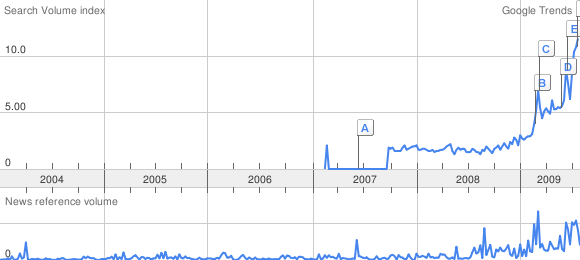
Sorry for the attention grabbing title, but remember how we all celebrated when augmented reality passed virtual reality on Google trends, showing an exponential growth rate?

Well, it sure looked promising back last September, but since then, the interest in AR has stopped increasing, at least when measured is search volumes and news references

The current trend is even more obvious when compare with Foursquare (in red in the graph below), which really does show exponential growth:


so, what’s going on? there are a couple of possible explanations:
(a) Augmented reality has peaked. I can’t really believe that’s the case.
(b) Google trends was never an adequate tool to measure the popularity of augmented reality. Other measures, such as investments, acquisitions and actual downloads are much better indicators. All of those show positive trends.
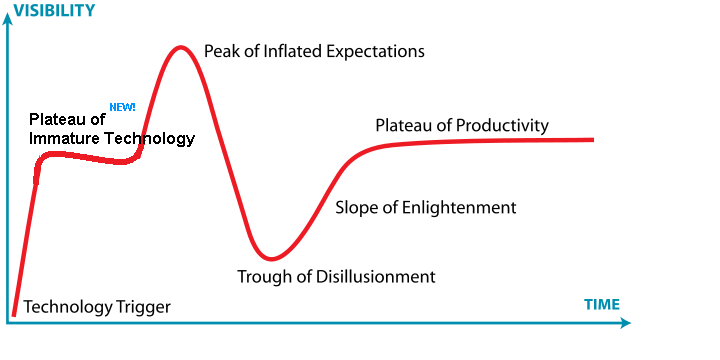
(c) We have entered a new, uncharted area in Gartner’s hype cycle, one that I call the Plateau of immature technology. Simply put, the iPhone is not the optimal AR device, and it’s not even the best currently out there. However, most of us limit ourselves to developing AR applications on the iPhone (or even worse, in Flash), and thus the solution space is really limited. We see the same ideas rehashed time after time (though, some pleasant surprises do happen), and people loose interest. The trend line seems pretty constant (for now) because there are still some users who discover AR for the first time.

If you’ll ask me, augmented reality is not dying, but stalling, waiting for a breakthrough either technological or conceptual that will bring new type of applications to the market (much like Foursquare was for location based services). Would it come for one of the incumbents companies, a giant like Google, or maybe a stealthy startup? only time will tell.

Augmented Rave

Who knew augmented reality markers were the new glowstick? Psychedelic jellyfish, oh my!