Augmented Reality Comes To World of Warcraft

Okay, probably most of you have read the title and said, so what.  World of Warcraft is a game, and definitely not reality.  Though don’t tell that to the 11.5 million players worldwide.

These “boss-kill” videos are common for the high-end guilds in WoW.  They use the videos as a recruiting tool for good players.  If you think WoW is just a marriage killing RPG then you’re wrong.  At the bleeding edge of the game, guilds compete to be the first at completing new content – i.e. boss-mobs.  These combats are intricate battles of coordination between twenty-five gamers using a host of dedicated UI mods and voice-chat programs to defeat the game.  The top guilds are rewarded with sponsorships and top guildleaders translate their leadership into real jobs (a prominant Everquest guild leader got a job with Blizzard because of his exploits.)  World of Warcraft is, in otherwords, a competitive sport.

So that’s the context of the video.  The important augmented reality aspect comes around the minute and a half mark in the form of six colored discs on the virtual ground.  The purpose of the colored discs is to show certain players exactly where to stand in the game.  This is akin to wide receivers running correct routes so the quarterback can throw them the ball.

Most likely, a program like this will eventually be banned from use because it will trivialize battles and give guilds that use it an advantage over others.  Just like any sport, a level playing field is important to keep top competitors interested.

World of Warcraft’s basis in virtual reality makes inclusion of “augmented” reality easy to pull off.  The computer already has a complete knowledge of the world (because it has to draw it) and the screen provides the augmented graphics on the virtual world.

What other sports or competition could benefit from using augmented reality in this form?  Could marching band competitions use the local spatial awareness of AR to tighten their formations?  Or dance groups?  Projection based AR could provide a rapid trainer for coordinating large groups.

But it’s going to be a long time before augmented reality gets banned as an unfair advantage in a sport or competition.

Holographic Augmented Reality Concept

I wish the real products were as cool as the concepts.  In due time…

Eye-Tracking Will Be The New Click-Throughs

Part of the Internet economy is built upon the “click-through” or CTR (Click Through Rate.)  The CTR attempts to measure customer interest in a particular product.  If a person finds the banner ad interesting enough, they will select it and be sent to that site, hopefully to purchase a product (or Conversion Rate.)  Thus the effect of the advertising can be measured and billed.

Even the layout of a site can affect the conversion rate.  Or in the case of Bing, Microsoft’s new search engine, the color blue can be worth $80 million in additional usage.  Website optimization rearranges the layout to achieve fung shui for dollars.  What is measured can be improved.

These products, like Google’s search engine, are worth more than just the product itself.  And they get first crack at the wealth of information flowing through their servers.  Using the misspelled words on Google search, they created the most robust spell-checker on the planet, in every conceivable language.

Using the information of what you click, they can run experiments to see what works best.  Collaborative filtering makes recommendations to users based on what other users like.  The data exhaust of websites can be as valuable as the product itself.

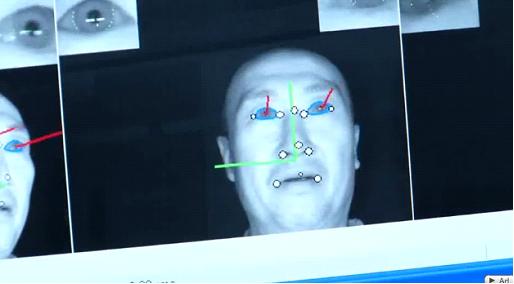
As augmented reality products use eye-tracking to achieve a realistic virtual overlay like in the recent GM augmented windshield, they are getting more information than just how to align the graphics.  Eye-tracking adds a new dimension to the data exhaust.  As any professional poker player will tell you, the eyes are the window to the soul, and to the tell.  Someone holding pocket kings might look down at their chips the moment they see their cards in anticipation of seeing a bigger pile later.  Players wear glasses for a reason.  The eyes can give away important information.

Studies on select groups of people using eye-tracking have given broad generalizations (read the before-mentioned link for more details):

1.Headlines draw eyes before pictures.

2. People scan the first couple words of a headline.

3. People scan the left side of a list of headlines.

4. Your headline must grab attention in less than 1 second.

5. Smaller type promotes closer reading.

6. Navigation at the top of the page works best.

7. Short paragraphs encourage reading.

8. Introductory paragraphs enjoy high readership.

9. Ad placement in the top and left positions works best.

10. People notice ads placed close to popular content.

11. People read text ads more than graphic ads.

12. Multimedia works better than text for unfamiliar or conceptual information.

Imagine what can be learned when the eye-tracking is always on and always sending data back to the home servers.  Contextual filtering will “pigeon-hole” you into a type of viewer and give you a website more suited to your style of reading.  Web design will customize based on your changing eye sight.  Older viewers that linger over the words will get larger fonts so reading isn’t so strained.  Colorful pictures will attract younger viewers so advertisements will be changed to align with them.

And that GM Augmented Windshield?  If their sensors can identify advertising along the side of the road in the form of signs and billboards, then can they collect the data on what works and what doesn’t and sell that to ad agencies.

Like I said, the data exhaust can be more valuable than the data itself.  And eye-tracking will prove to be more valuable because its an unconscious reaction.  Just be careful where you’re looking.

8 Fun Ways to Use the GM Augmented Reality Windshield

You’ve probably already seen the video below about GM’s initiative to put an augmented reality HUD on future windshields because its been posted on many sites.  The product, as explained, would improve safety in limited vision situations and create useful information for the viewer.

These are noble goals.  But why not have a little fun with the system, too.

1) Relieve rush hour stress with lasers that shoot that annoying “lane switching” guy.

2) Read your tweets on the move (and let voice recognition post your tweets.)

3) Add Unicorns and Rainbows to dreary city streets using a Cornify like add-on.

4) Create a game out of driving safely by checking your distance to next vehicle (okay, this one is noble too, sue me.)

5) Create stats on annoying things like how many stop signs you’ve passed.

6) Play SlugBug with your car.

7) Keep you from running over cute bunnies (your kids will love you.)

8) Make every street look like downtown Tokyo.

Augmented Reality at GDC2010

The video gives a good rundown of augmented reality at GDC2010.  I don’t have anything to add that Ori didn’t already say earlier this week on Live from GDC.

iKat Tickles My Cute Reflex

Okay, I get it.  A cute little kitten dancing across my keyboard (or other appropriate flat space.)  I’m a sucker for augmented pets.  I want one.

But why just a cat?

Come on, folks.  Can’t we dig a little deeper into the black sticky vat of emotions?

Why can’t we have a pet Banker to poke and kick and make it beg for money before we flick it off the desk into the trashcan?  Or a little Mahmoud Ahmadinejad to march around the table and then catapult into oblivion from my spoon?

Why must we tickle my cute reflex?  I have darker, baser needs that must be sated.

Until then, I’ll have an iKat. (meow)

The Augmented How-To Guide

While the narrator voice harkens back to old 50s ‘Technologies of the Future’ videos, the actual content IS actually from the future.  As much as I’d love to have this technology in my Toyota plant, I just can’t see making the ‘how-to’ videos for simple tasks as they suggest.  This kind of augmented efficiency improvement activity is only suited for highly complex tasks that are performed regularly by amateurs.

So I think the Maker culture would find better use of the technology when it actually becomes available to the masses.  Or it could work as a maintenance guide for short-run products that don’t have a large repair station base.  This summer I had to replace a pulley belt on a 70 inch zero-turn mower and the explanation sheet left a lot of steps out.  It took four neighbors to figure it out.

Here’s the description from VVT (Finland):

Customer specific and individualised products, small batch sizes, as well as increasing product complexity set higher demands for assembly work. Augmented Assembly is a research project at VTT, where AR technology is applied to increase assembly efficiency. In augmenting assembly work, the assembly worker is guided by virtual objects of components and assembly tools, and visual assembly instructions. The worker sees the augmented view through light weight head mounted devices (e.g. data glasses),and sensors provide feedback from the performed operations.

What Lola Wants…Lola Gets…

…and Lola gets a tons of augmented animations straight from the pages of the book directly to your webcam.

This unique picture book for children uses original torn-paper illustrations to tell the fun-filled story of the glamorous Lola the Leopard, who is incredibly vain, and her friend Monty the Meerkat, whose clumsy antics don’t add up to the purrrrrfection Lola is looking for. This book features an amazing bonus feature: Book, Webcam, Action! Just hold the last page of the book up to a web-cam and you’ll see Lola and Monty burst vibrantly to life in full 3D animation, accompanied by music! These are the first books to use augmented reality technology for very young children. “What Lola Wants, Lola Gets!” teaches children about different aspects of growing up in an amusing way that they can relate to.

While using the AR portion of the book sticks you to your computer when you might normally be reading the book to your kids in bed, it’s still a fun way to read a kids book.  I suspect we’ll be seeing a lot more of these markerless book products in the near future as publishers, desperate for revenue, latch onto the “next big thing.”

The augmented reality kids book “What Lola Wants…Lola Gets” comes out on April 1st by Scribblers, a division of Book House.

Invisible Synthesizer

Gesture based computing will open the doors for other creative endeavors. Not sure if this is a concept or the real deal, but who cares, I was entertained by this invisible (augmented reality) synthesizer for ninety seconds.

Playing music with guitars will seem primitive when interpretive dance becomes conceptual music.

Dell Tablet Mini 5 For Augmented Reality

While the Apple iPad Tablet announcement last month was disappointing for augmented reality developers and enthusiasts, the details about the upcoming Dell Tablet will make you salivate.

The Mini 5 will have a five inch touchscreen with both front and user facing cameras allowing full augmented reality capabilities.  WiFi and 3G connectivity allow enough bandwidth and the 1.0 GHz Snapdragon Qualcomm processor will give the Mini 5 the juice it needs to power resource-expensive AR apps.  It’ll run the latest version of the Android OS which gives it AR credentials right away since there are many apps already made for that system.

The price plan will affect the market that it’s trying to fill, though Dell says they will price it “competitively”.  But I don’t think I could have asked for better features from a tablet for augmented reality.  The weight of the device might impact AR since holding it up will be harder than a smartphone and since it’s a touchscreen, will you want to hold it with one hand and navigate with the other?  I hope some AR developers can incorporate voice commands into their games and products.

And while the screen might be too small in this version, they have eluded to a suite of tablet products so maybe a larger iPad sized version might come out in the future.  Personally, I already have a free smartphone from work, so a tablet that does different things on a bigger screen would be appealing to me.

Will this be a killer device for AR?  Probably not.  But it’ll give developers a bigger landscape to play on and increase the number of AR devices on the market.  The front facing camera certainly makes is a no-brainer for video conferencing.  Just add some facial recognition and you can talk to your kids while out on the road with bunny ears attached to your head.

[Via Wired]