Yahoo! and augmented reality leader Total Immersion have come up with some nifty ways to bring consumers into the action at the world’s largest winter sporting event. Yahoo!’s “Fancouver” exhibit enables passers-by to insert themselves into the festivities in a host of guises. Kicking off yesterday, Feb. 12, Fancouver features an entertaining and versatile digital out-of-home display, with dual windows that use augmented reality (AR) face tracking and tracking to a brochure, respectively, to give fans a distinctly different view of the proceedings.
Peter Meier, the CTO of Metaio, will also be giving a speech on Wednesday at 4pm within the session: “Mobile Innovation — A Vision of 2020.” This session will: “take a visionary look into the services and applications that mobile communication will provide in 10 years time and the impact they will have on the way we live and communicate in 2020. The latter half of this session will look at Augmented Reality.”
Thanks Jan from Augmented Blog for the update. He promises some exciting releases and a movie after MWC2010 has concluded.
And once again, we won’t be able to attend – so if you’re there – keep us updated about your experience.
Next week, February 15-18th, will be the Mobile World Congress in Barcelona. There will be a variety of AR related events during the MWC.
AR Showcase
Christine Perey has organized an AR Showcase on Wednesday, February 17th from 5:00-7:00, so AR companies can demonstrate their services and products to customers. Designers will also have a chance to compare and contrast their products versus the competition. The following companies have confirmed their attendance:
You can find the Showcase in the northeast corner of the courtyard. Announcements for the AR showcase can be tweeted to #arshow (changed for length.)
The Mobile AR Summit is an invitation only event. If you’re interested in joining, please contact Christine Perey at cperey@perey.com. More information can be found here.
Mobile Premier Award in Innovation
Monday, 15.2., 2010 15:00 to 20:00
Petit Palau of Palau de la Musica
Mobilizy is with Wikitude one of the 20 finalists of the “Mobile Premier Award in Innovation”. http://www.mobilepremierawards.com/
Martin Lechner, CTO Mobilizy, will present.
AR Summit
Wednesday, 17.2. 13:00 to 19:00
Location: to be announced.
Mobilizy CTO Martin Lechner presents a position paper “ARML an Augmented Reality Standard”. ARML is currently being reviewed by W3C (World Wide Web Consortium). At 17:00 there will be a Wikitude Showcase presentation.
We won’t be able to attend – so if you’re there – keep us updated about your experience.
Well, the Japanese have tamed the virtual makeup down. Created for cosmetic giant Shiseido by Fujitsu, the following application can be found in kiosks across Tokyo:
And, if you are not lucky enough to live in East Asia, Walmart and the British drugstore chain Boots are piloting the following kiosk by EZFace. Unfortunately, it works on a static image and doesn’t augmented live video feed, so it’s not really AR.
Sensor systems like cameras, markers, RFID, QR codes (and more) are usually done as single methods to align our augments. One challenge for a ubiquitous computing enviroment will be meshing together the various available sensors so computers have a seemless understanding of the world.
This video from the University of Munich shows us how a multi-sensor system works. It appears to be from 2008 (or at least the linked paper is.) Here’s the description on the project:
TUM-FAR 2008: Dynamic fusion of several sensors (Gyro, UWB Ubisens, flat marker, ART). A user walks down a hallway and enters a room seeing augmentations different augmentations as he walks on: a sign at the door and a sheep on a table.
In the process, he is tracked by different devices, some planted in the environment (UWB, ART, paper marker), and some carried along with a mobile camera pack (gyro, UWB marker, ART marker). Our Ubitrack system automatically switches between different fusion modes depending on which sensors are currently delivering valid data. In consequence, the stability of the augmentations varies a lot: when high-precision ART-based optical tracking is not available lost (outside ART tracking range, or ART marker covered by a bag), the sheep moves off the table. As soon as ART is back, the sheep is back in its original place on the table.
Note that the user does not have to reconfigure the fusion setup at any point in time. An independent Ubitrack client continuously watches the current position of the user and the associates it with the known range of individual trackers, reconfiguring the fusion arrangements on the fly while the user moves about.
The project brings up an interesting question. Is anyone working with multi-sensor systems? We know we’ll need a mix of GPS and local image recognition and markers to achieve our goals, but is anyone working on this complex problem for a real product? We’ve seen good image recognition with Google Goggles or SREngine, and GPS/accelerometer based AR is popular, but I’d like to see an app use both to achieve their aims.
If you’re working on a multi-sensor project. We’d love to hear about it at Games Alfresco.
In Switzerland you can play Pong. Yeah, I know, you can play Pong for about 30 years all around the world, but you could never play it like this – outside, with your legs serving as paddles.
It’s nothing new either – you could have rent the setup for the game for at least a couple of years. The company behind it writes:
The setting is very simple: a reflector on each foot is the only physical tool to interact with Sportpong. The interface is integrated in the field which is projected on the floor. The players control the game with their feet, nothing else. This control is intuitive, naturalistic and very direct.
I really, really, can’t wait to try it out. Last year I had a session of Atari Pong (the first in twenty years) and enjoyed it immensely. This looks even better. Would be great having it on ARE or ISMAR.
More details on sportpong.ch via SwissMiss.
The time has come for another fun-packed linkfest.
But before we begin, a special message to those of you who like beer as much as AR, and live in the vicinity of Munich. Toby of augmented.org is inviting you to the first Munich AR regulars’ table. You can find more details here, and don’t forget to take pictures. Feel free to tell me about your own AR event/meetup!
And now, for the links:
Whimsical infographics on GigaOM portraying mobile AR application that are going to change the world.
ReadWriteWeb asks whether AR should be open or closed, and the answer is not that clear when comparing Layar and acrossair, each advocating a different practice.
Did you know that Yahoo filed a patent on geo-located social AR? How Apple of them.
CNBC interviews the guys from QderoPateo we mentioned last week – they aim to build a custom AR device and software, would be interesting to see how successful they’ll be.
There were a couple of other interesting things happening this week, don’t you worry, I’ll have a dedicated post about them in the very near future. In the meantime, this week’s video comes to us via @chrisgrayson. It’s very cool, but unfortunately, I don’t understand how it was done. Yes, ARToolKit was involved, but how was the robot augmented to fire rockets? What provided the distance readings? If any of you read Japanese and can shed light on those question – please do so in the comments:
The biggest news about the movie Avatar has been the 3D experience and the way its blown the doors off the previous records. The movie has garnered huge success because it pushed the boundaries of technology and told an interesting story.
I loved the movie and the way 3D helped give more perspective to the enviroment. My own Star Trek loving mother didn’t even realize the Na’vi were CGI. She thought they were people in blue suits (really… I’m not joking.) And though storytelling will become important to later advanced augmented reality applications, it’s not what I wanted to point out.
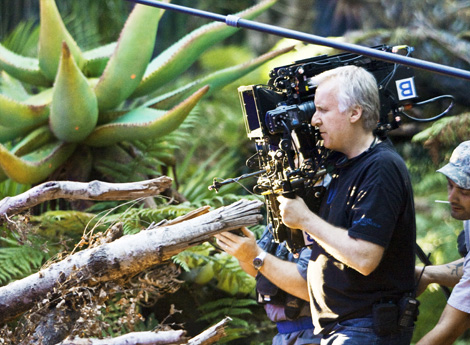
James Cameron is part art-dude and part tech-geek. He waited for years for the technology to ripen enough to do the movie the way he wanted. One of the innovations that he created for the movie was the Fusion camera for the live-action sequences. Normally, scenes are filmed before a green screen and then the CGI is added afterwards. The actors play a game of make-believe and the director has to guess at how the enviroment will unfold around them. CGI movies tend view flatly because the emotions are added later by the special effects guys and not the actors on the scene. Cameron has changed all that.
The Fusion camera system is an augmented reality viewport into the CGI world. When Cameron was filming the actors, he was able to direct them and see the results. When he looks through his camera, he can see them interacting with the world Pandora as the nine foot Na’vi and help them tell the story. The camera itself wasn’t even a real camera in the sense that it filmed the action. The camera allowed Cameron to see the action being recorded by multiple sensors and cameras. Once the action was recorded, he could go back and reshoot the action from a different perspective, even with the actors gone.
Facial expression was another hurdle they had to jump to make the movie work. So they added little cameras hanging on people’s heads to capture their range of facial expressions and then tweaked algorithms to get them to react correctly. Even now we can pull off this trick.
Together these systems are similar to an immersive augmented reality world. While we don’t have the HMDs, complete camera access and processing power to pull off the world of Pandora now, time and continued improvement will make lesser versions possible.
If you look at the Fusion camera system, the camera is essentially the HMD display, albeit a large and bulky one. Multiple cameras, RFIDs and tracking markers help the computer understand the world, and complex and powerful computers put all the pieces together. I can only imagine that this system could be turned into a mind-blowing game in an empty warehouse with the proper HMDs.
Essentially, the movie Avatar teaches us that augmented reality has sky-high practical possibilities. All the components of his Fusion system can be ported to the commercial world (not now, but in three or four years) and used to make complex and believable environments overlaid our own world.
In the future, you too can be a nine-foot tall blue Na’vi and you won’t even have to have your soul sucked through a fiber-optic tree.
Total Immersion leads the augmented reality industry in total projects (around 125 last year and they’re expecting over 250 in 2010.) They’ve successfully created world-wide campaigns like Coke Zero and the Avatar i-Tag game line. So when they talk about augmented reality, I want to make sure I’m taking notes. Iriny Kuznetsova from 2Nova interviewed Nicolas Bapst about the company and their current activities. The interview was short, but had a few interesting insights.
Total Immersion has done work for the military in creating augmented reality solutions that put simulated objects on the battlefield. This is a much cheaper alternative to war-gaming with real equipment. Hopefully this encourages the military to fund more see-through AR HMDs.
Total Immersion expects that AR mobile marketing will be the new trend in the coming year and shows off a brief demonstration. They’re converting their PC software to mobile to take advantage of the smartphone growth. I found Nicolas’ observation about how augmented reality marketing applications give you direct access to your customers interesting. By moving people from static newspapers to the computer (and especially the smartphone), then they can find out exactly who is interested in their product and then leverage social media to spread the word. Nicolas explains they doubled time on websites by adding augmented reality content. I’m curious if this increase will sustain as the novelty of augmented reality wears off.
Nothing game breaking here, but worth a few minutes if you’re not familiar with the company.






 Games Alfresco