California-Governor-Arnold -Schwarzenegger and German-Chancellor-Angela-Merkel jointly holding a Lego-digital box-by-Metaio.
In the back, a mirror screen featuring an augmented version of California-Governor-Arnold-Schwarzenegger and German-Chancellor-Angela-Merkel holding the Lego-digital-box-by-Metaio, with an exploded view of the assembled Lego toy.
This must have been the highest concentration of top-rank political figures in a single augmented reality scene – ever to be captured on (digital) film.
I have covered the Digial Lego Box when it was fresh news – now see it in video (in German) on the Cebit site.
Next political AR picture challenge:
capture Obama holding hands with Putin while watching an augmented view of a peaceful Afghanistan.
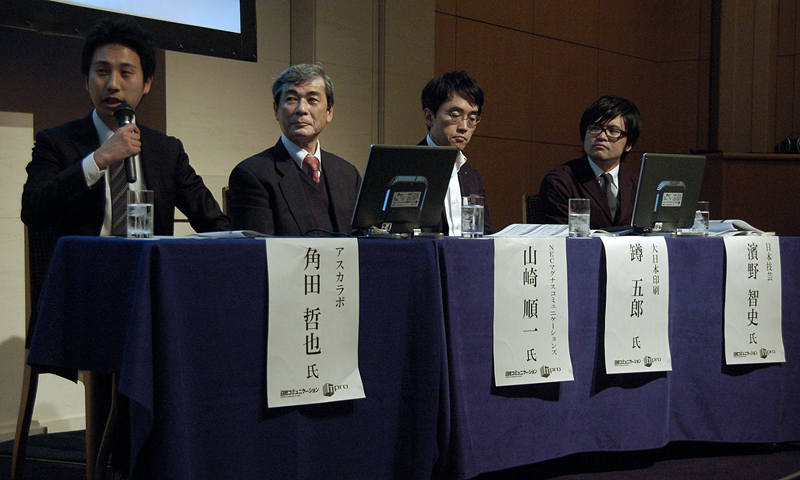
Predicted Mr. Yamazaki during this week’s Augmented Reality panel at the IT Business Pro conference in Tokyo.
The panelists were (from left):
Tsunoda Tetsuya from AR Lab Asuka – about content production, NEC’s Yamasaki Zyuniti MAGUNASUKOMYUNIKESHONZU about application development for mobile phones, AR DNP (DNP) Goro Nomotai, Mr. Hamano Satoshi of Japan about application development, and panel Chair Takebe Keniti from Nikkei Communications about the theory of media arts
The panel chair Takebe started with an introduction to the advancements in AR technology.
He continued with examples of applications possible Today: (1) in construction of health care, (2) navigate catalogs, and, (3) communication, social understanding and relationship building using “social AR”
The panel discussion revolved around the business challenges and expectations from this new technology and highlighted the important roles of GPS and mobile phones in its future.
Japanese applications using AR such as the Sekai Camera were brought as current examples.
The panel went on a tangent and mused about an AR scenario that could take place in the very panel discussion they were all part of.
What if we used face recognition software to overlay text on a screen in front of the panel members, that would reveal to us relevant information about individuals in the audience?
That thought triggered a concern about the implications of AR on social ethics, which evolved into a full blown discussions about the issues surrounding AR: low public awareness, hardware complexity, software scalability, security, etc.
The undisputed climax arrived when Mr. Yamakazi summarized the future of ARwith his prediction “I Think the Graphics of a Punch!”
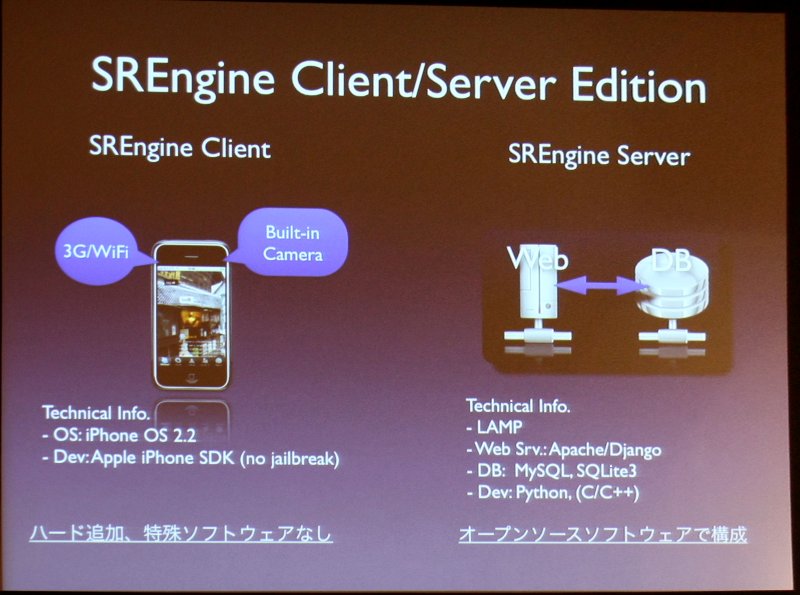
Scene Recognition Engine (SR Engine) demonstrates its ability to recognize buildings, pull relevant information, and display it live – on an iPhone. And it works outdoors – alfresco.
How does it work?
(loose translation from the creator’s speech in Japanese):
Stores in the city are stored in a database and mapped and tagged with information from brochures and videos. Based on the “scene” caught by the Camera, the app pulls information from its database and tags the actual image, the AR-free sensor networks. It uses GPS, angle variation and image matching, to recognize the targets.
So, I guess it only works when you observe the target from a certain perspective.
Why develop it for the iPhone?
IPhone’s CPU is [not] bad, folks like it…
Who’s behind it?
According to the blog it’s the man with the big name:





 Games Alfresco