Robert Rice Speaks At MOMA

Robert Rice, the CEO of Neogence Enterprises and blogger of augmented reality on Curious Raven, spoke back in June at Mobile Monday.  His speech targets the intermediate developer of augmented reality.  If you’re new to the technology, most of this speech will go over your head. 

The video is long, but if you’re serious about augmented reality and the future of mobile, the speech hits major points about the industry.  And at 40 minutes, I’d give it a good five minute buffer if you’re going to watch the whole thing.

“Mobile is dead,” said Robert to begin his speech.  He goes on to explain it should be brought back to life in a different format.  Reincarnated, if you will.  The point-to-point communication that we use right now will need transform into an immersive, predictive, meta-enviroment and can’t just be another way to access the internet. 

Robert briefly explains the history of communications and tells us that if we do augmented reality correctly, it’ll join the pantheon.  If we can remove the excess hardware of keyboards and screens in our mobile devices and convert to sunglasses, then the computer can become a buckle or a watch, conspicuous computing.  We need to get away from the 2D mindset of flat screens and create 3D spaces where we can throw a YouTube video to another person through our AR enviroment, or send an SMS as a paper-airplane. 

Augmented reality needs more than graphics over video, Robert goes on to explain.  Should move past being even interactive and more dynamic and meta.  It should answer the who, what, where, when, why and how.  Computers have been vague points of demographic data because multiple people can use them, but mobile is an individual thing which allows us to break away from aggregate statistics and start answering questions for individuals. 

Robert goes on to talk about venture capital, which he believes doesn’t get AR yet, and smart cities, and give suggestions to developers to keep the tagging of the world in mind, so we don’t have to go back and retag later.

Overall, I have to say I enjoyed the speech, though I was hoping Robert would get into specifics about Neogence Enterprises and their recent Mirascape announcement.  And having spoken to him at length at ISMAR09 about the details of augmented reality, I thought he might elaborate on his anecdotes about furries and micro transactions.  But maybe those weren’t appropriate for MOMA, anyway.

(edit note: while this was originally filmed back in June and even covered on GA by Ori, it’s still very relevent.  Enjoy.)

Weekly Linkfest

Anyone is coming to WARM 2010?
The augmented reality society is coming out of its winter hibernation, and we have quite a few links to AR related stories this week:

And this week’s video is the perfect example of AR being misused. A couple of young Dutch guys calling themselves “Teletekst Is Dood” (teletext is dead) assisted by the Layar browser have terrorized non-suspecting citizens (and their neighbors) whose only fault was to tweet about banal things. Yeah, I guess you can call it art:

[Vimeo=8946012]

Have a nice week (but be careful about who is reading your boring tweets)!

Magic Vision Lab will Melt, Distort, X-Ray and then Augment your Reality

Chris Sandor, a veteran AR researcher, who worked with some of the most distinguished AR labs and researchers in the world such as Graz University, Columbia University, TU Munich, and Canon Research – is now is the Director of the Magic Vision Lab at the University of South Australia.
Chris and team have recently revamped the lab’s website which is a good opportunity to revisit some of their work previously covered during ISMAR.
First a word on the lab’s name.
In his “Sermon on the flatlands“, augmented reality prophet Bruce Sterling cautioned the AR community to stay away from terms like “magic”: “Magic is cheezy and deceitful. Practicing a leisure domain is a problem” he argued.
Chris brings to his defense a no lesser sci-fi luminary, Arthur C. Clarke, which famously coined the third law: “Any sufficently advanced technology is indistinguishable from magic”.
***
What do you think about the usage of the term “Magic” in conjunction with AR?
***
Now to substance in the revamped site:
Humans perceive their environment primarily through vision. Our goal is to enhance human vision with computer-generated graphics in order to amplify human intelligence on a world-wide scale. Our vision is shared by a large and growing community that is investigatingAugmented Reality.
The lab focuses on 2 key areas:

Mobile Augmented Reality Visualizations (melting, distorting, xray)

The following X-ray Vision is one of the more inspiring videos in AR
The next video depicts a technique called “melt vision” which is useful when a user wants to see points of interest hidden from view (occluded) and could also double as a simulation of a building demolition:)

Vodpod videos no longer available.

***
The second area of the lab’s focus is dubbed:

Visuo-haptic augmented reality systems

In laymen’s terms, it’s about combining visual and touch.
In this video a user, wearing a head-worn display, can see the virtual car and feel the car with his right hand through a haptic device called Phantom.

Vodpod videos no longer available.

This technology has huge potential in training newbies and experienced professionals in many fields such as healthcare, design, manufacturing, and many more.

To wrap up this AR Lab review –

Here is a classic: AR Weather, received our tongue-in-cheek award of the “most down-under demo” during ISMAR 2008. All I have to show is this image that depicts an AR application that overlays snow on a sunny day in Australia.

If you would like to showcase your work in augmented reality labs – let us know!

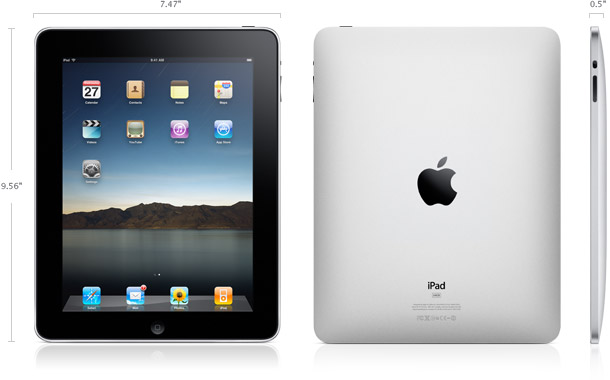
Apple’s iPad Camera Fail

Unless you’ve been living in a box today, you know that Apple finally unveiled the tablet iPad today. The biggest surprise about the announcement was the lack of a camera on the lap sized PC. No camera, really? If you don’t believe it, check the official spec page.

Besides the implications for augmented reality, which I’ll get to in a moment, the iPad not having a camera is a giant fail.  I actually expected the iPad to have two cameras.  One forward-looking so the iPad could function as a giant Polaroid and the other user-facing so videos could be recorded.  We could forgive eliminating one of them, probably the forward-looking one since its so big, but not having the user-facing camera is inexcusable.

The series of tubes we call the Internet has moved beyond simple text.  People want to record and upload videos straight to YouTube without having to yank out their dust-covered hand held or use Skype to call their friends while they’re watching the game.

The Apple iPad not having even one camera is like hooking up satellite without DVR.  Sure you can do it, but why?

Of course, I’m being overly melodramatic here.

The real point to the iPad is competition for the Kindle, eReader and the Nook.  Apple wants to revolutionize the way we read magazines, books and newspapers.  Functionality for augmented reality isn’t even an afterthought.  How many people are using their camera lying in bed reading an interactive book?

And is this a major setback for augmented reality?  Not really.  A giant-sized magic lens would add a fun new canvas to play with, but really wouldn’t be a game changer.  Additionally, Apple isn’t expecting the tablet market to come even close to the smartphone market in sales.

So in the end, the iPad is a fail for augmented reality, but will probably give Jeff Bezos nightmares for months as he wonders how he’s going to compete against a Pentium 286 when he’s selling a Commodore 64.

And maybe, just maybe, Steve Jobs is still working on a see-through AR-enabled HMD.  Then I’d say, all is forgiven Stevie, I’m coming home to Apple.

How to Produce Augmented Reality Applications: Share Your Experience and Help Nurture a Healthy Industry

Marshal Kirkpatrick, the lead blogger for Read Write Web – one of the first tech blogs to dive into the fascinating field of augmented reality  – is working on a research report about the use of AR for marketing.
In order to generate data for the report  that best reflects the market reality – he has put together a survey.
In fact, he prepared two surveys: one for webcam-based AR applications, and a second for mobile AR applications.
Here’s Marshal’s message:
We hope that people in the industry will be
interested in anonymously contributing their knowledge so we can all benefit from the aggregate results.   The intended respondents for these surveys are people who have built or have hired other people to build AR apps.  The intended readership of the results are people who are interested in hiring AR developers.  We hope this information will help more people feel comfortable hiring AR developers, that more information will be good for the AR economy and the people who want to be a part of it.   We’ll be sending the results out to everyone who participates, along with a discount code if you’d like to purchase the larger research report this will be a part of.   If you’ve got any questions you can email me at marshall@readwriteweb.com  Thanks for you time taking these surveys.
This is a most welcome collaboration between ReadWriteWeb and Gamesalfresco, and we intend to share the highlights of this initiative on this blog.
***
Expect a talk by Marshall about this initiative at this year’s most anticipated AR commercial Event – coincidentally titled the Augmented Reality Event, scheduled for Jun 2-3, 2010 in Santa Clara, California.

To access the surveys go to:

Webcam AR

Mobile AR

Spatial Computing Concept Video for Shopping

This summer, Phedhex, posted a concept video showcasing what augmented reality, or spatial computing, could do.  The video was well thought out and I enjoyed it.

In the second video, he uses hand gestures to show how we can use augmented reality to purchase furniture in our homes and verify it for decor and size.  The idea has been around with smartphone apps from Metaio, but Phedhex supersizes the idea and gives us a glimpse into an immersive version we’d see with a HMD.  The production value of the video makes me think Phedhex should be doing a regular series on AR because it shows a tangible business case for increased investment into the fledgling technology. 

Weekly Linkfest

Another week, another linkfest:

  • It all started with this funny look at augmented reality by the Gaurdian’s Charlie Brooker. Among other things Brooker imagines a world where unpleasant sights (such as poor people – his words, not mine) are transformed by AR goggles.
  • Futurismic developed that basic idea. In “Re-skinning the city – the dark side of augmented reality” they suggest that spam could become a ray of hope, as a medium through which (unpleasant) reality can still confront us in our utopian augmented world.
  • Finally, Toby of augmented.org explains why there are several other issues we should worry about before concerning ourselves with invisible homeless people. (thanks Thomas)
  • The first commercial AR event will be held in Santa Clara in early June. Unless, you count this other conference. The former is organized by Ori Inbar, Tish Shute and whurley (William Hurley). The latter is not. Your choice.
  • If you weren’t there, you may find the following recording of ARNY January meet up interesting (I can’t get ustream to work properly on my computer, so I can’t tell).
  • Some info about the intriguing Mirascape and a chance to become an alpha tester.
  • Financial Times “Reality Made Larger the Life” gives an overview on augmented reality.
  • Harry Potter. Augmented Reality Map. USA Today.
  • Dr Skully. Augmented Reality Fortune Teller.

We have a double feature for our weekly video. The next two clips bring AR to the big screen. The very big screen. First is Hungry Hungry Eat Head, an art installation commissioned by City of Edinburgh Council (more info, via Wooster Collective):

and next is another art installation called “A Someone Else’s Problem Field” commissioned for the Next Wave Festivals, which is mostly strange (more info):

That’s it, have a nice week!

Social Commons for the Physical World Platform

Tish Shute holds such great interviews for UgoTrade, that it should be considered a crime not to read them if you are an augmented reality fan or professional. Her last interview with Anselm Hook is especially interesting and engaging.

However, Tish’s pieces are usually quite long, and may be intimidating. In order to lure you into reading the whole interview with Hook, here are a few hand picked quotes:

Even things like Google Maps or mapping systems we think are so great are really just kind of almost an aspect of a hyper-local view. You actually don’t really care what is happening 10 blocks away or 100 blocks away. If you could satisfy those same interests and needs within a single block, one block away, you would probably be really happy. You really just want to satisfy needs and interests, find ways to contribute, or get yourself fed, or whatever it is you want. And AR seemed to be the playground to really explore the human condition.

There is a real risk of our augmented reality world being owned by interests which are not our own. There is a real question of when you hold up that AR goggle, what are you going to see? Are you going to see corporate advertising? Are you going to see your friends’ comments or criticisms? It is going to be an Iran or a democracy, right? It is unclear.

We, as a community, need to assert an ownership, kind of a commons, over how computers will translate what they see to information that we perceive.

As we move towards a physical internet where there’s no clicking and there’s no interface and the computer’s just telling you what it thinks you’re looking at, translating, you know, an image of a billboard to the name of the rock star who’s on that billboard, or translating the list of ingredients on a can of soup to the source outlets where it thinks that, those ingredients came from. When you have that kind of automated mediation, the question of trust definitely arises.

Search needs to be inverted, trust filters need to be built. We need to democratically own our data institutions. We don’t right now. That will be more of a concern, especially with AR.

Again, this is a very concentrated version of a most excellent interview. The ultimate augmented reality experience will be much different from today’s web. Instead of entering a search string and getting 10 results as possible matches, we will look at the world, and for each physical item we will get the first “I’m feeling lucky” result, as Google has determined for us.

If a new data provider finds it very challenging getting into the Google’s organic results these days, imagine how hard it would be for such a provider to win the first and only spot in tomorrow’s augmented search results. That’s assuming Google will keep playing fair and show results by how well they fit the search query (let’s just assume they are currently playing fair).

On the other hand, democratizing the outernet’s search engine may result with increased spam results. You may look at the Venus of Milo through your AR goggles, and get ads about prolonging your manhood. Wikipedia successfully fight spammers and hooligans. But, is there another Wikipedia like enterprise? Can the whole outernet be moderated by a limited number of industrious editors?

I don’t have an answer for any of those questions, but it seems to me that’s those are the most exciting and important problems we can try and tackle in the coming year. Tish advances the idea of a federated Google Wave-based infrastructure for AR. What do you think?

Real-Time 3D Modeling for Augmented Reality

I’m a big geek when it comes to the behind-the-scenes number crunching stuff that makes augmented reality happen. How it all works is a fascinating look at dynamic systems in concert. The two videos below show how on the fly modeling of objects can help create a fully interactive world with occlusion, shadows and other 3D illusions needed to created reality out of pixels.

The first comes from the Australian Center for Visual Technologies (ACVT) with a program called Jiim.  It allows in-situ modeling of the enviroment by picking up points and then allowing the user, in real-time, to draw in the world with those points as reference.   The resulting physics demonstration is quite impressive from throwing balls to killing moles.

The second video shows use of the MRToolKit to model a Chinese dragon figure in real-time and then interact with it.  The results aren’t as impressive as the Jimm ACVT video, but still, it’s nice to have options.

Having played around with a few AR systems like Metaio’s Unifeye, I can say that the programs in these videos look easier to interact with than what I’ve used before.  Instead of programming numbers and coordinate systems, the user can mouse click the world into existence.  Imagine if groups of people collectively worked on drawing in a city to create a general playground for augmented reality.  Just add some sweet HMDs and a SDK to create games and AR would be unleashed.

Augmented Reality, Newspapers’ Last Best Hope?

We all know the future looks quite bleak for newspapers and journals. Many publications have already fallen victims to the predatory internet with its free, easily accessible and real time reports. Some have speculated that newspapers must either over-specialize or abandon their offline presence in order to survive the coming decade.

However, there’s another option – forming a merger between an online and an offline presence, via augmented reality. We’ve already seen Esquire toying with such a concept, but now a daily newspaper in Switzerland has made a giant leap ahead.

Since this Wednesday, every page of the Swiss Blick newspaper can be scanned using Kooaba, an iPhone/Android application. Once scanned and identified, the user can see additional information about the articles or ads visible in the page, add them to her online library, and share with friends. Remember, this is not a single issue being augmented, but rather every issue from now on will have this extra layer of information.

Follow the link to see a video of Blick being augmented, but since that video can’t be embeded, here’s another one, showcasing Kooaba’s technology:

More information here.