Weekly Linkfest

Celebrating Ben Affleck’s 38th birthday, here’s this week’s linkfest:

Today’s video is of a project named “SMSlingshot” by the guys at VR/Urban (also check the link for its predecessor, the Spreadgun). As you can guess by its name, it’s a slingshot that throws short text messages at walls (aided by a powerful projector). The results are quite beautiful:

(via Beyond the Beyond)

That’s it, hope you enjoyed it, and see you at Ben’s party this evening.

Junaio 2010 Dev Contest Winner – archINFORM

I recently participated as a judge in the Junaio 2010 Dev Contest.  After a good debate, the panel of judges picked the winner — archINFORM.  The channel gives the user information about architectural structures in an AR view port.  Augmented reality fits the use of this channel because it’s an immediate need one might have while walking around, and sightseeing often involves picture taking so why not use your smartphone to learn more about those ancient buildings.

If you’re wanting to make in impact in Junaio, or with any AR app, try to consider why you’re using augmented reality in the first place.  archINFORM won because it was a natural extension of our everyday activities.  It added to the architectural database by making it visual.  Taking other popular applications and just linking them through Junaio, or other services, doesn’t lend itself to a useful product.

And I’m hoping Metaio decides to do another contest now that Glue is live.  I think the potential and creative applications could be quite interesting and I hope they give me a chance to judge again because I enjoyed the discussion with the other judges.

BlindType

I’m sure the implications for an air-typing interface are obvious.

Thanks @jelleprins for pointing this one out.

Logged In

I don’t much to say about the following video except that it’s named “Logged In” and I wish it was in English. On the other hand, it shows that AR can be an excellent tool for learning new languages. And I know it doesn’t meant to portray AR, but it sure looks like it:

[via Swiss Miss]

Augmenting TV

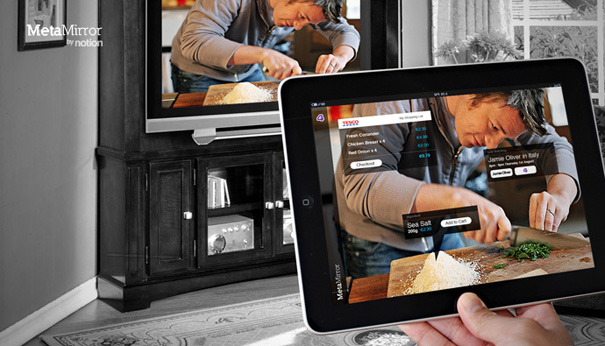
Recently two concept designs illustrating the use of augmented reality in order to enhance the plain old tv set, had come to my attention.
The first is a prototype from KDDI lab, presented at the NAB 2010 conference a couple of months ago. I couldn’t dig much information about it (here is some), though it seems to have the goal of personalizing advertisements in mind.

The other design is no where near reaching a prototype stage. Called the Meta-Mirror and imagined by Irish design studio Notion, it has less commercial agenda than the one by KDDI. It really strives to improve television. And with all the reality-tv shows out there, maybe augmented reality is the best way to do so. See more images of Meta-Mirror on Yanko Design.

Now Available on the App Store: SR Engine 2

My favorite independent augmented reality framework, Sein Kanemura’s SR Engine, has just reached the important version 2.0 milestone, freely available on the (Japanese) App Store. Moreover, an SDK was released, allowing developers to create their own image recognition based applications. Capable of identifying up to 150 images, one should be able to use SR Engine to create augmented reality applications for small galleries and venues.

As always, I’m pretty impressed with the UI design, fitting such a “futuristic” application. Mr. Kanemura seems to not only have excellent programming skills but a good eye for design.

Weekly Linkfest – The Justin Bieber Edition

This linkfest has nothing to do with Justin Bieber, and everything to do with augmented reality news bites from the last week. I’m just checking if the mere inclusion of Mr. Bieber in the title will generate more hits.

This week’s video is a promotion video for Sekai Camera. Tonchidot, the company behind this veteran AR browser recently got a $5M from Japan’s telecom giant KDDI (though some claim that KDDI actually bought Tonchidot). And if that’s not enough, Tonchidot announced the creation of social AR game. The future looks bright for those guys:

Have a great (and cool) week!

Invisible Sculpture

A little real-time camera trickery and some augmented reality, and wa-la…invisible cube.

A camera fixed on the concrete cube sculpture recognizes the presence of human faces within its scope. With a randomized choice it will focus on one of the bystanders and adjust its movement to his; tracking the eye movements of the viewer, a software computes the corresponding angle of view projecting onto the cube the very section of the space the sculpture is blocking from the viewers eye; thus making the cube appear transparent.
The video sculpture, Durchsehen, Exp. 01 (Augmented Perspective) overwrites the common notion of perspective and plays with the significance of perspective in an art historical perspective; the work of art evades the gaze of the viewer or rather: the two are equated. The gaze of the observer coincides with the object of observance in a piece that also draws a line to former strategies of dealing with vision and depiction: the renaissance praxis of “painting on glass”.
Through the real-time projection on the cube a 3dimensional depiction of 2dimensionality occurs; the catoptric turns dioptric. The framing plane of the conventional video image becomes fragmented as work and reality intertwine in an augmented perspective.

Learn more about it from the creators Daniel Franke and Markus Kison.

Becoming Cyborg – One Man’s Quest for a Good HMD

The great thing about technology these days is that anyone can get in on the action.  With a can-do DIY spirit, makers like Staffan Dryselius or Noah Zerkin (where have you been, Noah!), have been breaking new ground with their inventions.

Martin Magnusson, like Staffan, is trying to build a better HMD.  While he’s not as focused on the augmented reality portion as much as Staffan, he’s still trying to make a light-weight screen that provides continuous access to his information (like Manfred Macx from Accelerando by Charles Stross.)

To learn more about his project, I sat down with him for six questions:

Tom:  On your “Becoming Cyborb” blog, you go through great detail about the
technical details on your wearable computer project.  What is the end goal?
Or is this an ever evolving project?

Martin: It’s an ever evolving project towards the merger of man and machine. Hmm… that
sounds a bit pretentious. Look, I just want a decent text editor for note
taking. Paper doesn’t have copy/paste and undo (nor a legible font). The
iPhone’s screen and keyboard are puny. And my laptop has a weight problem. My
first goal is continuous access to Emacs and a keyboard.

Tom: Do you have ideas on how you might include augmented reality into
your project?

Martin: I would like to add a camera that tracks the fingers on your hands in front of
you. Perhaps paint colors or markers on the finger nails. A piece of software
would then translate finger movements into keystrokes. That way you’d always
have a keyboard without lugging a piece of plastic around.

Tom: What do you think of the other DIY projects out there, like Staffan’s?

Martin: I’ve talked to Staffan and find his work very interesting. I don’t know that
much about it yet, but he promised more information would appear on the Macxwear
webpage.

Tom: Why do you think commercial glasses makers have failed so far to
produce a good product?

Martin: Have they? I would love to get my hands on Myvu’s (MicroOptical’s) discontinued
products, like the CV-3. To venture a guess, they found the market too
small.

And perhaps companies don’t want to mass produce high-end head-mounted displays
until they’re completely stealth. However, just stroll down a street and look at
the outrageous sunglasses people gladly wear.

Tom: How do you plan to use your wearable computer on a daily basis?

Martin: I want to use it for displaying my todo list, writing notes, brainstorming,
etc. The basic idea is to augment my highly unreliable memory.

Tom: I see one of your favorite books is Accelerando by Charles Stross.
If you could, would you upload?

Martin: It’s on my todo list.

Martin is rigorously documenting his quest on his website Becoming Cyborg.  I’ve been impressed with his progress in a short amount of time.  Hopefully, he can keep up the pace.  I highly recommend going back and starting from the beginning on his blog.  He’s really done an excellent job in explaining step-by-step how he’s progressed and hopefully we’ll be hearing more from him in the future.

Metaio’s Markerless Shopping Experience with Seventeen.com

No over-the-shoulder backside check, but it’s better than staring at a catalog or webpage.

“This is the first truly instant online dressing room and as opposed to other augmented reality applications no markers or uploads needed,” said Noora Guldemond, head of sales & marketing for metaio. “We believe this application provides an enhanced interactive online shopping experience for the consumer.  We are very excited to be working with Hearst Magazines Digital Media on delivering this unique shopping tool.”