In Switzerland you can play Pong. Yeah, I know, you can play Pong for about 30 years all around the world, but you could never play it like this – outside, with your legs serving as paddles.
It’s nothing new either – you could have rent the setup for the game for at least a couple of years. The company behind it writes:
The setting is very simple: a reflector on each foot is the only physical tool to interact with Sportpong. The interface is integrated in the field which is projected on the floor. The players control the game with their feet, nothing else. This control is intuitive, naturalistic and very direct.
I really, really, can’t wait to try it out. Last year I had a session of Atari Pong (the first in twenty years) and enjoyed it immensely. This looks even better. Would be great having it on ARE or ISMAR.
More details on sportpong.ch via SwissMiss.
The time has come for another fun-packed linkfest.
But before we begin, a special message to those of you who like beer as much as AR, and live in the vicinity of Munich. Toby of augmented.org is inviting you to the first Munich AR regulars’ table. You can find more details here, and don’t forget to take pictures. Feel free to tell me about your own AR event/meetup!
And now, for the links:
Whimsical infographics on GigaOM portraying mobile AR application that are going to change the world.
ReadWriteWeb asks whether AR should be open or closed, and the answer is not that clear when comparing Layar and acrossair, each advocating a different practice.
Did you know that Yahoo filed a patent on geo-located social AR? How Apple of them.
CNBC interviews the guys from QderoPateo we mentioned last week – they aim to build a custom AR device and software, would be interesting to see how successful they’ll be.
There were a couple of other interesting things happening this week, don’t you worry, I’ll have a dedicated post about them in the very near future. In the meantime, this week’s video comes to us via @chrisgrayson. It’s very cool, but unfortunately, I don’t understand how it was done. Yes, ARToolKit was involved, but how was the robot augmented to fire rockets? What provided the distance readings? If any of you read Japanese and can shed light on those question – please do so in the comments:
The biggest news about the movie Avatar has been the 3D experience and the way its blown the doors off the previous records. The movie has garnered huge success because it pushed the boundaries of technology and told an interesting story.
I loved the movie and the way 3D helped give more perspective to the enviroment. My own Star Trek loving mother didn’t even realize the Na’vi were CGI. She thought they were people in blue suits (really… I’m not joking.) And though storytelling will become important to later advanced augmented reality applications, it’s not what I wanted to point out.
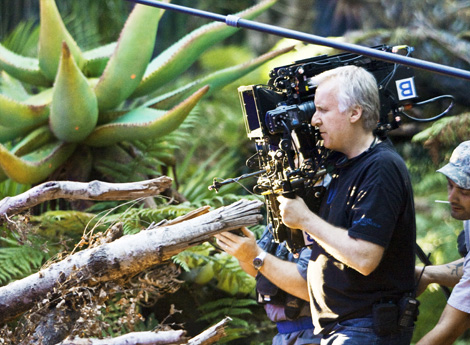
James Cameron is part art-dude and part tech-geek. He waited for years for the technology to ripen enough to do the movie the way he wanted. One of the innovations that he created for the movie was the Fusion camera for the live-action sequences. Normally, scenes are filmed before a green screen and then the CGI is added afterwards. The actors play a game of make-believe and the director has to guess at how the enviroment will unfold around them. CGI movies tend view flatly because the emotions are added later by the special effects guys and not the actors on the scene. Cameron has changed all that.
The Fusion camera system is an augmented reality viewport into the CGI world. When Cameron was filming the actors, he was able to direct them and see the results. When he looks through his camera, he can see them interacting with the world Pandora as the nine foot Na’vi and help them tell the story. The camera itself wasn’t even a real camera in the sense that it filmed the action. The camera allowed Cameron to see the action being recorded by multiple sensors and cameras. Once the action was recorded, he could go back and reshoot the action from a different perspective, even with the actors gone.
Facial expression was another hurdle they had to jump to make the movie work. So they added little cameras hanging on people’s heads to capture their range of facial expressions and then tweaked algorithms to get them to react correctly. Even now we can pull off this trick.
Together these systems are similar to an immersive augmented reality world. While we don’t have the HMDs, complete camera access and processing power to pull off the world of Pandora now, time and continued improvement will make lesser versions possible.
If you look at the Fusion camera system, the camera is essentially the HMD display, albeit a large and bulky one. Multiple cameras, RFIDs and tracking markers help the computer understand the world, and complex and powerful computers put all the pieces together. I can only imagine that this system could be turned into a mind-blowing game in an empty warehouse with the proper HMDs.
Essentially, the movie Avatar teaches us that augmented reality has sky-high practical possibilities. All the components of his Fusion system can be ported to the commercial world (not now, but in three or four years) and used to make complex and believable environments overlaid our own world.
In the future, you too can be a nine-foot tall blue Na’vi and you won’t even have to have your soul sucked through a fiber-optic tree.
Total Immersion leads the augmented reality industry in total projects (around 125 last year and they’re expecting over 250 in 2010.) They’ve successfully created world-wide campaigns like Coke Zero and the Avatar i-Tag game line. So when they talk about augmented reality, I want to make sure I’m taking notes. Iriny Kuznetsova from 2Nova interviewed Nicolas Bapst about the company and their current activities. The interview was short, but had a few interesting insights.
Total Immersion has done work for the military in creating augmented reality solutions that put simulated objects on the battlefield. This is a much cheaper alternative to war-gaming with real equipment. Hopefully this encourages the military to fund more see-through AR HMDs.
Total Immersion expects that AR mobile marketing will be the new trend in the coming year and shows off a brief demonstration. They’re converting their PC software to mobile to take advantage of the smartphone growth. I found Nicolas’ observation about how augmented reality marketing applications give you direct access to your customers interesting. By moving people from static newspapers to the computer (and especially the smartphone), then they can find out exactly who is interested in their product and then leverage social media to spread the word. Nicolas explains they doubled time on websites by adding augmented reality content. I’m curious if this increase will sustain as the novelty of augmented reality wears off.
Nothing game breaking here, but worth a few minutes if you’re not familiar with the company.
It’s been a while since we last visited one of my favorite AR application, Sein Kanemura’s SREngine, and my, how it has grown!
What started as an AR browser-like image recognition based project, has now been released as a “Point&Find” like application for the iPhone. Available for free on the Japanese App Store, Eigaru, powered by SREngine, enables to look at movie posters and see associated trailers and reviews:
Now correct me if I’m wrong (I don’t have an iPhone), it does look like Eigaru works by analyzing the video input, and I thought that the API does not expose such functionality. So, is Eigaru the first of its kind?
I really fancy this next iPhone app. It’s called iButterfly and it transforms the habit of collecting coupons into a fun little game. Created by Japan’s Mobile Art Lab, the app tasks its users with catching virtual butterflies , each representing one or more coupons. You can even share
“butterflies” with your friends via Bluetooth.
Though the technology is not overwhelming (GPS based), the overall execution looks great, see for yourself:
Robert Rice, the CEO of Neogence Enterprises and blogger of augmented reality on Curious Raven, spoke back in June at Mobile Monday. His speech targets the intermediate developer of augmented reality. If you’re new to the technology, most of this speech will go over your head.
The video is long, but if you’re serious about augmented reality and the future of mobile, the speech hits major points about the industry. And at 40 minutes, I’d give it a good five minute buffer if you’re going to watch the whole thing.
“Mobile is dead,” said Robert to begin his speech. He goes on to explain it should be brought back to life in a different format. Reincarnated, if you will. The point-to-point communication that we use right now will need transform into an immersive, predictive, meta-enviroment and can’t just be another way to access the internet.
Robert briefly explains the history of communications and tells us that if we do augmented reality correctly, it’ll join the pantheon. If we can remove the excess hardware of keyboards and screens in our mobile devices and convert to sunglasses, then the computer can become a buckle or a watch, conspicuous computing. We need to get away from the 2D mindset of flat screens and create 3D spaces where we can throw a YouTube video to another person through our AR enviroment, or send an SMS as a paper-airplane.
Augmented reality needs more than graphics over video, Robert goes on to explain. Should move past being even interactive and more dynamic and meta. It should answer the who, what, where, when, why and how. Computers have been vague points of demographic data because multiple people can use them, but mobile is an individual thing which allows us to break away from aggregate statistics and start answering questions for individuals.
Robert goes on to talk about venture capital, which he believes doesn’t get AR yet, and smart cities, and give suggestions to developers to keep the tagging of the world in mind, so we don’t have to go back and retag later.
Overall, I have to say I enjoyed the speech, though I was hoping Robert would get into specifics about Neogence Enterprises and their recent Mirascape announcement. And having spoken to him at length at ISMAR09 about the details of augmented reality, I thought he might elaborate on his anecdotes about furries and micro transactions. But maybe those weren’t appropriate for MOMA, anyway.
(edit note: while this was originally filmed back in June and even covered on GA by Ori, it’s still very relevent. Enjoy.)
Anyone is coming to WARM 2010?
The augmented reality society is coming out of its winter hibernation, and we have quite a few links to AR related stories this week:
QderoPateo are developing an AR dedicated device. GigaOM asks why (‘hich is a good reason to plug my “The Kindle Test” post)
BoingBoing featured a very strange artsy video about augmented dating.
Having problems getting your kids dressed in the morning? Brights&Stripes created a magic tee to help out.
And if you have a couple of hours to burn, ComputerWorld has a long, long review of AR.
And this week’s video is the perfect example of AR being misused. A couple of young Dutch guys calling themselves “Teletekst Is Dood” (teletext is dead) assisted by the Layar browser have terrorized non-suspecting citizens (and their neighbors) whose only fault was to tweet about banal things. Yeah, I guess you can call it art:
[Vimeo=8946012]
Have a nice week (but be careful about who is reading your boring tweets)!
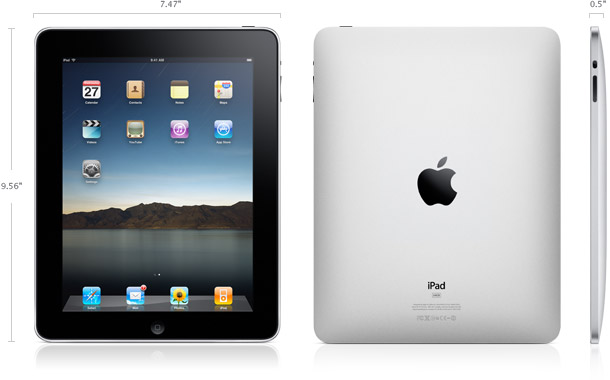
Unless you’ve been living in a box today, you know that Apple finally unveiled the tablet iPad today. The biggest surprise about the announcement was the lack of a camera on the lap sized PC. No camera, really? If you don’t believe it, check the official spec page.
Besides the implications for augmented reality, which I’ll get to in a moment, the iPad not having a camera is a giant fail. I actually expected the iPad to have two cameras. One forward-looking so the iPad could function as a giant Polaroid and the other user-facing so videos could be recorded. We could forgive eliminating one of them, probably the forward-looking one since its so big, but not having the user-facing camera is inexcusable.
The series of tubes we call the Internet has moved beyond simple text. People want to record and upload videos straight to YouTube without having to yank out their dust-covered hand held or use Skype to call their friends while they’re watching the game.
The Apple iPad not having even one camera is like hooking up satellite without DVR. Sure you can do it, but why?
Of course, I’m being overly melodramatic here.
The real point to the iPad is competition for the Kindle, eReader and the Nook. Apple wants to revolutionize the way we read magazines, books and newspapers. Functionality for augmented reality isn’t even an afterthought. How many people are using their camera lying in bed reading an interactive book?
And is this a major setback for augmented reality? Not really. A giant-sized magic lens would add a fun new canvas to play with, but really wouldn’t be a game changer. Additionally, Apple isn’t expecting the tablet market to come even close to the smartphone market in sales.
So in the end, the iPad is a fail for augmented reality, but will probably give Jeff Bezos nightmares for months as he wonders how he’s going to compete against a Pentium 286 when he’s selling a Commodore 64.
And maybe, just maybe, Steve Jobs is still working on a see-through AR-enabled HMD. Then I’d say, all is forgiven Stevie, I’m coming home to Apple.
This summer, Phedhex, posted a concept video showcasing what augmented reality, or spatial computing, could do. The video was well thought out and I enjoyed it.
In the second video, he uses hand gestures to show how we can use augmented reality to purchase furniture in our homes and verify it for decor and size. The idea has been around with smartphone apps from Metaio, but Phedhex supersizes the idea and gives us a glimpse into an immersive version we’d see with a HMD. The production value of the video makes me think Phedhex should be doing a regular series on AR because it shows a tangible business case for increased investment into the fledgling technology.




 Games Alfresco