Popcode Pops into the AR Scene

The young British company, Extra Reality Ltd. (founded this June) has posted a couple of very impressive demos of its first product Popcode. With the goal of commercializing AR research done in the University of Cambridge, Popcode is a combination of marker based and marker less approaches. First the user needs to scan an easily identifiable code which causes her mobile to download a model used to register and augment a marker-less image. The registration seems quite robust:

The best thing is that Extra Reality provide an SDK to develop your own AR models, which can then be uploaded to their servers to be identified by clients worldwide. And it’s free for non-commercial use.
I’m a bit worried about their marker code, though, as it seems to contain a very limited number of bits. If Popcode becomes hugely successful (and I really hope so), they’ll have to come up with another scheme.
Sadly, it’s only available for Android right now, so I can’t really test it (hey, benevolent sponsors to be, this is a call for help!).
See more demos at Popcode’s website.

A Brief Interview with Ori

Have you ever heard of this guy? A brief interview from Geoweb Forum with Ori Inbar.  In it he talks about ARE2010, ARNY, the state of the industry and a gives a brief demonstration of Put A Spell.

Weekly Linkfest

On this edition of the weekly linkfest, face detection, bug squishing and Hollywood stars.

This week’s video comes to us from Youtube user bittman25, or as his friends call him Danny. The clip is called “If Minority Report Was Our Twisted Reality”. It’s not a masterpiece, but has a nice twist at the end:

That’s it, have a nice week!

Augmented Shadow: The best AR project you’ll see today

Beautiful work by programmer and designer Joon Y. Moon using a projector hidden inside a table. Words can hardly do it justice, so just watch the video:

Apparently Augmented Shadow stems from Moon’s MFA thesis in Design & Technology for Parsons. He writes:

In this installation, the shadows exist both in a real and a virtual environment simultaneously. It thus brings augmented reality to the tabletop by way of a tangible interface. The shadow is an interface metaphor connecting the virtual world and users. Second, the unexpected user experience results from manipulating the users’ visual perceptions, expectations, and imagination to inspire re-perception and new understanding. Therefore, users can play with the shadows lying on the boundary between the real, virtual, and fantasy.

More details on the project’s home page.

ISMAR 2010 Mobile AR Summit

October is coming up fast.  Seems like it was just the other day we were  waiting for ARE2010 and now it’s gone and ISMAR2010 is almost here.

One of the highlights of ISMAR2010 will be the Mobile AR Summit, chaired by Christine Perey, Jung-hee Ryu and Woontack Woo.  The event will be held on October 13th, 2010 in Seoul, Korea.

This summit provides a single forum for all stakeholders to meet and discuss the future of commercial Mobile Augmented Reality, present their contributions, and set future directions for collaboration.

Towards these ends, the Summit seeks to:

  • Include representatives from all parts of the ecosystem of Mobile Augmented Reality:
    • Mobile Network Operators
    • Independent Software Vendors
    • Experience Designers
    • Augmented Reality Service Providers
    • Handset Vendors
    • Silicon/hardware component manufacturers
    • Publishers
    • Advertising Agencies
    • Local Search Companies
    • Internet Companies
    • Standards Organizations, Industry Bodies
  • Discuss current technical and/or business barriers to growth with an eye to understanding how these can be reduced,
  • Learn about proposed mobile augmented reality protocols, and how these will be integrated with existing mobile industry constraints and trends. Solutions addressing privacy, security, and monetization on mobile are of interest.
  • Identify the gaps in the industry at technical and business levels so as to chart the roadmap to continued and accelerated growth in the future, and
  • Explore avenues for industry collaboration.

See the Mobile AR Summit page for more information.

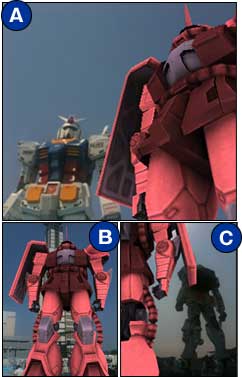
Gundam Robots in Augmented Reality

This post can be summarized by three magic terms:

  • Augmented Reality
  • Giant Robots
  • Yahoo Japan

Yes, it seems that the Japanese branch of Yahoo is much cooler than its American counter part. They have recently announced the coming release of a free iPhone application set to display a virual Zaku II mecha from the animated series Gundam (and sorry if I get this wrong, I’ve never seen it).
Interestingly enough the application is both image-recognition based and GPS/compass based. It will show the mecha when the iPhone camera will be directed at the (real) 18-meter tall Gundam statue in Shizuoka, Japan, and when the camera is pointed at a special marker.

For more details check out Anime News Network. Via Development Memo for Ourselves.

ARE2010 Video Montage

Sweet montage video of ARE2010 highlights.  Nothing more to say!

Weekly Linkfest

I hate August. It’s too darn hot over here. Luckily there a few cool and refreshing augmented reality stories this week:

This week’s video is of a year old, yet cool project by Karolina Sobecka with software development by Jim George. Sniff is a projected virtual dog that interacts with people passing it on the street. You can find lots more detail over Sobecka’s site (where you can watch other fun projector based projects, like Chase). [via Augmentology]

Have a good week!

Augmented City: The Creator of Domestic Robocop Blows Your Mind Again

I know some of you already seen the following clip on other blogs, but when I contacted Keiichi Matsuda two weeks ago, he asked me to wait till the final version is ready. Luckily, the wait was shorter than expected.

Keiichi Matsuda, the creator of the now famous dystopian short clip Domestic Robocop, is at it again. In “Augmented City”, a project that got him nominated for the Royal Institute of British Architects (RIBA) Silver Medal award (and no, there’s no golden one), Matsuda pushes forward his belief that modern cities are more than concrete, metal and glass occupying a physical space but also the digital information that is produced and consumed by the city’s residents.

Or, in Matsuda’s own words:

Augmented City explores the social and spatial implications of an AR-supported future. ‘Users’ of the city can browse through channels of the augmented city, creating aggregated customised environments. Identity is constructed and broadcast, while local records and coupons litter the streets. The augmented city is an architectural construct modulated by the user, a liquid city of stratified layers that perceptually exists in the space between the self and the built environment. This subjective space allows us to re-evaluate current trends, and examine our future occupation of the augmented city.

AR coupons may be littering the streets in Matsuda’s vision, but it still looks amazing –

I crossed my eyes to see this clip, but if you go on and watch the clip on Youtube you’ll be able to pick a red-cyan version and use your favorite 3d glasses. Want to learn more? Check out Keiichi Matsuda’s thesis.

AR Door and LG 3D TV

Multiple forms of AR (marker and markerless) together in the same camera view.  Plus a little furry action for you animal types.  My only disappointment was that the AR is being used as an advertisement *for* LG 3D TV and won’t actually show up on it.

AR Door Moscow has Created Augmented Reality for LG

AR Door has spearheaded the creation and integration of augmented reality for LG advertising campaign in Russia. The campaign included the integration of augmented reality into the promo website, devoted to a release of a new LG 3D TV model.

Augmented reality is a term for a direct or indirect live view of a real-world environment, whose elements are augmented by virtual computer-generated imagery.

The web page (www.lg.com/ru/3d) incorporating augmented reality allows the users to enjoy a 3D world just right at their homes.

By visiting the web page the customers can flash the ad in front of a web camera. After the web cam recognizes the image, jungles appears just in front of the user, on the screen. The user can enjoy the colors of the fascinating scenery, watch parrots and a puma. One more feature is a possibility to take screenshots of your experience.

Face tracking technology tracks the movements of the head and superimposes 3D glasses and puma’s ears on the user’s face and head. The markerless technology of an augmented reality – D’Fusion – allows the camera to recognize not black-and-white images but colorful ones, people’s faces, bottles, etc. D’Fusion is currently admitted to be the most flawless AR technology.