Obama’s administration is promoting augmented reality.
Really?
How else would you explain the “Get Up and Play” campaign launched by the department of health & human services ?
“Go online, just don’t stay too long” says the ad. “Be a player, get out there and play” it presses on.
Now, why would a 21st century child go out there and play, confront reality and deal with its harsh limitations when she can Wii in or stay inside the Xbox?
Here’s how the drama unfolds:
On the one hand, kids are not stimulated by reality as their forbears were. It’s not as fun.
Reality isn’t what it used to be.
On the other hand, kids need to spend less time in front of the screen. Parents always knew it in their gut – but now, it’s scientifically proven – thanks to a mega study of 173 other studies by the National Institution of Health which concluded unequivocally:
Too much TV, games, and internet harm kids’ health.
So, how do you resolve this conflict?
That’s where the augmented reality industry comes to the rescue.
We’ll make them go out, interact with their real surroundings – and they’ll totally think it’s all fun and games.
How are we going to do it?
Reality is actually pretty cool as it is, we just need to make it a bit more significant to them. Add a little spice. A sparkle. A challenge. A dream. A new dimension or a hidden depth. A reward for an unnoticed deed.
All these would make them do anything – even go outthere and play.
The Health Department dreamed it up to the extreme with an animated donkey; what an
[The author: the “Get out and play” campaign was reportedly launched by the Health department 2 years ago. I only noticed it now…on Hulu…while watching the Colbert Report…I trusted the Obama adminstration to have not only inherited but embraced this campaign both in practice and in spirit]
While we are on the topic of touristic applications, LastMinute.com labs, a travel site, has found a new way to tackle the problem of interfacing with an augmented reality world – for tourists. It is uncovered in an article on FastCompany.
The application Nru (pronounced Near You) uses the GPS, compass, sensors and other goodies available on Google’s G1 phone. As you point it to different directions while strolling on a London street – Nru will display signals about your surrounding attractions; the usual suspects include restaurants, movies, shows.
Now, here comes the interesting part: the user interface. Hold it parallel to the ground and it displays a radar like view of your touristic targets. Hold it vertically and it transforms into a purple-black “heat” sensor highlighting worthy targets in your front.
To get more info about a selected target use the “old” gesture: just touch it.
They claim to pull information from a number of sources including Qype and fonefood. Not surprisingly – both are London focused information services.
Some will argue that since it doesn’t overlay (register) the signals on top of what’s in your field of view – it’s not a pure augmented reality implementation, but rather a location-based app.
But the British accent certainly masks that thought and adds a certain Je-ne-sais-quoi to the demo. Absolutely fabulous.
Nru is now available on the android marketplace – but only for UK customers. Top bollocks.
In a land where what you see is what you get, those who can see more – even with one eye – are kings.
Kijin Shin from Yanko design believes in it and makes a point with this interesting concept design. He calls it the “Third Eye concept designed is for travelers.”
See something interesting? Just place the Third Eye up to your eyes like a monocle and the device pulls all relevant historical, travel, shopping, and tourist information.
Augmented reality lends itself well to touristic applications. When people explore new places – extra (augmented) information in context is highly sought after.
What’s interesting in this one – is the form factor and the user interface.
Sometimes you have to reduce features (one eye only) to achieve simplicity. That has the potential to drive massive adoption.
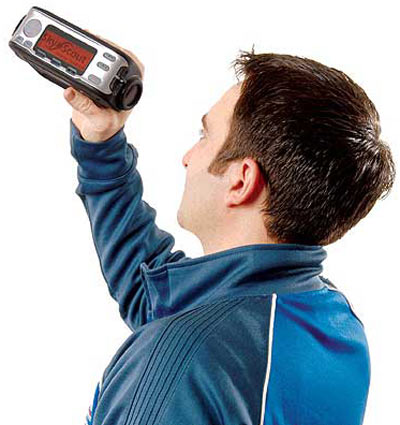
If you are into the pros and cons, check out the interesting discussion on the site featuring the usual supporters vs. skeptics. One commenter compared it to the Celestron SkyScout:
We’ll see if Kijin’s design raises interest among hardware manufacturers. By then we’ll realize if the one eyed man becomes king – or whether he’ll be facing a land populated with 2 eyed specs.
LEGO, the Danish toy manufacturer will test launch its “DIGITAL BOX” in selected toyshops and LEGO® stores worldwide. This interactive terminal will utilize innovative technology supplied by Metaio in the form of a software program specially-developed for the LEGO Group by the Munich-based experts in augmented reality solutions. Together with a camera and display screen, the software lets LEGO packaging reveal its contents fully-assembled within live 3D animated scenes.
The press release continues:
The partnership between Metaio and one of the largest toy manufacturers in the world is a truly major milestone in the history of the company.
Indeed, Lego is associated with playful, innovative toys and will certainly expose the concept of augmented reality to many kids around the world.
Kudos to Metaio for a great splash at the onset of the AR year.
Now who’s going to post the first video of this experience?
Tish from Ugotrade interviewed Robert Rice about his latest Sekrets AR endeavors. It was an unmissable opportunity to rant about everything augmented. Check out the blog of one passionate AR fan.
The dust from CES 2009 has barely settled over many shiny new devices, and new advancements in Handheld Augmented Reality software are already emerging from Vienna.
Daniel Wagner and his team at Graz University have come up with new and improved capabilities.
We saw an early implementation of Studierstube ES at ISMAR 08, so I asked Daniel what’s new about this capability, besides being faster and more robust.
Daniel: We can now track multiple images and switch arbitrarily. I believe it is now at a level that it can really be used in practice.
Games alfresco: Looks great. Based on the video it seems that it runs on Windows Mobile 6 (ASUS p552w, iPAQ 614c). What about other platforms?
Daniel: Not bad! It is written in C/C++, [but] since this is pure math code, it could be ported easily to any platform. Our AR framework is still Windows Mobile only, although we now also have Linux support (desktop only since we lack a Linux phone). MacOS and Symbian are in the making and should be available in a month or so.
Daniel: On January 20th we have the official opening of our “Christian Doppler Lab” (founded by the Christian Doppler agency). For that purpose I created a small demo for tracking business cards. In the future we’ll replace the 3D content with something more useful…
I can’t talk about Daniel without mentioning WARM ’09; He is the main organizer of this Winter Augmented Reality Event on 12th-13th February 2009 at Graz University, Austria. Registration is over, but if you really want to go and have something cool to present – you may be able to convince Daniel to let you in.
Should you get your hands on this powerful technology (assuming Imagination makes it available for licensing soon) what would YOU do with it?
A quick look at all MIDs (Mobile Internet Devices) Intel is showcasing at CES 2009 (thanks to Truc and Warner from GottaBeMobile)
Vodpod videos no longer available.
Intel introduced the MID design concept only last year with just a handful of working devices. This year, they are definitely making a big splash with too many to count.
Here’s Intel’s own Uday sneak-peaking a bag full of MIDs prior to the show
A notable MID, the Gigabyte m528, was released last month boasting great capabilities albeit a steep price ($750)
Stay tuned for Mid Moves – where four well-known technology bloggers will be taking 8 Intel-based Mobile Internet Devices on a fun and challenging 4-day tour starting on Jan 19th.
Now, which one will you use for your next augmented reality experience?
It always delivers a gadget-splashy kick-off for the year. If you are there in person, or following virtually (like I do) – you will want to check out these events:
Wow!
Sad to say, it’s not the next AR goggles…it’s for shooting underwater HD video…
But there’s more.
TN Games
Wear this helmet from TN Games and when they shoot you (in a game) – you’ll feel the wonderful sensation of actually getting hit in the head. Now, try it on a street while playing an augmented reality style laser tag. You may feel cool – but you’ll still look dorky.
To complete the awkward look, don’t miss the matching game vest and you’ll feel the shots and blasts on your torso.
PrimeSense
Prime Sense, an exhibitor in CES 2009, makes “video games more immersive and fun to play by allowing users to play naturally using body movements and gestures”.
Though unique in its technology, Prime Sense is not the only company that offers body game play. A handful of companies compete on that niche – somewhere between the Wii and augmented reality games.
Lunch@Piero’s – with Total Immersion
Total Immersion is sure to deliver a great augmented reality tour de force this CES. They are the best at demonstrating AR today. This year, though, they left the keynote stage and went for lunch at Piero’s. January 8-9, 2009 — 11:30 am to 2:00 pm press demonstration only.
Kids at play conference
I have argued before we first need to get the next generation hooked on AR. The conference within conference, Kids@Play, will provide some of the ingredients needed to do it right.
As usual, CES 2009 will kickoff the AR year with a glitz. Expect to see new AR devices unveiled: new Intel MIDs, mobile devices powered for the first time by the promising chips: Texas Instruments OMAP3 and NVidia’s Tegra .
We will see consumer AR apps selling for the first time, AR games played by cellphone owners, and the AR Market doubling in size.
And not to forget – ISMAR 2009 – the world’s most important Augmented Reality event, will mark the first year where the show expands beyond the engineering department. In October 2009 ISMAR will make a foray into art, , experience, entertainment, and business – all key building blocks of the future AR industry. Orlando will host this year the most ambitious ISMAR yet to be planned. To join the effort contact Chris Stapleton.
2009 is posed to be the year where AR breaks from the lab and gets in the hands of consumers which will change the way we experience the world – forever.
Top 10 AR milestones in 2008 was one of the most popular posts this year. What came out of it was even more gratifying: a multitude of reflections, impressions, and thoughts I received about your own AR moments, including some last minute finds.
Here is an anecdotal collection of your greatest AR moments in 2008:
1. The Most fundamental AR milestone in 2008
Oriel Bergig: During 2008 we have seen some major advances in the field of Augmented Reality. Porting AR technology to mobile devices and especially cellular phones creates an opportunity to reach millions of users. For several years, the biggest AR labs and companies have made huge steps in this direction. In 2008 these efforts have started to show results. Pose estimation has been upgraded with the StbTracker release in the end of 2007. Research focusing on better user experience, and in particular on making mobile AR technology accessible to people with no special training, is being conducted by the best minds of the HitLabNZ. During one of the top covered events of the year, CES2008, Intel’s CEO Paul Otellini demonstrated Total Immersion’s technology enabling mobile AR experiences such as urban guidance. To wrap-up, the 2008 most fundamental milestone would be: AR technology is closing up fast on the mass user market.
Charles Woodward: The greatest milestone? Commercial breakthroughs by Metaio and Total Immersion.
Thomas Wrobel: Wikitude I think. Seems the first released, useful, AR software. Runner up to the AR Geisha doll…
2) The best AR device of the year
Oriel: Since 2008 would most be remembered for its advances in mobile AR technology, the AR device of the year is the mobile phone. Nokia has released the Navigator phone that includes a GPS and an accelerometer, which make a valuable addition. The N95 has been demonstrated as well in many more contexts as a good choice for AR applications. The next AR device of the year would be the Nokia N97 and of course the iPhone with its huge global success. iPhone feets very well AR applications and a successful attempt to port ARToolKit to iPhone has already been made by ARToolWorks. Appealing applications are next to come but only after the iPhone OS has better support for real time video acquirement.
Charles: Best device? iPhone, and/or Nokia 6210…
Thomas: hmz…tricky. I personally think hardware is still rather lackluster, and I have had little experience with some of the most recently released stuff.
I guess probably the iPhone + G1 devices…while far from ideal, they are at least getting location-aware services, and “barcode scanning” style product information into public hands.
Eric Rice shares what gets him excited about a video comparing between PS2 Eyetoy and PS3 Eye.
Vodpod videos no longer available.
3) Best AR Demo
Oriel: The best demo of 2008 is the demo that will be remembered by most people a decade from now. The demo that reached most of the people in the world is most likely Intel’s CEO Paul Otellini keynote talk during CES2008.
Charles: Haunted Book, Cherrer et al at ISMAR2008 – just beatiful!
(click Interaction on the left menu bar and then Haunted House.)
Thomas: LevelHead [by Julian Oliver], I think. Although this pet demo [ARf] is also nice; (that may be because I want my own desuke though :p)
Vodpod videos no longer available.
4) Person of the AR year
Charles: Georg Klein – leads the way in anything he touches [single handedly won ISMAR 2008 tracking competition]
Thomas: There’s been so much development by so many individuals and companies I don’t know one specific person.
5) The most significant AR deal of 2008
Charles: Beijing Olympics fake fireworks. About the viewers of the Olympics openning ceremony:”What they did not realise was that what they were watching was in fact computer graphics, meticulously created over a period of months and inserted into the coverage electronically at exactly the right moment. ”
Thomas: Not sure about AR deals as such, but Total Immersion getting offices in the US is a good sign for the company and AR in general.
6) A [Predictable?] disappointment
Gizmondo won’t be coming out this year after all…The Nordik Link has the scoop.
7. Last minute find: A Surprising Simplicity in AR
Anyone can build 3D models with Google’s Sketchup. With the AR Media plugin from Inglobe – anyone can bring it into an augmented reality scene. ArchDaily tried it here.
Thanks for contributors and especially: Charles Woodward, Oriel Bergig, and the always there AR enthusiast: Thomas Wrobel
Bonus: Blair MacIntyre shares his greatest AR moments in 2009 in his blog.




 Games Alfresco