How to Get the Next Generation Hooked on Augmented Reality – Today

Our belief:

…in 10-15 years everyone will use Augmented Reality to experience the world in a more meaningful way.

Our collective mission:

…nurture a healthy industry that will drive the adoption sooner than later.

So where do we start?

…by educating the youngest “digital natives”.

That generation is ripe and eager to try new experiences that speak their language. And that same generation will carry the AR movement to its glory.

The challenge is how to give them something they like, and at the same time offer value to those who hold the buying power  – their parents, guardians, or teachers.

Tech savvy parents and teachers tend to recognize the value of PCs and video games in educating their kids – but they hate the isolation resulting in too many hours in front of the screen.

Eric Klopfer argues in his excellent book, Augmented Learning, that we should give them mobile learning games:

These games use social dynamics and real world contexts to enhance game play…and can create compelling educational and engaging environments for learners…help develop 21 century skills…tackle complex problems…and acquire information in just-in-time fashion”

Eric doesn’t stop at arguing, he actually does what he preaches. Together with colleagues at MIT Teacher education program & the Education Arcade and in collaboration with Madison-Wisconsin and Harvard, they developed multiple mobile games (see below) – and experimented and improved them – with kids.

And they’re not alone. Researchers around the world have studied this huge opportunity and wrote about it extensively.

Future Lab in the UK is passionate about transforming the way people learn, and develop new approaches to learning for the 21st century (see games below).

Mark Billinghurst, an AR god from New Zealand’s HIT Lab, published this guide about Augmented Reality in Education.

Mike Adams ranted in 2004 about the prospects and dangers of augmented reality games in his passionate  The Top Ten Technologies: #3 Augmented Reality

Cathy Cavanaugh wrote the essay  “Augmented Reality Gaming in Education for Engaged Learning”  as the fifth chapter of a massive hand book dubbed Effective Electronic Gaming in Education. (You can get it for $695.00 at Information Science Reference.)

Cavanaugh explores a (surprisingly large) number of educational games developed in the last 4 years:

Most were designed to teach concepts in scientific systems, and the remaining AR games focus on the difficult-to-master, ill- defined domains of communication, managing data collected in the field, problem solving, and understanding cultural and historic foundations of a region.

Based on that list, here is an (alphabetical) culmination of mobile educational games in recent history:

Big Fish Little Fish (MIT)

Concepts including predator-prey dynamics, over fishing, biodiversity, evolution for school-age children.

Groups of students use handheld devices while physically interacting with each other to simulate fish feeding behavior.

Charles River City (MIT)

Outdoor GPS-based Augmented Reality game for teenagers. Players team up as experts including scientists, public health experts, and environmental specialists to analyze and solve an outbreak of illness coinciding with a major event in the Boston Metro Area.

Create-a-Scape (Future Lab)

Mediascapes are a powerful way of engaging with the world around us. Using PDAs they offer new opportunities to explore and interact with the landscape in exciting and varied ways.

Eduventure Middle Rhine (Institute for Knowledge Media)

Learning the cultural history of the Middle Rhine Valley for adults. Learners alternate between problem solving using video of the castle setting and problem exploration using mobile devices in the real castle.

Environmental Detectives (MIT)

Collaborative understanding of scientific and social aspects of threats to the environment and public health for adults. Participants role-play as teams of scientists investigating contaminated water using networked handheld devices in a field setting.

Epidemic Menace (Fraunhofer Institute)

Collaborative problem solving and experiences with learning arts for adults. Teams assume the roles of medical experts to battle a threatening virus using gaming and communication devices in a room and outdoors.

HandLeR (U. of Birmingham)

Support for field-based learning of children ages 9-11. Groups of children respond to scenarios in the field using a portable data collection and communication device.

Live Long and Prosper (MIT)

Concepts including genetics and experimental design for school-age children. Groups of students use handheld devices while physically interacting with each other to simulate the genetic actions of reproduction.

Mobi Mission (Future Lab)

Communication and reflection activities for teenagers.

Groups of students write verbal missions and respond to the missions of others using cell phones.

Mystery @ the Museum (MIT)

Collaborative thinking skills for adults and youngsters. Teams consisting of a Biologist, a Technologist and a Detective must work together to solve a crime at the Museum of Science.

Newtoon (Future Lab)

Physics principles for adolescents. Students use mobile phones and Web sites to play, create, and share games that demonstrate physics principles.

Outbreak @ MIT (MIT)

Experience with the complexities of responding to an avian flu outbreak, for young adults.

Players are brought in to investigate a potential epidemic on campus with hand-held networked Pocket PCs.

Savannah (Future Lab)

The science of living things interacting within an ecosystem, for ages 11-12. Children, acting as lions, navigate the savannah using mobile handheld devices.

Sugar and Spice (MIT)

Concepts including population economics and mathematics for school-age children. Groups of students use handheld devices while physically interacting with each other to simulate interactions between populations and resources

Virus (MIT)

Concepts including epidemics, scientific method, population growth for school-age children. Groups of students use handheld devices while physically interacting with each other to simulate the spread of disease

So what’s next?

These old games have built-in educational value, they strive to be more fun than traditional classroom lessons, and most importantly – they achieve it while detaching children from the screen.

However, none of these games has really made it to the mass market.

In order to break into the mainstream, games will have to be

  • more visual (see what you mean),
  • more intuitive (touchscreen and accelerometers – drop the Pocket PC look & feel),
  • more ubiquitous (play anywhere, anytime),
  • and they will have to run on devices that look more like an iPhone than a Newton.

Devices for education is in fact the main topic for the second part of this post.

Stay tuned. Or better yet – tell us what you think.

10 TV Commercials That Will Inspire Your Next Augmented Reality Experience

Hours in front of the tube during election season offer some gratifying moments.

TV commercials is not one of them.

But once in a blue moon (pun intended), TV commercials appear as a blessing in disguise: if you open your mind, they will inspire your next augmented reality experience.

There is no cutting-edge technology in these videos.

There is something we consumers consider more precious: visual visions that will freshen up our reality.

To illuminate my argument, here is the countdown of the 10 best TV commercials for AR inspiration.

10. Disney commercial: “What Will You Celebrate”

Take any mundane situation such as the class room in this unpretentious Disney Parks commercial – and lighten it up with fireworks, literally. (Just make sure to wear your AR goggles)

9. Dassault Systemes – See What You Mean

These two commercials from Dassault, the visionary company for collaborative design, literally demonstrate the look and feel of an augmented reality design experience.

8. Sony Walkman

Noisy art work on your clothes, fluffy wings, and puffy speech bubbles on your walls; you’ll feel that cool with Sony Walkman. (Can you handle that much 70s on your retina?)

7. Nice+Smooth

How about this creepy face recognition application?

6. Mercedes C class

Now, you can see the history of me over the years

5. HP

Augmented reality puts it all in your palm

Kzero collected the entire celebrity series featuring Seinfeld, Jay Z and many more.

4. Dodge Caliber – Too tough

A fairy redecorates the city to look like in her dreams

3. KoreaLife

Augment everything in your life! Live the awesome [Korean] life.

2. British Airways

Terminal 5, Heathrow airport, London is swarming with fish. It may be all 3D animation – but it inspires an amazing AR vision.

1. Sprint Lights

Garbage trucks and school busses come to life. So simple, so inspiring.

and…Nascar cars fighting like monsters (why not any car)

TV commercials creators work hard to beautify reality on TV. They’re armed with nothing but their creative lenses. Should you have such lenses, what would you do with it?

How would you beautify your reality?

***Update***New TV Commercials***

11. Zappos

12. Playstation 3 – Entertainment Unleashed

13. Coca Cola Avatar

14. Hulu Superbowl

Watch  second 33 for a cool xray


Will The New Blackberry Storm Through the Augmented Reality World?

In our quest for a better augmented reality experience we keep evaluating new devices that could deliver a superior AR experience.

The new kid on the block that is attempting to take on the iPhone is Blackberry’s Storm.

It will be on sale starting tomorrow. Here is a collection of roundups.

Should it make the top 5 best AR device list?

To achieve that feat it first has to beat the iPhone. Its haptic capability (pressing a button on the touch screen feels like pressing a real button) won’t do it alone.

Well, the Storm has a better camera (3.2 MP vs. 2MP), a somewhat better screen (especially in sun light), and it records video. One could also expect a longer battery time.

On the down side: the user experience and the OS is reportedly not up to snuff with the iPhone (freezes, awkward user interface at times). Plus it’s missing WIFI support (what gives?), and it’s heavier (by 17%).

The verdict?

The Storm will have to prove itself in the market with adoption among users and developers before making the top 5 AR device list.

Can The New Nintendo DSi Augment Your Reality?

The Nintendo DSi, now with camera, went on sale in Japan on November 1st; next year in the rest of the world.

We were excited when it was announced in September, and thought it could energize the augmented reality games scene. So, here it is, not just with one camera – but two!

Eurogames shares their hands on experience with the newcomer. If you have a fetish for unboxing new products, get your fix with 1Up.

Aaah, but here’s the rub: the cameras boast a mere 0.3 MP each…

Nintendo’s strategy of taking advantage of inexpensive technology and creating new and compelling game experiences has been wildly successful in the past with the DS and the Wii.

Will developers’ ingenuity be able to beat the DSi constraints (cpu power, resolution) and make it play cool AR games?

Still remains to be seen. Until then, take a look at this basic augmented reality software loaded on the DSi:

  • change the color of your shirt – virtually – with the touch of a stylus
  • face recognition that makes you look happy, angry or sad,
  • or if you are more into felines, why not grow cat-ears-and-whiskers?

The Perfect Augmented Reality MID Device Has Arrived: Ciao!

When you’re in pursuit of the ultimate augmented reality game, you’d better be riding on an ultimate augmented reality device.

So far, we have been hitchhiking “lesser evils” such as described in my “Top Mobile Devices Compete

The conclusion was grim:

No big winners on this list.
Some have to be hacked to do AR; some might not see the light of day; others don’t even have cameras.
[What in the world are MIDs with no cameras doing on the list, you ask?
Patience my friends. The MIDs are coming. They will have cameras in no time.]

A couple of days later, before you could say “Intel’s-Atom-based-mobile-internet-device”, a MID with a rear camera was announced; and it speaks Italian: Ciao Itelco IDOL!

Itelco IDOL

Those of you following the MIDs evolution, will immediately recognize it as a rebranded Aigo 8880 or a Megabyte M528 or maybe a SFR M! PC Pocket… all various rebadged configurations of Option’s Compal JAX-10 design unveiled at Intel’s IDF this August.

This time with a confirmed rear camera.

It is on sale on Itelco’s site for 449 euros (~$573).

Itelco apparently rushed to publish it and had no time to fully translate the specs. Luckily, Poketables were there for us:

[The 320g device includes] a 800MHz Intel Atom Z500 CPU, [running Linux] 4.8-inch 800 x 480 touchscreen, and 4GB SSD…integrated 3.5G, 3-megapixel rear camera, and GPS.

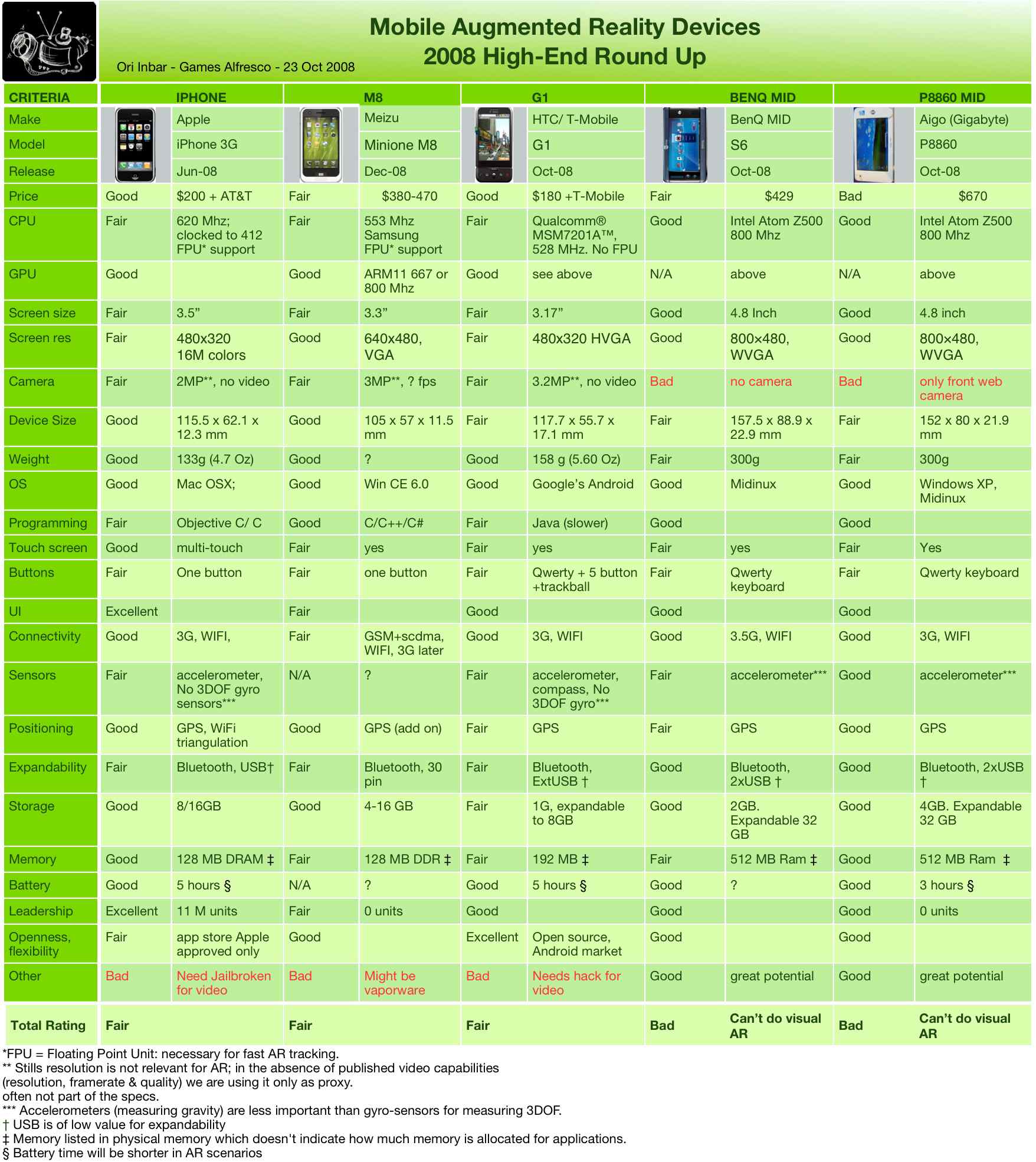
I am inclined to announce the IDOL as the front-runner in the race for augmented reality device greatness, but since I am yet to receive a first hand confirmation of its use in an AR scenario, I’ll settle for an update of the “2008 High End Round Up”

.

Nice. Finally a contender with no major flaws. Back to the pursuit of the ultimate augmented reality game.

Let us know when you try the new ragazzo on the block.

Augmented Reality Game Wins Best Mobile Game

We have a winner.

Nokia just announced the winner of its Mobile Game Innovation Challenge. And it’s all…augmented.

I believe the first to break the news was the Earth Times.

In our previous coverage of the competition, we spotted 6 out of the top 10 finalists as augmented reality games. It was a good day.

Kudos to Different Game studio and their creation: Ghostwire, an augmented reality game where players can use the camera on their mobile device to find ghosts.

Just in time for Halloween. How felicitous. Arg…

Different Game is walking away 40,000 EUR richer. Back to Sweden to complete the game and make it a mega success.

***

Update: Stephan from Int13 unearthed the trailer of Ghostwire, and he claims it isn’t a real augmented reality game because it doesn’t register in 3d.

He’s right. But is the experience breaking away from traditional virtual games and encouraging the player to explore reality?

See for yourself in this clip. Or read an interview with creator Tom Soderlund on PoketGamer

Top Mobile Devices Compete for Augmented Reality Puissance

One of the most popular posts on this blog has been, and still is, my “Top 10 Augmented Reality Devices“.

Based on the feedback, you appreciated the condensed collection of various categories of devices, as well as the suggested criteria for evaluating upcoming devices. What you were missing is a practical head to head comparison of the top devices.

So ,here it is: the (mostly) complete, (roughly) unbiased, and accurate (at best) comparison of the top mobile devices for high end augmented reality.

How do you become a high-end AR device?

If you’re snug in my hand, have the power to track natural features and objects in live video, while interacting with the overlaid 3D graphics at 24 fps — and all looking good on the display – welcome to the high end club.

Now, take a deep breath, click…and dive right ahead: 5 devices, 22 criteria, rated from bad->fair->good->excellent, with no frills.

Contribution by Daniel Wagner

No big winners on this list.

Some have to be hacked to do AR; some might not see the light of day; others don’t even have cameras.

[What in the world are MIDs with no cameras doing on the list, you ask?

Patience my friends. The MIDs are coming. They will have cameras in no time.]

Have you seen any better high end device?

Should Nokia sneak up there?

What would you like to see next on the list?

These Top 20 Game Publishers Will Disappear – Unless…

Game Developer Magazine just published its Top 20 Publishers of 2008.

How many augmented reality games have these formidable companies published?

Sweet Fanny Adams. Diddly squat. Zilch.

Here’s a summary of the Top 20, with links to individual profile pages:

20. Midway
19. Eidos Interactive
18. Codemasters
17. LucasArts
16. Disney Interactive Studios
15. NCSoft
14. Capcom
13. Namco Bandai Games
12. Vivendi Games
11. Konami
10. Square Enix
9. Microsoft Game Studios
8. THQ
7. Sega of America
6. Take Two
5. Sony Computer Entertainment
4. Ubisoft
3. Activision
2. Electronic Arts
1. Nintendo

The article recaps the publishing landscape:

This year’s list seems to have been influenced somewhat by which companies could adapt with the times…most of the publishers in our top 20 have a decided console focus, demonstrating that the adaptation of new forms of games into the existing model will take some time.

Sure. When a game title costs upwards of $20M to develop (not including marketing) you got to sell a whole load of it. You can’t take risks.

Darvin said that if you can’t adapt, you’ll die. I will argue that in 10 years these publishers (and affiliated studios) will disappear from the list. That is unless they open their minds and wallets to reality games.

I have raved this month about a flood of augmented reality games coming to the iPhone, Google’s Android, and Nokia mobile devices. So what am I ranting about today?

Well, these mind-blowing games are not coming from the above top publishers; they are emerging from the fringe. Tiny boutique studios aren’t trying to predict the future; they are bringing it forward by pushing the envelop of game experiences.

If I were a betting man, I’d say these risk-taking-tiny-boutique-studios will top the charts in the future.

Nokia’s MGIC: Augment Reality – the Nokia Way

Forget the iPhone. Forget Google’s Android. Today is Nokia’s day.

As of Today, Nokia is playing in the big leagues of Augmented Reality. It just announced the top 10 finalists in its Mobile Game Innovation Challenge.

Guess what type of games made it to the top?

Augmented, augmented, and more augmented.

To make my point, I have filtered out the “traditional” games and put on the list only games that smell like augmented reality spirit. Here they are:

1. Active Tecnologia e Consultoria Ltda. (Brazil) with Cinemarena – set in a movie theatre, controlling avatars on the big screen

Sounds pretty augmented to me.

2. CreatePlayShare (India) with Ball – play any ball game on your mobile or even create your own new game

Reminds me the legendary SymBall, one of the first augmented reality games on a phone.

3. Different Game (Sweden) with Ghost Wire – use your mobile device to communicate with ghosts

Blurring the line between real and virtual couldn’t be more spooky.

4. Eclipse Interactive (UK) with Watchers – conspiracy adventure game that uses Nokia Maps and other real world tools to find locations

Sounds more like a mixed reality game, but hey – let it benefit from the doubt. Today, we are celebrating.

5. Int13 (France) with Kweekies – augmented reality virtual pet game

We were expecting Stephan and the Int13 team to come up with great augmented reality games on the iPhone. Well, they have first delivered for Nokia. Wish them success.

6. TechnoBubble (Spain) with Fun Cam – a mixed reality game that connects your camera on your mobile device to the TV

I don’t really get it – but since it’s a self-proclaimed mixed reality game, we’ll include it.

There you have it: 6 out of the 10 top games in Nokia’s “Mobile Innovation Challenge” fit in the augmented reality category. That’s a landslide victory!

And it’s not all: the three most innovative game concepts will be offered by Nokia Publishing pre-production contracts. The first winner will be awarded 40,000 EUR, the second 20,000 EUR, and the third 10,000 EUR.

Congratulations to the top 10 finalists (including the non augmented reality games…). The winners will be unveiled at Nokia’s Game Summit in Rome next week. May the best win.

***

It’s been a good month for AR games; news have been embracing the iPhone, Google’s Android, and Today – Nokia.

Which begs to say: ready or not – here comes a groundswell of games to a reality near you.

Would You Kill for These Android Augmented Reality Apps?

Tom Spring from PC World put together a nice collection of Android apps for T-Mobile’s G1.

The lion’s share of these apps is compelling thanks to their novel use of camera, GPS, communication capabilities – or all combined.

Tom listed 15 Android “killer apps”. I pick 4 apps which could inspire the augmented reality world.

You will judge if they “kill”, Bill.

1. BreadCrumbz

First step towards user generated Geo tags

BreadCrumbz is a different kind of navigation application.

Navigate-by-Pictures: Navigate your route using pictures instead of a map (there’s also a map, if you like).

Users Create Routes: Easily record routes using your smartphone. Share them with your friends, share them with the world.

2. CitySlikkers

Attempting a real-world social network

City Slikkers is a Pervasive Game (alternatively Location Based Game) which takes place in the real-existing city. It is designed to connect a large number of players through-out the world and change the way the surroundings are seen. The central idea behind the concept is to give people the opportunity to symbolically interfere with the everyday urban environment and come into contact with previously unknown people.

3. ShopSavvy

Using the oldest Marker technology: barcode

ShopSavvy™ is a shopping assistant developed exclusively for Google’s Android mobile phone platform and is one of T-Mobile’s featured applications in their 2008 US and UK launch. Users can scan the bar code of any product using their phone’s built-in camera. ShopSavvy will then search for the best prices online and through the inventories of nearby, local stores using the phone’s built-in GPS. ShopSavvy won Google’s Android Developer Challenge and is available in Google’s Android Market.

4. Get a Life

Getting folks out of the house is a good thing

Locate your friends and family– LifeAware gives you the ability to create your own network of friends and family members and locate them. Unlike other location services, LifeAware will provide you with their last known location, providing insight even if their phone is off or out of range.

Establish safety zones for family members – Create geographical zones and setup notifications for when a family member enters or leaves the defined zone. Setup a zone to be notified when Johnny arrives or leaves school, or when a loved one arrives at their destination when taking a trip.

Tag locations for yourself or for sharing– Tag locations you visit, or find on the map and share with the members of your network.

Send locations– Send your current location or location of your choosing to friends in your network, or to any email address. Send the favorite meeting place to friend and have them meet you.

Now, you be the judge!