

We’re probably at least five years away from something like this, but it sure does look fun.
Filed under: Uncategorized | Tagged: AR Games, augmented reality | 6 Comments »
We’re probably at least five years away from something like this, but it sure does look fun.
Filed under: Uncategorized | Tagged: AR Games, augmented reality | 6 Comments »
While I’m probably not going to be playing Balloon Burst from Popcode obsessively like I do Civ 5 on the PS3, the game is much better than the floating pixel games of six months ago (I’m looking at you Firefighter 360.) Still, I’m looking forward to that innovative AR game that I just can’t put down. Keep at it, Popcode!
Filed under: Uncategorized | Tagged: AR Games, augmented reality, Popcode | Leave a comment »
“They have returned”
I’m a sucker for a good tag line. Gary Hayes from MUVEdesign has put out a teaser video for his upcoming, well 2011 release date, game called Time Treasure. Gary explains more on his blog, but I wanted to add my comments.
Gary says:
Without giving the plot away, the structure of this game is quite straightforward. There are ten layers of time from 2050 back to 5000BC that you slowly penetrate following stories, clues and trails all based at POIs (points of interest, precise locations) around your city. The traditional MMOG talking-head quest and story givers are a unique part of this as well as a range of capture & loot quests that require you in some cases to do a little ‘real world’ grinding… ok not too much
For me the challenge as always is about creating strong ‘call to actions’ and constructing a narrative backbone to make it worth your while walking and in some cases running around town! I will do a post when this reaches a full working pilot.
I think this is a terrific idea and I find it interesting he’s planning this on a tablet rather than a smartphone. I’m in agreement that the more immersive games are going to require a bigger screen to make work. On the other hand, I’m not sure how much people will want to hold their tablet up all day, but its worth a shot. Personally, I’m amazed at how much people are willing to hold their cellphones to their ear with their necks bent while they drive down the road. If people want to do it, they’re willing to suffer a little pain.
I also like his questing idea and creating a narrative. Though I’ve been around gaming long enough to know that every developer wants to create narrative but it’s much harder when you get around to coding.
The other challenge point for Gary and MUVEDesign is making the game work across multiple cities. I suppose you can come up with a general plot that can be dropped into any city, just change the GPS codes, but it’d be nice to get some personal touches from each city’s history.
Overall, I think its a good idea and I hope we see it come to fruition. Good luck, Gary.
More about Time Treasure:
A Location Based Augmented Reality Game in development for Android Tablets, planned release 2011 © MUVEDesign.com 2009
Game, film & music created by GaryPHayes. Some placeholder animations World of Warcraft © Blizzard Entertainment. Tablet featured is the Samsung Galaxy
“Travel back through layers of time
across your city”“Discover stories and clues from
those who are no longer hidden”“Find and capture treasure
thought lost for over 8000 years”“In your city, control time and place
follow the guardians and guides”
Filed under: Uncategorized | Tagged: AR Games, augmented reality, Gary Hayes, location gaming, MUVEDesign | 4 Comments »
Not the snazziest of article titles but I couldn’t think of anything catchier. That point brings me to the addendum topic of this blog post, which is the unsexy nature of the hard work that goes on behind the scenes in the AR movement. But first, let’s see what’s going on in the scene.
W. Lee, Y. Park, V. Lepetit and W.Woo, showed off their paper “Point-and-Shoot for Ubiquitous Tagging on Mobile Phones,” at ISMAR10. These two nifty videos show off some crazy-good in situ markerless detection, including an x-wing fighter, complete with shadows, flying over a parking lot. Cue the movies:
The addendum point I wish to make today is that how much we forget all this amazing technology has been built on the backs of some amazing researchers. Back over a year and a half ago, most of the content online was from researchers. Now-a-days, we’re usually only showing the commercial videos which tend to be better constructed.
However, there’s something truly awesome about the unvarnished videos from pre-hype days like the ones here. You can almost feel the excitement when they got the project working and rushed to the camera to record their efforts and upload it to YouTube–more Wright Brothers than Donald Trump.
So if you’re a researcher and I’ve missed your AR research video, please send me a note, along with some background information on the project and I’ll be happy to highlight you here on Games Alfresco.
Filed under: Uncategorized | Tagged: AR Games, augmented reality, iphone, ISMAR10, mobile phones | 3 Comments »
Since September 2009, we have seen many quasi-augmented reality (AR) games on the iphone, some fun concept AR games (on other platforms and devices with no real commercial distribution).
Today I had the pleasure to play the first truly fun, truly AR game on the iphone – and I loved it.
It’s called AR Defender, developed by the talented team and our good friends at Int13.
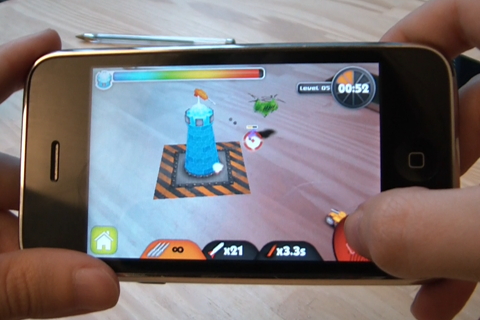
With close to 30 frames per second – it’s a huge achievement from a technical perspective (even though they are using their proprietary marker).
And it’s looks great. The game play is a mix between a simple table top game, and a typical to Tower of Defense game, nicely adapted for the AR experience. Few seconds into the game you forget you are aiming at a marker and get immersed into the game play – wow!
That together with the fact it’s available on the app store may lead to commercial success that we haven’t seen before with an AR game.
This is VERY encouraging, because Games Are The Killer App For Augmented Reality.
Check it out:
The game should be approved by Apple soon – so when it does – try it and let us know what you think!
Filed under: AR Games | Tagged: AR Defender, AR Games, int13 | 15 Comments »
I can see you’re a little bored (yes, I’ve hacked your webcam) and I’ve scoured the Intertoobs to find some augmented reality to cheer you up. From free to over one hundred dollars, here are a few ways to inject a little spice into your boring life.
Free – AR on Webcams
Does it work for Chatroulette (don’t click that unless you have a strong stomach)?
Less than $5 – Chatterbucks
More than $100 – Playstation Move “Start the Party“
Beer not included. Comes out on September 19th.
Filed under: Uncategorized | Tagged: AR Games, augmented reality, Chatterbucks, Playstation Move | 3 Comments »
No licensing issues here, really…
I applaud the robust hand tracking, but could the game be something new rather than a Pac Man rip-off? Come on Total Immersion. You guys are better than this.
Learn more on the Total Immersion blog.
Filed under: Uncategorized | Tagged: AR Games, augmented reality, tasbeeraman, total immersion | 2 Comments »
This fall, Qualcomm is going to host a $200,000 Augmented Reality Developer Challenge. The details for the challenge haven’t been released yet, but the total amount of prize money should have would-be developers planning their products as we speak. The challenge will start when they release the Qualcomm AR SDK. More details can be found here.
Filed under: Uncategorized | Tagged: AR Games, augmented reality, Qualcomm | 3 Comments »


 Games Alfresco