Proctor & Gamble has launched a new AR campaign to promote some kind of Always “Infinity Pads”.
Since I’ve offended to many people in the last few weeks I’ll keep mum this time. However, the kind people at AgencySpy, who are also responsible for uploading the above video to Youtube, had this to say:
This campaign is complete crap. …
P&G pitched the AR piece to you ladies as magic, which of course it isn’t. This is the kind of advertising that reiterates how ineffective “look at me” work truly is. It’s also annoying and dilutes the power of this new tool for those who have salient ideas for how to use it.
For some reason, one of my most successful posts, was the one about Total Immersion’s promotion for Transformers 2, where everyone had the chance to virtually try an Optimus Prime mask.
Now, a bunch of nerds (no other word to describe them, sorry), have taken their Transformers fandom to a whole new level. If you are a pregnant woman, younger than 15 or suffer from heart arrhythmia, please don’t push the play button. You see, AR entering the mainstream is not always a good thing:
Another lazy summer week has passed by (unless you live below the equator), bringing us some more augmented reality news:
I’m not sure what exactly does it mean, but it was all over the blogosphere – Apple will allow augmented reality applications in its iPhone OS 3.1 release. I suspect it only applies to AR applications of the Wikitude-Layar-TubeFinder kind, that don’t have image recognition capabilities.
And here’s OneZeroThrice’s implementation of AR business cards (sorry …). OneZeroThrice are the creators of ARtisan which aims to provide a simple frontend to FLARToolKit.
Brian Selzer has this review of Comic Con from the AR perspective.
While the whole web is gushing over James Alliban‘s augmented business card, I find the next implementation even more exciting. Don’t get me wrong, Alliban’s card is cool, but this one is a bit more useful:
It was created by Jonas Jäger, and more importantly, he doesn’t plan to keep the technology to himself. Jäger plans to release a front-end application that will let you create your own “presentation” that will be displayed when your business card is flashed in front of a web camera. It uses a QR code to identify your card from others, and an AR marker to have FLARToolKit something to get a fix on. All in all, it answers Thomas Carpenter’s call to create a service for these kind of augmented business cards, and really looks good.
Doritos had several augmented reality campaigns we previously covered (here and here). Now, they let Blink-182 fans watch a virtual concert by the band using a bag of Doritos, a Webcam, and setting their web browswers to this site.
“An online 3-D performance was something we just had to be a part of,” Hoppus said in a press release. “As big technology guys, we’re pumped that people can now experience a little bit of our summer tour through something as accessible as [a] bag of Doritos and a computer.”
Dutch website (what’s with all those Dutch companies lately?) YouTellMe.com, which specializes in social shopping online (e.g. recommendation engines) has just launched a new augmented reality application, letting you see how your favorite electronic products look like in the palm of your hand (or in your living room).
By harnessing the power of your webcam, Flash, and probably FlarToolKit (though, I failed to prove it), you can now try the new iPhone, or that Canon camera you always coveted:
Actually, since style and appearance play a big part these days when we are out to buy a new gadget, I can imagine such an application would have a market (much like those magic mirrors that let you try on jewelery and accessories). Though, IMHO, it could be much improve if instead of simply printing a marker, you would be able to print a simple paper-craft box with markers on its sides, that although will require some folding, will give you some more “hands on” experience.
It was bound to happen. As augmented reality becomes more and more prevalent, it was all a matter of time till someone took credit for something he is probably not entitled for. Enter Chris Hughes best known for jailbreaking the first iPhone. Last February, at TED palmsprings, Hughes briefly showcased his work that “makes creating ‘augmented reality’ a cinch”.
(video was pulled down by TED, but here you can still watch it)
If this demo looks familiar to you, you are not alone. Ralph Hauwert, a Papervision3d developer, took offence at Hughes talk, and subsequent interview. According to Hauwert, Huges is taking credit for porting ARToolKit to flash, while he only took FLARToolKit and “followed a tutorial like this one from the FlashBlog, then gathered all his courage and energy to work with 2 opensource projects and take credit for it” (source).
Apparently, TED folks are working to fix things up. Till then, you can find more details over Hauwert’s blog.
[author comment: I published this post a few days ago at Augmented Times, and deemed as uninteresting enough for Games Alfresco. Per Ori’s request, I repost it here as well. Since a few days have gone by, you might want to check the featured links for more up to date information]
Do you want to play with AR, but too afraid you don’t have the required programming knowledge needed? Now you have two applications to play with from the comfort of your own home.
First is Metaio Unifeye Design. Available freely in an (almost fully featured) demo version, this tool is far from being a toy. You can create elaborate scenarios of marker based and marker-less image based augmented reality without writing a single line of code. You can test your creations with your web-camera or using a prerecorded video clip of a marker. There’s even a tool for creating new markers.
However, such flexibility does come with a price. I had a hard time working with the user interface beyond the basic functions, and I’m quite sure I only scratched the surface of what’s possible with this tool. That’s why I had this application installed for about a month now, but I was hesitant about writing anything about it.
Metaio claims that video tutorials are coming shortly, and I think they are very much needed (and I’m a programmer in my spare time :).
In more somber news, you can’t use your own 3d models, or export your scenarios as a stand alone application. You probably have to pay for those features.
Now, if Metaio Unifeye Design was a bit too complex for you, the next application is truly augmented reality for beginners. It’s called Atomic, and it wraps ARToolKit to give you the basic functionality of augmenting markers with VRML 3d objects when you examine them using your webcam. The application source is available to download as well, so eager programmers may add more features to it in the future. Another advantage of this tool is that it allows you to import and use your own models. However, don’t expect to amaze any AR veteran using it.
The USPS has a very neat AR application, which is also surprisingly useful. Using FLARToolKit, you can now see if the stuff you intend to send fits in any of the flat-rate boxes. As the novelty augmented reality fad becomes old very quickly, I hope more companies will favor a more useful approach to AR.
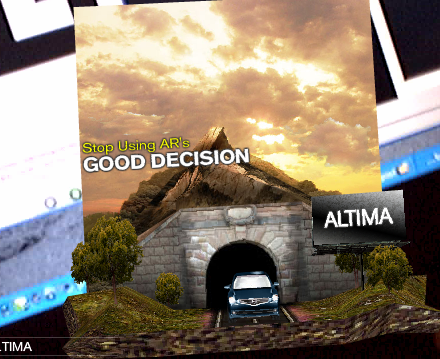
Nissan has a new augmented reality campaign to promote their cars. It’s much better than their old campaign promoting only the Cube, but it’s still meh. But don’t you think that they didn’t consider my plead to stop using AR to sell cars (go there to see their former use of AR, as well as many other augmented car campaigns). They actually think that’s the right decision. Here, see for yourself:
No video this time, sorry. Via Twitter, on every other mention of augmented reality.




 Games Alfresco