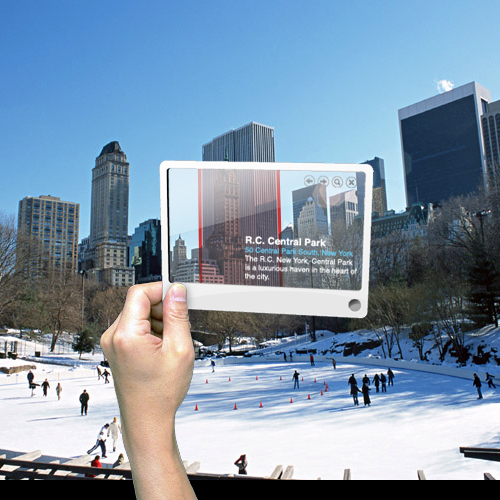
Augmented Reality and the Future of Social Interactiona

Jessica Lamb, a student at Georgetown University pursuing a Master’s degree in Communication, Culture & Technology asks:

If we are more easily able to find information about things and people around us — how do you think that might change the way we interact with people when we rely more and more on computers to deliver information we used to rely on people for?

Do you think that easier access to information will help or hinder meaningful social interactions? Will it create a bigger gap between people who can leverage virtual communications to widen their social network and those who are more reclusive? Do you think AR is more likely to expand or shrink the majority of people’s social networks?

Like many other technologies, scifi grade augmented reality can have both a positive and negative effect on one’s social life. Reclusive people will find the loss of anonymity a real threat, making them even more reclusive. On the other hand, friendly people will find more people to befriended with, and common interests with strangers.
Some will think of AR as a wonderful technology that transfers all the advantages of cyberspace to the real world, and for others, it will bring the dangers.

And yet, Jessica (and yours truly) are interested in your opinion on the subject. Be a science fiction author for a day and share your thoughts in the comments.

Weekly Linkfest

A slow news week, and I’m not the only one who thinks so. Nevertheless, here are some augmented reality related news from around the web:

Weekly quote comes from the fantastic piece, Augmented Reality Network Crashes, Leaving Millions Dataless, imagining a news article from the future:

“I started chatting with a very nice man in line with me at the deli near by office,” said Chicago resident Sue Spiches. “I was waiting for information about him to pop up on my contact lenses, but it never came. For all I know, he was a registered sex offender or a Mormon.”

And this week’s video comes to us from MindSpace Solutions a spinout company from Hit Lab NZ, which created a device called the Digital Binocular Station. Using extra sensitive sensors in the base station, this pair of binoculars can augmented a museum display (or any other room) in a way unmatched by any of their competitors, or at least that’s what the video suggests. I’ll have to visit New Zealand to try it out (here’s my vote for holding ISMAR 2011 in New Zealand).

Have a great week!

ARScope: Augmented Reality Through the Crystal Ball

ARScope originally Presented at SIGGRAPH 2008 by the University of Tokyo (yes, the guys behind ARForce), is obviously not a new concept. However, as far as I can see, it got only little coverage at the time, and certainly deserves our attention.

ARScope is an interesting combination of old world metaphors such as a magnifying glass and a crystal ball, head mounted display and projected AR. The user holds a handheld device covered by reflective material, on which an image is projected from a micro-projector the user wears on his head. Two cameras, one on the handheld device and one on the headset, and a sophisticated algorithm are used to calculate the user’s point of view relative to the handheld device, and thus ARScope is able to project a suitable image. In the case of the crystal ball, it even allows two users to see two different perspectives on the augmented world.

Can’t understand why no-one has commercialized this idea yet. It seems to be far more natural than HMD that blocks your peripheral vision.

Another video can be found here, and an interview with one of ARScope’s creators is here. More details on the project’s website.

Spads and Fokkers – Brainy AR

I always enjoy featuring a hobbyist augmented reality project, and Davide Byron’s (aka @Need2Revolt) game “Spads and Fokkers” is especially pleasing. On the face of it, it doesn’t look anything special, two virtual planes having a dog fight, using a marker for easy augmented reality:

The twist is in the method the user may exploit in order to control the planes, using a brain-computer interface. Writes Byron:

As for the control mechanism, we actually have some devices that are able to read brianwaves and infere what the user is thinking about, so the choice was easy. The newest and most promising headset for thought control is the epoc, not yet on the market, but with a free SDK I can play with. With this technologies I was actually able to develop something that works and doesn’t need any special stuffs you can’t buy off the shelf. In the story, the players controls 3 airplane each, but in practice it was too hard to simultaneusly control 3 airplanes, so I reduced the number to a single airplane for each player. Furthermore, since the airplanes are not projected into the real world, it’s suggested you wear a HMD.

You can download the binaries and source code and learn more about this interesting project here.

A Bit of Microsoft AR

In a striking coincidence last Friday brought two little tidbits showing Microsoft’s interest with augmented reality. First, TechFlash had a Q&A session with Craig Mundie, Microsoft’s chief research and strategy officer. Here’s Mundie on AR:

Q: Another technology that you’ve talked about in the past, and shown, is the idea of augmented reality — overlaying data on top of the real world, as people experience it. Are you expecting that to come more into the marketplace now, and do you expect Microsoft to offer products along those lines?

Mundie: I do believe that will continue to be important. Some of the things we continue to do with Photosynth (a Microsoft 3D photo browsing program) and work related to Bing Maps are trending in that direction, so I think they’ll be a steady progression there. I demonstrated an ultramobile PC where you could use the video camera to look at a scene and then we would do image-matching on the scene to identify well-known items, and then we would bring data forward and annotate the scene dynamically on that. I think that’s certainly in the cards, and you’ll do that on your cell phone.

Then, just to prove the point the Microsoft Research has its sights set on AR, Simon Winder of the Interactive Visual Media group at Microsoft Research (who we mentioned previously here) has uploaded two videos to his Youtube account. The first is another iteration of a treasure hunt powered up by Photosynth to match the camera view to previously recorded scenes:

That’s nothing we haven’t seen before. However, the second video is more conceptual, showing an “augmented cubicle”. I fancy the calendar –

Weekly Linkfest

Here are some more augmented reality news stories that happened this week:

We are signing off this week with a new video out of TU Graz, showing adding annotations online to panoramas. I’ve written about it in more detail before, here, so we can just relax and enjoy the video this time:

Have a nice week!

Bionic Eye Resurfaces as Fire Fighter in new Augmented Reality Game for the iPhone

Presselite announces new AR iPhone game:

Our new project has been revealed today, we are very proud to announce a new Augmented Reality game called Firefighter 360 for the iPhone 3GS.


We actually used our Augmented Reality engine developed for Bionic Eye application to create this little game.


In this life-saving fire-person shooter, you play as a firefighter, rather than gunning down enemies, you will have to douse virtual flames spreading very fast in your real environment. As you physically turn around 360 degrees with your iPhone, you have to methodically extinguish the flames you see, thanks to the camera. The fire itself isn’t just a static “enemy” to be dealt with. Flames will propagate and spread if you don’t put them down completely, the fire itself is capable of doing you harm if you’re not careful.

OK, nuff said. Let’s get it on the App store pronto.

New Video for ARForce

Back when my blog had just a few visitors (only nine months ago), I wrote about ARForce. In a nutshell, ARForce is a concept input device that harness infrared to create something akin to a 3d multitouch marker.

Luckily, Tokyo University, which is behind ARForce, has just uploaded a new video demoing the use of ARForce is several scenarios, so this cool concept will gain larger exposure:

You can find more details, and another video of this device on my original post, or go directly to the project’s homepage.

Junaio is Available on the iPhone App Store – Can Social Augmented Reality be Fun?

They made it:

metaio, Inc. is proud to announce that junaio – the world’s first social augmented reality platform is now available in the App Store. The application is free and available globally on all iPhones. Users without an iPhone can also edit and share 3D augmented reality images via the online platform on http://www.junaio.com.

junaio is a mobile and online platform that lets users create, explore and share information in a completely new way using augmented reality and location-based content. Users can place 3D objects, Twitter messages or websites into the real world and then share their creations with friends through social networks such as Facebook.

Download from the App Store or Visit the website

I participated in the beta and it was quiet fun.

I took pictures of interesting things in and around my house, and in a few minutes – folks from around the world (mostly Germany…) added creative fun stuff to it.

I like Junaio’s concept of You (stuff you created), Here (stuff people around you created), Now (stuff being created right now). However, it was a bit weak on the Here. I guess no one else in NYC participated in the beta. Hopefully that will change now that it’s on the store.

What I am missing in Junaio is the ability to see my creation (and others) truly overlaid on reality. That is quiet hard to achieve on the iPhone with just GPS and compass. This will get much more interesting when computer vision is used and objects are aligned with your real time view of reality.

In the meantime – congratulations to Metaio and all the best!

The Kindle Test

[This post is going to be strange at times, readers should note that I’m the author, not Ori]
According to some estimates, up till now, Amazon sold more than one million units of Kindle.

That’s one million units for a device that is not a phone, doesn’t include a camera, can’t guide you from point A to B, has a grayscale screen, and really doesn’t do much but serving as an e-book reader (don’t get me wrong, I would love to have one).

The point is, e-book readers are far less revolutionary than AR devices. Some would claim (me included) that AR devices are also more useful. Yet, it seems that no one is building a dedicated augmented reality hardware. If AR was really that hot and not a technology that is still a few years away, shouldn’t we see at least a concept AR device? After all, if over a million Kindles were sold, the FlARe would sell like cupcakes.
Yes, the HMDs coming next year can be used for augmented reality, but it seems that they primerly target other markets.

Another “AR capable” device that targets other markets is, of course, the iPhone. Instead of complaining about the iPhone’s lack of support of augmented reality, can’t AR enthusiasts take action to their own hands? Isn’t there another Noah Zerkin type of guy that instead of building an amazing glove, would build a rough hand held AR device to prove that augmented reality is not a lot of hype? Sergey Ten has written today a set of features he is looking for in the perfect AR device. If you are a resourceful guy or girl, start from there.

Consider this post as a call for action, or at least for comments. Is augmented reality going to be bigger in 2010 than e-books readers to merit its own dedicated device?