Where 2.0: The World is Mapped – Now Use it to Augmented our Reality

O’Reilly’s Where 2.0 event is a tightly run ship. One track for all attendees, fast paced 20 minutes sessions, discussing laser focused topics.

Low tech location services at Where 2.0

Low tech location services at Where 2.0

I got my fair share (3 minutes!) to educate the audience about how AR could impact our life, as part of the Mobile Reality panel, covered by Rouli.

A show of hands survey confirmed that only 5% of the audience was familiar with the concept of augmented reality before the event. Not too surprising considering the percentage among the general population is less than 1%.

What came out strongly at the event is that unbelieveable amount of data is being captured about people, places and things around the world. This data combined with sophisticated models (such as Sense Networks) result in the existence of super intelligent information about the world that we still don’t really know how to use.

My point is not a shocker: all we need is to tap into this information and bring it, in context, into people’s field of view.

***

For some time now, researchers in the augmented reality community have attempted to leave markers behind and leap into the great world of outdoor AR (alfresco). These pioneers typically hit walls such as low accuracy of GPS, lack of 3D modeled environments, and the usual device-specific limitations.

Where 2.0 gave stage for two new approaches to map the world that may help overcome the traditional challenges: Earthmine and Velodyne’s Lidar.

Earthmine uses its own camera-based device to index reality, at the street level, one pixel at a time. They have just announced Wild Style City – an application that allows anyone to create virtual graffitis on top of designated public spaces. However, at this point, you can only experience it on a pc!

Why not take advantage of their 3D pixel inventory of the world to make these graffiti work of arts available to anyone on the street? All is needed is some AR magic and a powerful mobile device.

The second novice approach is Velodyne’s Lidar. Remember Radiohead’s funky laser (as opposed to video) clip?

They did it with Lidar.

Now Velodyne is embarking on a broader mission to map the outdoors. Check out this experiment.

Can AR researchers harness these new approaches to index reality?

Reblog this post [with Zemanta]

IGC East: What I Learned About The Game Industry in Boston

On a train from New York to IGC East (Independent Game Conference) in Boston.
The forests along the tracks are blooming yet foggy – I wonder what’s in store at the first ever IGC on the east coast.

The day is structured into 2 tracks: business-oriented as well as developer talks; the highlight of the day is expected to be the demo session, where east coast indies show off their babies for the first time.
I may attempt to do the same.

In my pursuit of the ultimate augmented reality experience, I review the agenda; I am predictably shocked not to find any augmented reality talks.

I miss the keynote (damn trains…) and join the business track mid way with Aaron Murray’s session about the ins and outs of MMOs.

Law and IP session gets into the nuts and bolts of IP protection and licensing content. Some folks get a kick out of it.

Next I learn from Brett Close,  the secretive CEO of 38Studios, about “How To Build Games, Make Your Company Successful And Still Have a Life” 3 noble causes all stringed into one sentence. I get it – it’s not an oxymoron, if you have the right size pockets, or extra patience.

A panel of branding experts from the game industry – beautifully orchestrated by Jeffrey Anderson from Quick Hit – provide tips and strategies for managing your brand.
I use the opportunity to pick Amy L. Brosius‘ brain about how to evolve your brand with the bite-size apps of the iPhone world. Hint: make it simple, short…or bite size…

The sessions end with an activity. Not just any activity, a social change activity. The participants join an effort to transform the lives of unfortunate members of the community – by designing games!
results will be sent tp the participants. I can’t wait.
Dan Roy represents Games4Change and leads the charge. Don’t miss their Festival this month in NYC.

Now for the cherry on top: demo night.

The room is packed with enthusiastic developers showing off their off springs on laptops. Some pretty creative stuff, but I have no time to dig deeper.

One guy, stands next to a corner table, but on the table there’s nothing but a printed image. The guy is waving a mobile camera phone. You guessed it – it’s yours truly, showing off a prototype of his company’s upcoming  augmented reality game. It will be launched this summer on the iPhone app store.  Attendees are wowed. He enjoyes the positive feedback. Curtains. The end.

Enterprise Solutions in the Palm of Your Hand with Augmented Reality

When a large conservative corporation, the #1 enterprise software company in the world, adopts augmented reality technology to promote its new ecosystem site – you know AR is nearing a tipping point.

SAP is launching today its own AR flash based campaign to promote the ecohub.

Is it as slick as the Sasquatch campaign or as cool as the Star Trek app?
Well, keep in mind we are talking about an Enterprise Software company which is less about wowing customers and more concerned with providing value to its customers. And this app is no exception. Naturally the novelty factor still plays a role – but check out what it actually DOES.

SAP’s AR app simulates a search across various dimensions of its massive library of community-created solutions, and it allows you to pick your solution of choice!

A first app striving to be functional among a sea of AR gimmicks.

Full disclosure – I helped SAP produce this app just in time for its annual customer event with less than 3 weeks to put it together.  Programming credit goes to Patrick O’Shaughnessey

Reblog this post [with Zemanta]

11 Industries to be Reinvented with Augmented Reality

We have been raving about how Augmented Reality will reinvent reality. Which slices of “reality” will be affected by AR first? Researchers and entrepreneurs worldwide are already plotting its impact on specific industries.

Investors – here’s a chance to educate yourselves.

Here are 11 of my favorite clips depicting industries reinvented with augmented reality:
(Credits inside the videos)

1. Advertising

Despite being the first on the ar band wagon, the $600 Trillion ad industry has used AR as a gimmick. It has the potential to literally bring consumers to products and totally reinvent itself.

2. Art

Street art democratized minus the vandalism.

Here is another fantastic example – a free form street art.

Vodpod videos no longer available.

3. Design

Real-collaboration, real-time, real-life design

4. Entertainment

Entertainment content could reach you in every part of your day AND be relevant to your surroundings.

5. Health care

Doctors: you have the information – now use it in context of your patient.

6. Learning

Books reinvented. Gutenberg must be turning in his grave.

7. Maintenance

See through walls, floors and roofs? awesome dude – I wanna be in maintenance!

8. Personal Productivity

No more being glued to a screen. No more screens. No more (visible) hardware.

9. Retail

Stores and products talk to you about themselves (but only when you want…)

And from the consumer perspective – shopping will be reinvented

10. Tourism

Your personal tourist guide, anywhere you go.

11. Training

User manuals are dead. Watch the instructions live in your field of view.

What industry would you like to reinvent?

GDC 2009 Roundup: a (tiny) spark of augmented reality

The dust over GDC 2009 has settled a while ago and finally I got to reflect on the AR experience at the show.  Guess which headline would summarize it best:

a) augmented reality was the talk of the show

b) the expo floor was swarming with AR demos

c) AR games snatched lucrative game awards

d) none of the above

dsc03400

A friend in San Francisco wearing retro AR goggles

Unfortunately (d) is the right answer.

But – and it’s a big ‘but’ – the ignition spark was there. The seed was planted. The first shot of the revolution was fired.

(OK, maybe the last metaphor went too far.)

Here are 5 triggers I identified that ignited the spark:

1) Blair

The first GDC augmented reality talk – ever: Blair MacIntyre covered the latest and greatest about mobile augmented reality in front of a packed room of game developers. Awesome.

2) Demos

Was it the first time AR demos (and more demos) were presented at a major Game Developer Conference ?

Not sure – but it certainly was my first…

3)  Mentions in talks

Was Blair’s AR talk an isolated case?

Perhaps as a main topic it was. However, for the first time, I heard significant mentions of AR in multiple other talks. Check them out:

A talk about pervasive gaming. I liked the title: “Beyond the Screen: Principles of Pervasive Game” by the folks from Pervasive Games. The played with the concept in which the whole world is the playground.  These games, are founded in the belief that doing things for real is pleasurable. Games that harness reality as a source book have interesting dynamics.  Everything in reality matters to the game, the game play emerges from coincidence, and real and artificial blur.

Jane McGonigal fantastic talk “Learning to Make Your Own Reality: How to Develop Games that Re-invent Life As We Know It” introduced a concept she calls programmable reality. Augmented reality is among the key technologies to enable that idea.

Camera Based Gaming: The Next Generation by Diarmid Campbell attracted the attention of a room packed with game developers. He talked about Sony’s upcoming camera games for the PlayStation 3 such as Eye Pet. Armed with the EyeToy camera, these games will have the power to extract amusing gestures from players. Not quite AR – but sure smells like it.

Stretching Beyond entertainmentAR made a surprise appearance in a high profile panel discussion feturing some of the gods of the gaming industry: (from right) Ed Fries , Lorne Lanning,Bing Gordon,Will Wright, and Peter Molyneux.
The best quote award went to Ed Fries for saying: “We need to take game mechanics and apply them to the real world”.

dsc03394

4) Meet ups

Dinners, lunches, business meetups, brainstorming sessions – haven’t had that many meetings with AR enthusiasts since ISMAR 2008…

5) The iPhone

When it comes to bringing AR to the masses – the iPhone is a category on its own . And it doesn’t even know it yet…why the iPhone changed everything

-*-*-

Will we ever get to see answers a, b, or c become a real headline?

Most likely in the next few years, if you ask me.

A (tiny) spark was ignited.

GDC 2009: More Augmented Reality Demos at Game Developer Conference

Reporting live from GDC 2009 in San Francisco: it’s just getting better!

From Blair’s team at GA Tech:

Zombie Attack on Nvidia Tegra

From Beyond Reality at the Dutch pavilion:

Pit Strategy

Stay tuned for more…

GDC 2009: First Augmented Reality Demo at a Game Developer Conference

As soon as the exhibition floor opened today at the Game Developer Conference (GDC) in San Francisco, I rushed to visit the Vuzix-Metaio booth to witness the first consumer-oriented augmented reality booth ever to exhibit at GDC.

I was not disappointed. Just watch this clip.

Stefan Misslinger (Metaio) did a fantastic job  acting it out, don’t you think?

Vuzix also had on the display the upcoming-anticipated-long-awaited-soon-to-be-released 920AV AR glasses. It wasn’t in working condition, but Vuzix promised it will be released this fall.

When the event kicked off, I offered to serve as your eyes and ears; Peter Milford took the offer and expressed his curiosity about the latest from Vuzix. This one is for you Peter: yours truly posing with the goods.

vuzix920v

Now the key question is:

how would you rank the look of these specs on a dork-to-cool scale?

ArToolKit Wins the Oscar of Virtual Reality

An important message from Mark Billinghurst about ArToolKit:hirokazu

On Tuesday March 17th, Hirokazu Kato recevied the 2009 IEEE VGTC
Virtual Reality Technical Achievement Award for his development of the
ARToolKit tracking library. This was given at the IEEE VR 2009
conference, the premier academic conference for virtual reality. The
VR Technical Achievement Award is a great honor and has only been
given out five times before, to such people as the inventors of the
CAVE immersive VR system.

For Hirokazu Kato this is well deserved because, although it was
developed ten years ago, ARToolKit is still the dominant computer
vision based AR tracking library with over 170,000 downloads. Almost
all of the researchers in the AR field have used ARToolKit in one way
or other, and many of the AR applications in the field have roots that
can be traced back to ARToolKit. As a result of his work, AR
researchers and developers didn’t need to build tracking code, but
instead could focus on AR application development and interface
design. The community owes a huge debt of gratitude to Hiro and it’s
great to see that his achievement has been recognized.

The full announcement.

GDC 2009: I Have Seen The Future Of Games and I Wasn’t Alone

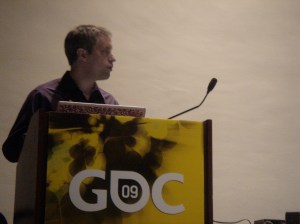
In front of a packed room, Blair skips the typical introduction to augmented reality (he knows his audience) and dives right into demonstrating how fun AR is. What better video to explain it in a game conference than showing Roku’s Reward.
blair-gdc-1
Blair explains the essence of AR play:  tight integration between the real and the virtual. He then shows examples of existing handheld AR games: The invisible Train,  a Gizmondo game, and of course his own baby: ARf running on an iPhone.

He’s excited about the next generation of handhelds (e.g. from Nvidia Tegra, TI OMAP) which are going to make the experience more pervasive and popular.

But why do AR at all?
How can you go beyond just an eye candy?

You have to use the new game mechanics that are made available. And as always create compelling stories and game play.

Now a little bit of technology for the geeky audience:
how do you do tracking?

He quickly goes through various types of techniques: markers, natural feature tracking, and 3D tracking. Daniel Wagner from Graz is mentioned multiple times.

Handling camera and lighting is mentioned as key for a good experience.

And of course graphics. In order to create a more believable and tangible look don’t forget shadows, occlusions, physics, and how about a rotoscoping-like look?

Now for some more examples of games developed by his students:
There’s a whole category of table top games which emphasize interaction between players. It’s fun to see when players get into the game, they point into thin air, refering to the virtual objects.

Blair describes the game Bragfish: using a Gizmondo, multiple players around a game board navigate virtual boats to capture fish in a pond. Interesting social interactions emerge such as pushing and obstructing each other…

Art of defense: a co-op game for 2 players running on Nokia 95.

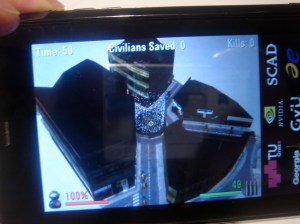
ARf: a virtual pet toy on the iPhone. where you can interact with a pet that walks on your table. Scratch the table and the cute virtual dog will sniff it.

Joe Warpin: flying in a helicopter and shooting terrorists in a building. Only the building is really a chair covered with markers…

AR Zombies (just finished this Saturday): running on Nvidia Tegra – this time – shooting Zombies. Graphics are nice. Lighting changes to reflect the themes.
blair-gdc-2

Outdoor AR and large area AR will become reality in the near future and will be really cool.
And with that optimistic note, he’s opening the floor for questions.

Question: How can you go and play in a ad hoc site and play with no pre-prep?
Blair: in the future games will be able to recognize with no prep. Example is SLam which maps the environment while playing and then allows to play there.

Question: Are you using other sensors such as infra red?
Blair: I don’t do that stuff – but others do…there are some expensive sensors systems that work well and open up very interesting stuff.

Q: you could solve the problem of outdoor modeling with a captive audience (I am an ARG guy…)
Blair: absolutely. See what Microsoft is doing with Photosynth. Military has done that in submarines to track people in case of emergency.

Q: You mentioned that AR could be exciting and terrified…what did you mean?
Blair: When you can see an alternative reality it could be really fun (and scary)…that’s what I meant.

Q: Could we use the same indoor markers for outdoors purposes?
Blair: too much work…too many markers are required. They’re ugly. But you could overcome thee challenges with clever design.

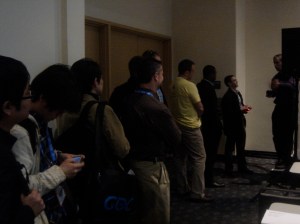
The time is up but a long line is stretching in front of the podium – people want to hear more.
blair-gdc-3

After the talk, I had a couple of hall conversation; folks were totally intrigued with the new opportunities.

I have seen the future of games and I wasn’t alone.

Such a shame this is the only AR session at GDC. I am back to my pursuit of more AR vignettes.

Did I just see Ron Azuma (one of the fathers of AR) in the room?