Final Schedule Published For the World’s Largest Gathering of Augmented Reality Professionals at ARE 2011

The second annual Augmented Reality Event (ARE 2011) is just 1 week away – and the final schedule published today has got it all: Entertainment & drama, learning & playing, psychology & emotion, brain & heart, capitalism & art – and many other superlatives about augmenting the world.

Confirmed number of speakers at the event is a staggering 113 leaders from 82 AR companies!

But it’s not about the quantity – the quality of these speakers is what makes it a must see event: check out the wide variety of talks in the ARE2011 schedule-at-a-glance and you’ll start drooling. Come to the event and see for yourself how AR is already changing practically every aspect of our lives.

Register today with the exclusive discount code for games alfresco readers: ORI295

The Best of the Best in Augmented Reality Compete for Top Industry Award

Industry icons Bruce Sterling, Vernor Vinge, Will Wright and Jaron Lanier to judge “The Auggies” – at the worldʼs largest AR event.

Register Today!

SANTA CLARA, CA (April 26, 2011) – The Augmented Reality industry is getting ready to show off a new round of innovation to the technology, media, and marketing communities.  If you ever wondered about the potential of Augmented reality and wanted to check it out up close, you will be excited to know that “The Auggies” returns to the world’s largest augmented reality event, ARE 2011 at the Santa Clara Convention Center in California. The second annual Auggies competition will take place at the heart of Silicon Valley as the brightest minds in the industry put on a show to impress the industry’s most iconic judges and inspire the audience packed with AR enthusiasts.

The thing I like best about ARE is personally witnessing things that never show up on the Internet. There’s a tension in Augmented Reality, between the global scope of the technology and the local character of the teams that produce it. When you’re in the room with committed, creative people — looking them in the eye, breathing the air they are breathing — that’s what makes it an “event.”

– said Bruce Sterling.

For the Auggies competition, augmented reality teams get 5 minutes each on stage and compete for the coolest live AR demo. The panel of judges provides their unabashed comments, critiques and if they are deemed worthy praise. Winners will be voted by the audience and receive the prestigious “Auggies Award.”

The Auggies is the opportunity for AR developers to unveil their vision of the future, not only in terms of technical progress, but also on how creative you can be with this technology. Winning is truly an important recognition from the AR community and it surely means you’re defying the norm and taking one step further.

– said Ivan Franco of YDreams – the 2010 Auggies winner.

Nominations for live demonstrations at the 2011 Auggies include: Previznet, Georgia Tech, Mobilizy, Whistlebox, Ogmento, Metaio, Vertigore, and Occipital.

The competition is still open for additional nominations until May 10th.

The only way to witness the yearly AR battle for the Auggies and participate in the live audience voting is to register for the ARE 2011 event. Event registration is limited and does sell out.

Special Discount for Games Alfresco Fans for ARE 2011 – an Event Packed with Augmented Reality Goodness!

The second annual Augmented Reality Event (ARE 2011) is unveiling a sneak preview of the schedule for the world’s largest event – focused exclusively on advancing the augmented reality industry.
ARE 2011 will take place in May 17th-18th at the Santa Clara Convention Center in California, and is surely a must-attend event for the Augmented Reality (AR) community, and anyone interested to learn about AR.
****
Join Bruce Sterling (“the prophet” of AR) on the main stage, with Vernor Vinge (author of “Rainbows End” and “The Coming Technological Singularity”), and Will Wright (Legendary game designer of SimCity, The Sims, and Spore). Also returning from last year’s event, Blaise  Aguera Y Arcas (a leader in Microsoft’s mobile strategy), to top his Ted talk demonstrating innovations in Bing Maps and Augmented Reality. And if that’s not enough magic – Marco Tempest, the world’s most notable AR magician will stun the audience with a live augmented magic show.

****

The 2 day event will feature more than 33 hours of talks running the gamut of AR essentials in 3 tracks: Business, Technology and Production:
a) BusinessFor executives of established and start-up AR companies, as well as mobile hardware companies – in search of business models and promising verticals for AR;  a venue to form partnerships, learn about latest innovations, and most importantly speak with clients.

b) TechnologyFor Developers, programmers and technologists seeking the latest and greatest engines and tools for AR; learn from case studies and post mortems delivered by experienced developers from the leading companies in the space.

c) ProductionFor Producers, designers, project managers (in gaming companies, agencies, marketers, brands, and artists) hungry for proven techniques to leverage augmented reality to advance your brand, attract and keep your customers, and build successful campaigns and products that will delight users.

For a complete list of confirmed speakers checkout the website at: ARE 2011 Speakers

If you are an AR Enthusiast – you will feel like a kid in a candy store at are2011.

Not convinced yet? Check out these special activities:
1) “Startup Launch pad” – Five AR startups present their business models and products in front of an expert panel: VCs, Entrepreneurs, and industry luminaries – hosted by a major industry powerhouse. Winner receives: “ARE Best startup prize” (to be announced.) Submit your proposal here under track: “Startup Launch Pad”.

2) “The Auggies” – Teams get 5 minutes each to present on stage and compete for the coolest live AR demo. An extraordinary trio of judges: Bruce Sterling, Vernor Vinge, and Will Wright, will comment on the demos – American Idol-style. Winners will be determined by the audience and receive the prestigious “Auggies Award.” Submit your proposal here under the “Auggies” track.

3) ARt Gala – A display of AR art projects and live performance art by the world’s top AR artists featuring: Helen PapagiannisAmir BaradaranSander Veenhof and more to be announced. And to make sure all your senses are stimulated – drinks and food are on the house – courtesy of our sponsors.

4) ARE Press Conference – If you are planning to announce a new product or service – secure your spot in the press conference that will kick off the event. Submit your proposal here and add: “Press Conference” in the title.

5) Exhibition and Sponsorships – A small number of booths is still available in the exhibition hall ($995 for 10′x10′).Grab them while they last!

Use ORI295 – special discount for Games Alfresco’s fans and shave off $100 of the already sweet price tag of $395.

Register today for the augmented reality event!

Live from GDC: Augmented Reality Games Are Here Big Time

Augmented Reality games made a splash at GDC 2011.

From a first ever mention in a GDC keynote, through multiple dedicated talks, and major product presentations on the exhibition floor – augmented reality games are warmly embraced by the gaming industry.

1) Qualcomm’s talk and major AR presence throughout the event

Jay Wright spoke about the opportunities with Qualcomm’s AR SDK and showed examples of mobile AR games, applications, services and best practices for engaging new adopters. Qualcomm was visible throughout the event championing AR games, including a series of demos of AR games from their developer challenge presented on the show floor.

For an in-depth interview about Qualcomm’s offering check out this YouTube video

2) Ogmento’s talk and demo of its new geo-social AR game

Terrance Cohen and Oriel Bergig from Ogmento gave a fantastic talk – “Taking the Purple Pill: Lessons Learned Building a Platform for Social Augmented Reality Games.” Awesome job, guys!
The talk was accompanied by demos of never-before-seen technical and experiential achievements in this game. No video of the talk is yet available, so to get a sense of the game checkout the trailer:

Several other talks mentioned augmented reality as an emerging field such as Booyah’s Keith Lee.

3) Nintendo 3DS AR games demo

Archery – one of the best single card AR games I have seen so far, was available for playing on the show floor. The experience is distinctly different than any other type of games you can play on PC, consoles, or portables. 5 other games are in the pipeline and should hit the US market by the end of March.

Satoru Iwata, the president of Nintendo gave the main keynote of the event: “Video Games Turn 25: A Historical Perspective and Vision for the Future.” I was blown away when AR Games were mentioned as the first attractive feature of the upcoming 3DS.

I am pretty sure it was the first mention of AR in a GDC keynote EVER.

3) Augmented Reality demo on Sony’s Next Gen Portable

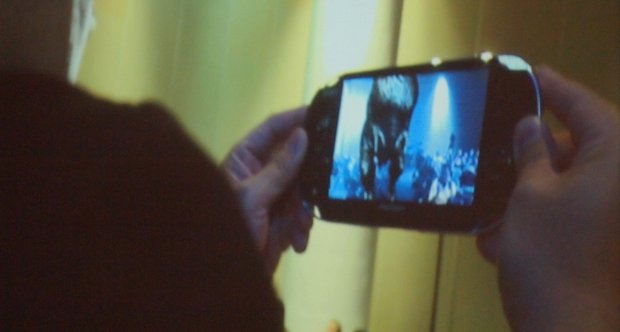
Sony’s next generation portable (code name for the upcoming PSP) was not available for playing at the event (you could only appreciate it behind a glass case), but a cool demo at a Sony talk (via Shack News) showed a little bit of its potential. And not surprisingly – AR was once again its main attraction – a full size dragon marching among the audience!

5) AR Drone made a return appearance

We are almost accustomed to seeing this fantastic use of AR with the easy to maneuver quadrocopter, in game industry events, and GDC 2011 was no exception.

6) Sony Move and Microsoft Kinect games

Sony and Microsoft presented a bunch AR games on Move and Kinect respectively – which by now almost feel like mainstream. Man, AR has made a long way since 2009.

So how does GDC 2011 compare with GDC 2010 and GDC 2009’s Tiny Spark of Augmented Reality?
In a nut shell: if in 2010 Augmented Reality made progress in mind share, in 2011 it’s making a significant impact on new products; it’s popping up everywhere. That is awesome.

***

When will EVERYBODY at GDC be talking about AR?

When will AR games win major awards at GDC?

It’s coming real soon, don’t miss it folks!

Top 10 Augmented Reality Projects by the Music Industry

Augmented Reality is like music to my ears (couldn’t resist the pun…)

The music industry is known more for stifling technology innovation than adopting it (cough*Napster *cough) which makes it especially gratifying to see recent attempts to harness augmented reality for music lovers (and/or nerds).

Here are my Top 10 augmented reality projects created by the music industry:

10) StudioB, Adobe and John Mayer “AR video clip”

“Studio B teamed with Adobe and John Mayer to create the worlds first Augmented Reality music video. Studio B shot and keyed the green screen footage using the new Apple ProRes 444 codec. I’m holding up a piece of paper with the designated marker (in this case a broken heart), and the video of John Mayer follows it around the screen, and even tilts in 3D space!”

It’s impressive to see a major music figure dedicating his time for an AR app – but is this significantly more interesting than just watching this 3D video on your PC?

9) Video for German Band Saint Aside

Here’s a “me too” music video in Germany for the band Saint Aside:

“Germany’s first Augmented Reality music video of the band Saint Aside. Das erste deutsche Augmented Reality Musikvideo der Band Saint Aside. Powered by AUGMEDIA dem Virtual Reality Marketing Kreativ-Netzwerk aus Deutschland, Leipzig.”

8) Doritos and Rihanna deliver AR experience

Can’t really see the AR interaction in this video, but hearing Rihana say “Augmented Reality” is worth it.

“To view “Who’s That Chick” by Rihanna in full, simply buy a bag of Doritos Late Night and got to http://www.doritoslatenight.com
Using special packs of Doritos Late Night chips and a web cam, you can unlock an augmented reality experience with Rihanna.”

Triggering the experience from a consumer package is cool (no more printed markers!)

7) Kit-Kat and Scouting For Girls music

“Scouting For Girls – Augmented Reality with Kit Kat. If you open up a Kit Kat, do you see the augmented reality of Scouting for girls? Do the She’s So Lovely Stars really play in there? Join Scouting For Girls here to find out. Or, visit http://www.kitkat.co.uk/musicbreak

Yet another music video triggered from a consumer package (Kit-Kat) – this time it’s more mindful to the new medium.

6) Eminem augmented reality competition by Polydor Records

“To take part all you need is a printer and a webcam – then, using the graffiti tools on the entry page, customize your very own 3D rotating Eminem “E” logo.”

“…enter the amazing Eminem augmented reality competition and you could win the trip of a lifetime to visit Em’s home town of Detroit”

Although not an AR music experience per se (more of a graffiti experience)- it’s definitely encouraging fans to interact with their idol in a new way. Talk about high profile motivation.

5) 10th Dimension create your own music video, TakingDog Studio

(Start watching at minute 2:03)

“Now you can create your own Augmented Reality real time interactive music videos for two of the songs from this project. Go to http://www.talkingdogstudios.com/10thdim to try it out for yourself.”

Anything that involves some creation beats “screen watching”.

4) Music mixer with 5Gum

“Truly interactive Augmented Reality Application. Log on to http://www.5gum.fr to record your mix.”

Making music with an augmented reality interface is a cause for celebration.

3) Aphex twin overlay on Audience faces

“At this weekend London Electronic Festival (LED) Aphex Twin used live facial recognition to map the audience and overlay images of his own, trademark distorted face. Mesmerising and disturbing in equal measure! “

This is one of these things that had to be done. And they did it – beautiful!

2) Lost Valentinos customizable video clip with AR

“Innovative Sydney band Lost Valentinos and label etcetc have pushed an emerging technology to the very limit by launching the world’s first truly interactive augmented reality music video project. The project allows fans to record their own customised music videos for the single ‘Nightmoves’ by capturing band members performing the track in the fan’s own world. From lead singer Nik performing the song atop a user’s shoulders, to the whole band playing the song at the base of the Eiffel Tower – it’s a project limited only by the imagination.”

Record your own video clip with AR? Can’t get much better than that!

1) Black Eyed Peas 360

The most impressive use of AR in the music industry so far and the reason behind this post:

“App review: The New ‘BEP360‘ App for iPad, iPhone and iPod touch Takes Fans Inside ‘The Time (Dirty Bit)’ with 360-Degree Motion Control and Augmented Reality app Developed by Peas Front Man will.i.am”

Edo Segal, from Futurity and a good friend – is behind this initiative that attempts to redefine how we experience music.

***

Didn’t make the list:

  • Voodoo Experience by Zehnder with Layar Augmented Reality browser (meant to enhance the concert experience – not to deliver a new way to experience music which is the focus of this post)
  • Exile on Your Street – an AR app for Rolling Stones fans – built on Layar – it enables you to leave Rolling Stones posters at your current location.
    Each poster can be customized with a track from Exile on Main Street and a personal message (no visual reference found)
  • N-Dubz, Against All Odds record cover triggering AR by Total Immersion (couldn’t find a video)
  • Album by hip-hop act Sinik, “Ballon d’Or,” include images giving access to ‘augmented reality’ features, by Total Immersion (couldn’t find video)
  • Sean Kingston: printing a special icon in the CD booklet for his album, which gave users access to the special AR section of his website. They could then sing along into their webcams to Sean’s Fire Burning track, with an animated version of the star appearing to dance around them. There were sharing elements here, too – the resulting videos could be posted on social networks or shared on the main site. (via Music Ally)
  • Lynx Augmented Reality Groupies on your desk (promoted a deodorant)
  • AR in French Music Video by Toxic Avenger (not really AR)

Ok, that’s cool. But grab any music industry executive that gets it, and you’ll hear that the true value of AR doesn’t lie in helping promote music (the industry is pretty good at marketing music as is), but in creating new experiences, new products which will lead to new revenue streams (think Guitar Hero). The sober realization is that it’s unlikely people will buy more music than they already do – but they are likely to want to experience music in new ways, and through new channels.

What will it look like?

How would you like to experience your favorite band in the real world (AR style)?

Additional references for AR in the Music Industry:

The First Fun Augmented Reality Game on the iPhone App Store Was Just Submitted

Since September 2009, we have seen many quasi-augmented reality (AR) games on the iphone, some fun concept AR games (on other platforms and devices with no real commercial distribution).

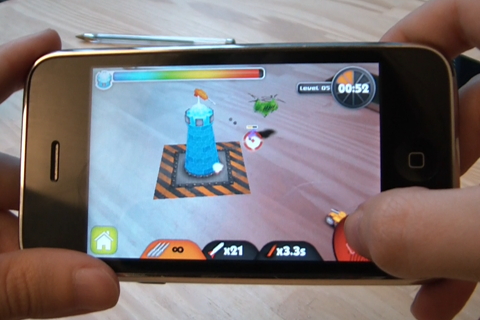
Today I had the pleasure to play the first truly fun, truly AR game on the iphone – and I loved it.

It’s called AR Defender, developed by the talented team and our good friends at Int13.

With close to 30 frames per second – it’s a huge achievement from a technical perspective (even though they are using their proprietary marker).

And it’s looks great. The game play is a mix between a simple table top game, and a typical to Tower of Defense game, nicely adapted for the AR experience. Few seconds into the game you forget you are aiming at a marker and get immersed into the game play – wow!

That together with the fact it’s available on the app store may lead to commercial success that we haven’t seen before with an AR game.

This is VERY encouraging, because Games Are The Killer App For Augmented Reality.

Check it out:

The game should be approved by Apple soon – so when it does – try it and let us know what you think!

A New Device for Augmented Reality Games Was Born

Finally, the iPod Touch has a camera!

Today, Steve Jobs announced at the Apple Music Event, the new incarnation of the legendary iPod product line.

One of my personal highlights was of course the new iteration of the iPod Touch. Faster (Apple A4 processors – like in the iPhone), with the new Game Center(iOS 4.1), the largest games market (1.5 billion games and apps have been downloaded to the Touch), and now – can do Augmented Reality.

Jobs bragged the iPod games outsells Nintendo DS and PSP games – combined!

There you have it – the perfect new platform for augmented reality games (as long as you have WIFI…)

3 Reasons Why Games Are The Killer App For Augmented Reality

We all are great believers in the potential of Augmented Reality (AR). Within the next 10 years, we say, it will totally change the way we interact with the world.

But what industry will be the first to bring AR to the masses?

When you co-found a company that focuses on Augmented Reality games – and especially – when it secures an investment from a venture capital firm – you have some deeper explaining to do.

Here are 3 key (business) reasons why games will be the first industry to spearhead augmented reality into the mainstream:

Reason #1 Games are the killer app for emerging technologies

Games Accelerate the Adoption of New Technologies by the Mainstream

Games have a history of pushing the envelop of new technologies and bringing new inventions to the masses: computer graphics, memory, silicon, screens, 3D animation, interactive story telling, immersion…and the list goes on and on. What made GPUs popular and drove its development? Games! First mainstream handheld electronic device? Games! When PCs were first introduced to consumers how were they marketed? As more capable than video game consoles…

Nolan Bushnell (the legendary founder of Atari) wrote back in 1996:

“WHIMSY and fun are often the precursors to powerful tools that are used later for more serious applications. A project at inception might not be useful because of lack of infrastructure or incomplete refinements. The automobile and airplane were considered toys before they were reliable and safe. The computer game has filled a similar role in being the incubator for many innovations that drive the usefulness of the computer.”

Was the first PC a video game console?

Gaming has done it many times in the past – now it could accelerate the adoption of Augmented Reality (AR) by the mainstream. And it has another advantage…

Game Design Can Overcome Technology Limitations And Deliver a Powerful Experience

In the best games, the pleasure manifests itself in the players imagination – not necessarily on the screen.
Skeptics will say AR is not ready for the mainstream yet: It’s not fast enough; it doesn’t work in bad lighting conditions; hardware has a long way to go – and you know what – they may be right. However, in games – clever game design can help overcome technical limitations and provide a fun experience. This luxury is not available for many types of real world apps, definitely not military or healthcare apps – which deal with life or death situations.

In games, you can focus the player on the highlights of the technology, and dodge the stumbling blocks. Or you can take advantage of a technical drawback and present it as a challenge of the gameplay  – which makes the game even more captivating. In the words of Raph Koster, a veteran game designer: “Creativity, is largely about finding solutions within a known problem space.”

For example: recognizing an object takes too long? build it into the suspense of the game. Tracking gets out of whack when the camera moves too fast? encourage players to keep it steady as a special skill required for succeeding in the game. Tell a good story; use non AR elements to create a more rounded experience; use AR as a highlight that takes the game to a never-before-seen level.

Game design is a strong reason why games will be first to drive AR into the hands of consumers.

But is there a market for these AR gaming experiences?

Reason #2 Games is a big business going through transformation

500 Million Digital Natives Will Spend 10,000 Hours Playing Games Before the Age of 21

A recent statistic (heard at TED by Jane McGonigal quoting a research by Carnegie Mellon University): “500 Million gamers Will Spend 10,000 Hours Playing Games Before the Age of 21” (and in a decade another billion gamers will be added.) That’s a lot of people, spending a lot of time with your product. Plus they are early adopters which makes them a likely audience to want to try your product.

AR devices are already in our pockets

What’s the barrier for entry? Can digital natives afford the hardware required to experience AR games?

With the invasion of the iphone, Android phones, and other smart phones into our pockets, all of a sudden, we carry with us at all times, the ingredients required for an augmented reality experience (nice screen, video camera, adequate processing power, communication, GPS, and other sensors). Many digital natives already have an AR capable device…in their pockets.

(31% of U.S. teens want iPhones And 14% already own one and Android phones are catching up.)

By the way, how many americans currently play on mobile devices? 42%!

OK, so many people are spending a lot of time playing games and have the hardware to play AR games, but what’s the revenue potential of the game industry?

Gaming is a $67 Billion Growth Industry Going Through Transformation

Gaming is huge. Bigger than music, bigger than movie box office. And yet, it is going through a major disruption.

On the one hand revenues by major publishers such as EA and Activision, are growing, but on the other hand they are struggling with profitability.

One of the key drivers is the massive transformation from retail distribution to digital distribution: the iphone, online games, and social games – are bypassing the old retail distribution model which charged $30-$60 per title and are reaching directly to consumers with a race to the bottom in terms of pricing.

Another major disruption is the rise of new game genres – most notably social games. Companies which as recent as 3 years ago were unknowns, are now being gobbled for huge sums:  $300M for Playfish (acquired by EA), $763M for Playdom (acquired by Disney), Slide (acquired by Google), Kongregate acquired by GameStop, Zynga is estimated to be worth $3B and can hardly be acquired…

Zynga's Farmville

Social games and casual games are reaching new audiences that previously were out of reach for game developers (survey shows that dominant age group playing social games such as Farmville is women 35-55).

Jesse Schell, instructor of entertainment technology at Carnegie Mellon University  says: “There are games now for pretty much every age, every demographic. More and more women are going online. It comes down to everybody is playing games. Games are just evolving like species in order to fit into every little niche of our lives.”

In parallel to the change in game genres and audiences there is also a massive change in business models. If up until recently games were selling for $30-$50 a pop and required a trip to the store which limited its potential audience – nowadays a new game is a click-to-download away and more and more games are available for free.

Which leads to the next point – a fresh business model that was made for games.

Free2Play + Micro-transactions is a Business Model  that Works Best in Games

web 2.0 has brought about the concept of Freemium business models which help reach massive audiences and drive light speed growth in revenue. Free2Play + micro-transactions is taking it further. Games are much more engaging than any other form of apps and drive the consumption of digital goods. Tying purchase to the compulsion loop in games has proven to be very effective. In the words of ngmoco’s Neil Young – it’s the new “Quarter Sink” from the arcade games era.

Of course, when using micro-transactions in games it’s important not to detract from the experience. Farmville by Zynga is a good example: impatience is the driving factor behind the appeal of micro transactions. And thus the experience is in no way impacted by those with patience and resourcefulness. As long as you avoid the potential pitfalls with micro transactions as articulated by Kevin Miller this business model is a fantastic revenue stream for games. Especially on the iphone where a 99 cent for a virtual weapon needed in the game is just a tap away. Worldwide sales of virtual items are expected to reach $7 billion by 2015, according to online games research firm DFC Intelligence.

Where else (except music) do you find such levels of revenue from digital goods?

Games Are a Key Tool For Marketers to Reach Their Audiences and Bolster Brands

Games are such a powerful medium for engaging audiences, that it is becoming a key tool for marketers to reach their customers and strengthen their brands. Take GE’s Smart Grid interactive campaign featuring augmented reality –  it got more than a million YouTube hits – an order of magnitude higher than equivalent traditional online campaigns. The Advergaming industry had revenues in excess of $3 billion on mobile, iPhone, and social networks platforms. And this is accelerating because digital natives expect to interact with the world through games. New target age groups and demographics are playing games which are more immersive than other types of advertising.

Games have just surpassed email as the #2 online time killer for americans. Guess what’s the first time killer? social networks. And what do people do on social networks? 40% of the time is spent playing games…

Adam Dole (a Design researcher) wrote in his paper : “Games engage consumers and build value around products and services, creating a powerful competitive advantage. The highest level of consumer engagement and brand loyalty comes from positive experience. By reflecting the way people want to act, a product or service more effectively changes attitude and behavior.”

Couldn’t have said it better.

So, games are big, and will get bigger. But how does it relate to AR Games which are played in reality?

Reason #3 Games are Getting Physical

For Digital Natives Gaming has become the primary metaphor for interacting with the world

The next generation (aka digital natives) has evolved to expect a very different way to interact with the world, and it’s largely influenced by games and the internet. They expect everything they interact with – to behave like games: provide challenge and reward loops, fellowship, discovery, narrative, expression. These are game pleasures (loosely taken from Marc LeBlanc’s list) that digital natives are used to – and they seek them in anything they do – in their real lives.

So if games escape computers and consoles and penetrate the real world, how will it impact our lives?

Games have the power to transform our real lives

Really?  Just checkout the Fun Theory Guys’ work. This team is hard at work proving that by injecting fun into daily routines you can change people’s behavior . When presented with multiple options (stairs or escalator) people are more inclined to chose the option that is more fun (playing piano while going up the stairs.)

Gabe Zichermann – which has been touting the funware theory says: “anything can become more fun if you bake games into it. The human brain is attracted to fun. Games can improve the outcome of every aspect in life. Points, rewards, immersion…”

In sales, it has already been used successfully: leaderboards, scoring and badges are a common aspect of sales people in many sectors.

Jane McGonigal takes it further in her Ted Talk and claims: “Games create urgent optimism and blissful productivity.” How could we harness this power to make the world a better place?

Jane McGonigal

Speaking of Jane, she has a track record of applying game mechanics to non game environments: she designed game features in ebay.com to reward sellers for high throughput combined with high satisfaction, by awarding them badged and literally unlocking levels.

Here are more examples listed by Adam Dole (a Design researcher) in his paper about Gaming for Behavior Change:

Mint.com, a financial management tool that leverages gaming principles to successfully capture and expand its market.

When Toyota began visualizing fuel consumption for drivers in their Prius models, they created a “fuel economy game.”

RecycleBank is a web-based service designed to promote recycling. Families accrue points based on the weekly amount of materials recycled; these points can be redeemed for discounts at over 1500 national businesses.

Byron and Leighton in their book: Total Engagement – show how to use games and virtual worlds to change the way people work and businesses compete.

But are websites the most optimal interface to “gamify”  our lives?

Why not insert these same mechanics into our field of view?  Into our visible reality? Into our daily routine?

Augmented Reality and games mechanics is a match made in heaven to reshape our real lives.

But here’s the caveat: when I first gave my 12 year old daughter an AR game to test – she asked: will I have to move…?

Are kids really interested in moving while playing? Will gamers be leaving the comfy couch and beloved controller in exchange for playing in the real world?

Games are Already Moving (Back) into The Real World

Digital natives were born into the digital revolution; they may be shocked by the following revelation: before video games – games were actually played in the real world. Since the dawn of man – playing games was how humans learned new skills. When civilization started 10,000 years ago people have already been playing board games and team games. In 1972 with the introduction of Pong – games have started a transition away from the real world and into the digital realm…

The latest trends in the gaming world (across consoles, social games, and location based games) point to games moving back into the real world: interfaces are becoming more intuitive – losing the traditional game controllers in favor of gestures. This has been aggressively persued in the game console segment: first by the phenomenal success of the Nintendo Wii which opened up new markets for gaming beyond hard core gamers. Sony Eyetoy and Sony Move are taking it a step further with a camera based system that tracks the movement of gamers. Microsoft  Kinect for Xbox (planned to be introduced this holiday season) will not require any controller whatsoever – the player’s body becomes the controller.

In social games, players interact with real life friends instead of imaginary avatars such as DragonSlayer85 which, in a way, is making the games more linked to the real world. In addition, Zynga, the leader in social games, expanded its super successful Farmville game to interact with real world objects. Starting this summer, consumers will be able to purchase specially marked products to receive a redemption code that can be used for a new, limited-edition virtual good in one of three Zynga games. For instance, you can buy a real Big Gulp from 7-Eleven and get a virtual version as well.

Location-based games are emerging and attracting massive audiences. Games such as MyTown which let you buy and own your favorite real-life locations, and collect rent when other people check-in to your shops – has amassed more than 2 million users in several months (more users than Foursquare has!), and has recently introduced Product Check-ins – registering interaction with an actual product by typing in a code.

Facebook, a phenomenal growth engine for social games, is also getting closer to the real world with the recently announced Facebook Places.

Clearly, there is an appetite for gamers to play in the real world. This transition from a made up virtual world that takes place on a screen – to the real world – is already happening. Augmented Reality has the power to accelerate this momentum and along the way introduce a new type of experience to massive audiences.

The Opportunity

Now here’s the big question: if games can advance AR forward, have a huge market potential, and have the power to impact our real lives for the better  – how do you explain the following fact:

The top 18 of 20 paid iphone apps of all time have been games and entertainment (2 are music and 16 are games) and yet, there are only a handful of (mediocre) AR games available on the app store?

How come?

The underlying reason is that good AR games are hard to make. Since the technology is admittedly in its early stages, developing AR games require in house expertise in AR, which are hard to find. Even if you do posses these rare expertise in house – it must be merged with game design skills to take advantage of the technology and create a fun and sustainable game experience.

Building successful AR Games relies on nurturing multiple disciplines and carefully fusing them together – with lots of passion. This has never been done – until now.

Fusion...

This gap between the attractiveness of games in general and the lack of AR games for sale – points to a huge opportunity.

Someone, somewhere is currently working on a killer Augmented Reality game that will completely change the way we look at games, and will catapult Augmented Reality to mainstream awareness. I believe it will be unveiled in the coming months.

Are you it?

Do you have what it takes to make AR Games that reach the mainstream?

The Great Civil War Augmented Reality Project

Augmented Reality is the best way to experience history.

My dream is to have a “time machine slider” that allows me, in any given location, to see how things looked at a certain point in history. My field of view would be overlaid (with perfect registration;) using old maps, drawings, old photos, recreations in the form of documentaries, or even big hollywood productions.

It could get really interesting when I slide the time machine slider forward to see how a certain city might look in the future.

***

Some folks are already trying to make this happen today. Just in time for the 4th of July. Checkout this fascinating initiative by a group of educators in Pennsylvania:

Our project, the Civil War Augmented Reality Project, is intended to
enhance the experiences of people visiting Civil War sites. It is also
intended to increase attendance and revenue for historic sites by
offering both “high” and “low” tech experiences to best reach the
majority of the population.
We feel that our project is fulfilling a need that educators, park
workers, technology enthusiasts, and Civil War enthusiasts have
discussed in the past: How can historic sites both raise educational
value and public interest in their institutions though technology,
while not alienating the non-technical history fans?
We have worked hard on the answer, and are interested in promoting our
creative solutions.
We would like to make clear that the project is not intended solely
for Pennsylvania. It is our hope that the project will expand to other
venues, as we feel that we have the ability to use our ideas to
enhance the experiences of all students at historic sites.
How is this going to work technically?
Jeff responds they’ll start by using Layar as the platform for the AR apps, and
they’ll probably use Google Earth in the binoculars installations. The
binocular installations will be self fabricated, and the AR
applications will be available to the public and of course an integral
part of the tablets they’ll be adapting for use.
The approach for funding this project is also interesting: micro-funding using Kickstarter.
I am looking forward to seeing more visuals about how this will look, but in the meantime, check out these articles and posts, and even a Facebook page.

The initiative is driven by 3 visionaries:

Jeff Mummert- Hershey High School and York College of Pennsylvania
Art Titzel- Hershey Middle School
Jay Vasellas- Red Lion Area High School and York College of Pennsylvania
Good luck guys! Will be looking for more content.

Press Release: TIME OUT NEW YORK AND JUNAIO® BRING TO YOU: “THE TONY SUMMER DRINKING AUGMENTED REALITY CHANNEL”

SAN FRANCISCO / NEW YORK, June 15th, 2010 – Time Out New York launches its premiere mobile augmented reality editorial for TONY`s “Summer Drinking Special” which hits newsstands June 16. Time Out New York and junaio®, the next generation augmented reality browser, are partnering to provide the first-ever mobile guide to cool drinking destinations in NYC. With just a smartphone and the TONY channel within the junaio® browser, you can unlock summer discounts and deals around town by simply pointing your phone.
“The TONY Summer Drinking Guide features great places to take advantage of drink specials throughout the city, ” says Marci Weisler, Digital Business Director of Time Out North America. “Our readers today are on the go and mobile. By leveraging augmented reality technology, we add another dimension to our print and online content and make it available anywhere they go.”
Users can visit the TONY Summer Drinking channel by downloading the junaio 2.0 app for iPhone and Android devices. After launching the app and selecting the TONY Summer Drinking channel, users can point their smartphones in all directions to reveal details on featured bars offering deals and incentives, browse venue photos, contact numbers, directions, neighborhood maps, as well as a web link to the actual Time Out New York summer drinking page.
The hot “Augmented Reality” Technology behind it
TONY`s “Summer Drinking Special” is made possible through junaio®, the exciting new augmented reality browser designed for camera equipped mobile devices. “junaio® delights mobile users with easy and intuitive access to information presented in ways that provide an instant grasp of essentials through unusual and enjoyable new media experiences. Our partnership with TONY shows the potential of extending and enriching offline content for people on the go,” said Lisa Murphy, junaio® Product Marketing Manager.
How to get the “Summer Drinking Special” on your smartphone
Download junaio® from the Apple App store or from the Android Marketplace. junaio works best for iPhone 3GS. Tune into TONY`s Summer Drinking Channel and point your phone to unlock the nearest discounts around you as part of the June 16th issue of Time Out New York. For more details go to: http://www.timeoutnewyork.com/ar/

SAN FRANCISCO / NEW YORK, June 15th, 2010 – Time Out New York launches its premiere mobile augmented reality editorial for TONY`s “Summer Drinking Special” which hits newsstands June 16. Time Out New York and junaio®, the next generation augmented reality browser, are partnering to provide the first-ever mobile guide to cool drinking destinations in NYC. With just a smartphone and the TONY channel within the junaio® browser, you can unlock summer discounts and deals around town by simply pointing your phone.
“The TONY Summer Drinking Guide features great places to take advantage of drink specials throughout the city, ” says Marci Weisler, Digital Business Director of Time Out North America. “Our readers today are on the go and mobile. By leveraging augmented reality technology, we add another dimension to our print and online content and make it available anywhere they go.”
Users can visit the TONY Summer Drinking channel by downloading the junaio 2.0 app for iPhone and Android devices. After launching the app and selecting the TONY Summer Drinking channel, users can point their smartphones in all directions to reveal details on featured bars offering deals and incentives, browse venue photos, contact numbers, directions, neighborhood maps, as well as a web link to the actual Time Out New York summer drinking page.
The hot “Augmented Reality” Technology behind it
TONY`s “Summer Drinking Special” is made possible through junaio®, the exciting new augmented reality browser designed for camera equipped mobile devices. “junaio® delights mobile users with easy and intuitive access to information presented in ways that provide an instant grasp of essentials through unusual and enjoyable new media experiences. Our partnership with TONY shows the potential of extending and enriching offline content for people on the go,” said Lisa Murphy, junaio® Product Marketing Manager.
How to get the “Summer Drinking Special” on your smartphone
Download junaio® from the Apple App store or from the Android Marketplace. junaio works best for iPhone 3GS. Tune into TONY`s Summer Drinking Channel and point your phone to unlock the nearest discounts around you as part of the June 16th issue of Time Out New York. For more details go to: http://www.timeoutnewyork.com/ar/