Hours in front of the tube during election season offer some gratifying moments.
TV commercials is not one of them.
But once in a blue moon (pun intended), TV commercials appear as a blessing in disguise: if you open your mind, they will inspire your next augmented reality experience.
There is no cutting-edge technology in these videos.
There is something we consumers consider more precious: visual visions that will freshen up our reality.
To illuminate my argument, here is the countdown of the 10 best TV commercials for AR inspiration.
10. Disney commercial: “What Will You Celebrate”
Take any mundane situation such as the class room in this unpretentious Disney Parks commercial – and lighten it up with fireworks, literally. (Just make sure to wear your AR goggles)
9. Dassault Systemes – See What You Mean
These two commercials from Dassault, the visionary company for collaborative design, literally demonstrate the look and feel of an augmented reality design experience.
8. Sony Walkman
Noisy art work on your clothes, fluffy wings, and puffy speech bubbles on your walls; you’ll feel that cool with Sony Walkman. (Can you handle that much 70s on your retina?)
7. Nice+Smooth
How about this creepy face recognition application?
6. Mercedes C class
Now, you can see the history of me over the years
5. HP
Augmented reality puts it all in your palm
Kzero collected the entire celebrity series featuring Seinfeld, Jay Z and many more.
4. Dodge Caliber – Too tough
A fairy redecorates the city to look like in her dreams
3. KoreaLife
Augment everything in your life! Live the awesome [Korean] life.
2. British Airways
Terminal 5, Heathrow airport, London is swarming with fish. It may be all 3D animation – but it inspires an amazing AR vision.
1. Sprint Lights
Garbage trucks and school busses come to life. So simple, so inspiring.
and…Nascar cars fighting like monsters (why not any car)
TV commercials creators work hard to beautify reality on TV. They’re armed with nothing but their creative lenses. Should you have such lenses, what would you do with it?
Bruno Uzzan from Total Immersion sent me this invitation and I thought you might be interested as well.
He is inviting you, augmented reality avid fans, to visit their new offices and have a treat: try some cool augmented reality installations such as transforming yourself to the Joker, or to a hip-hopping break dancer, virtually drive a luxury sedan, hold a beating heart, and he promises even more…
Whether you go or not – you will probably enjoy this clip…
WHEN: September 26th, 2008 from 3-7pm
WHERE: 900 Wilshire Blvd. Suite 255 Los Angeles, CA 90036
WHO: Media & Event Planners, Brand & PR Strategists, Creative, Marketing & Industry Professionals
RSVP TO: RSVP@t-immersion.com by September 19th, 2008
For more information, please contact Kris Woods at 323.617.4843
If you happen to stop by – tell Bruno I invited you, and ask him how come he missed ISMAR ’08…
ISMAR ’08 is the epicenter of the world’s best augmented reality demos. Here are the audience favorite picks:
The most beautiful demo
Markerless Magic Books
Created by the only artist at ISMAR ’08…
(on the left menu bar click Interaction/Haunted Book)
Our demonstration shows two artworks that rely on recent Computer Vision and Augmented Reality techniques to animate the illustrations of poetry books. Because we don’t need markers, we can achieve seamless integration of real and virtual elements to create the desired atmosphere. The visualization is done on a computer screen to avoid cumbersome Head-Mounted Displays. The camera is hidden into a desk lamp for easing even more the spectator immersion. Our work is the result of a collaboration between an artist and Computer Vision researchers. It shows beautiful and poetic augmented reality. It is further described in our paper ‘The Haunted House’.
Camille Scherrer, Julien Pilet, Vincent Lepetit (EPFL)
The most invisible demo
Sensor-fusion Based Augmented Reality with off the Shelf Mobile Phone
OK, you see a Scandinavian guy standing in the middle of the yard with a cell phone held high in his hand. What’s the big deal ? Exactly!
We demonstrate mobile augmented reality applications running on the newly released Nokia 6210 Navigator mobile phone. The device features an embedded 3D compass, 3D accelerometer, and assisted GPS unit – the fundamental ingredients for sensor-based pose estimation, in addition to smart-phone standards: forwards-pointing camera, high-resolution displays and internet connection. In our applications sensor based pose estimation is enhanced with computer vision methods and positioning error minimization techniques. Also the user interface solutions are designed to try to convey the relative uncertainty of the pose estimate to the user in intuitive ways.
Markus Kähäri, David J. Murphy (Nokia Research Center)
The most 90’s demo
See-Through Vision for Mobile Outdoor Augmented Reality
(compare to the previous demo)
We have developed a system built on our mobile Augmented Reality platform that provides users with see- through vision, allowing visualization of occluded objects textured with real-time video information. The demo participants will be able to wear our lightweight, belt- mounted wearable computer and head mounted display. The display will render hidden locations captured from the University of South Australia. These locations consist of 3D models of buildings and courtyard areas that are textured with pre-recorded video images. The system includes a collection of visualizations and tools that assist with viewing these occluded real-world locations; e.g. digital zoom and texture highlighting.
Benjamin Avery, Bruce H. Thomas, Wayne Piekarski, Christian Sandor (University of South Australia)
The most playful mixed-reality game demo
Mobile Phone Augmented Reality
In our demo booth we will show a compilation of recent developments created by the Handheld AR group at Graz University of Technology and Imagination Computer
Services. None of these demos has been shown before at a scientific conference making it a unique experience for every ISMAR attendee. All our demos are hands-on: During our demos we will hand out devices and let people experience our applications.
Superimposing Dynamic Range In a dark, corner room the size of a closet, about 150 people are gathering around an artifact from the future….
We present a simple and low-cost method of superimposing high dynamic range visualizations onarbitrary reflective media, such as photographs, radiological paper prints, electronic paper, or even reflective three-dimensional items. Our technique is based on a secondary modulation of projected light when being surface reflected. This allows boosting contrast, perceivable tonal resolution, and color saturation beyond the possibility of projectors, or the capability of spatially uniform environment light when illuminating such media. It holds application potential for a variety of domains, such as radiology, astronomy, optical microscopy, conservation and restoration of historic art, modern art and entertainment installations.
Oliver Bimber (Bauhaus-University Weimar), Daisuke Iwai (Osaka University)
The most iTouchy demo
Multimodal Mobile Augmented Reality on the iPhone
How do you spell ARToolkit in iPhonese? (Hype is a beautiful thing)
In this demonstration we show how the Apple iPhone can be used as a platform for interesting mobile phone based AR applications, especially because of its support for multimodal input. We have ported a version of the ARToolKit library to the iPhone and customized it for the unique input capabilities of this platform. The demo shows multimarker-based tracking, virtual object rendering and AR overlay, gesture-based interaction with shared virtual content, and accelerometer input. This demonstration shows some of the possibilities of AR when there is no hardware to configure, no interface to learn, and the interaction is natural and intuitive.
Philip Lamb (ARToolworks)
The most down-under demo
An Augmented Reality Weather System
You have to live down-under to conceive a machine that simulates bad weather…brilliant!
This demo presents ARWeather, a simulation application, which can simulate three types of precipitation: rain, snow, and hail. Our goal is to fully immerse the user in the simulated weather by multimodal rendering of audio and graphics, while preserving autonomous and free movement of the user. Therefore, ARWeather was developed and deployed on the Tinmith wearable computer system. Software highlights of this demo include: GPU-accelerated particle systems and video processing, spatial audio with OpenAL, and physics-based interaction of particles with the environment (e.g., hail bounces of the ground).
Marko Heinrich (U. Koblenz-Landau), Bruce H. Thomas (U. South Australia), Stefan Mueller (U.Koblenz-Landau), Christian Sandor (U. South Australia)
The most highbrow demo
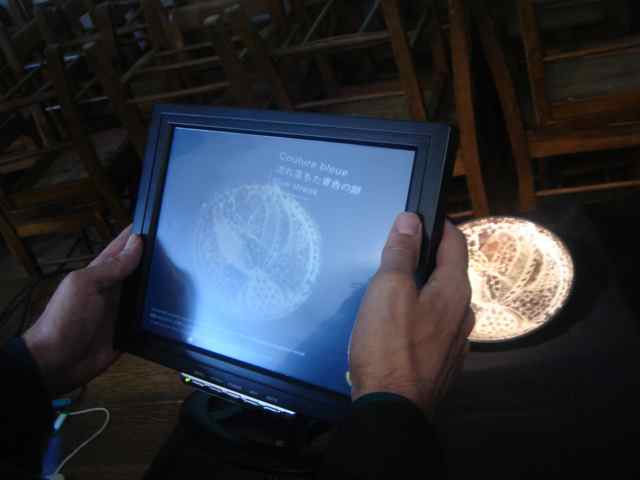
AR Museum Presentation Room
I never would have learned about this ancient plate’s history – had AR not been invented. A Classic.
The artwork to which the augmented reality technology is applied, is a plate produced by the technique called metallic lustre. Around the exhibited real artwork,
information is provided by multimedia tools, offering the visitor various approaches to the artwork. Adding information with augmented reality is intuitive and offers an illustration of something that cannot be seen by the naked eye, without turning away the visitor’s eyes from the real artwork. The system is currently in use at the Louvre – DNP Museum Lab (LDML) – Tokyo/Japan.
T. Miyashita (Dai Nippon Printing), P. Meier (metaio), S. Orlic (Musée du Louvre), T. Eble, V. Scholz, A. Gapel, O. Gerl, S. Arnaudov, S. Lieberknecht (metaio)
The “I am waaaay ahead of you” demo
Mapping large environments using multiple maps for wearable augmented reality
video of last year's demo
A demonstration of a wearable robotic system that uses an extended version of the parallel tracking and mapping system by Klein and Murray from ISMAR 2007. This extended version allows multiple independent cameras to be used to build a map in unison, and to also create multiple independent maps around an environment. The user can explore an environment in a natural way, acquiring local maps in real-time. When revisiting those areas the system will select the correct local map and continue tracking and structural acquisition, while the user views relevant AR constructs registered to that map.
Robert Castle, Georg Klein & David W. Murray (University of Oxford)
Additional great demos weren’t included due to the lack of space on this post and lack of sleep of the author…
Yesterday, at the TechCrunch 50 conference in San Francisco, a small start up from Tokyo stole the show; the name: Technidot, the cool product they unveil: Sekai Camera (World Camera) running on the iPhone.
In their own words, the Sekai Camera is:
…a real-world interface for the iPhone that connects real and virtual worlds, allowing anybody to create, experience and participate in both.
While at your favorite mall, point your iPhone camera at things around you such as food, toys, art, transit maps, and get detailed information about it. More fun for you, more business for retailers.
AirFilter takes care of the customized search to bring you the additional information, based on a database generated by advertizers.
And you’re not on your own; the Sekai Camera is also a social networking environment: leave messages to your friends – in space – so they can see it when they pass by.
Isn’t that a killer augmented reality application?
And Tonchidot’s take on Evolution could become the symbol of the AR revolution…
As the light at the end of the (summer vacation) tunnel is almost insight, let me ask you a reflective question:
Where do kids prefer to be on a summer day:
(a) Museums
(b) Theme parks
(c) Staying at home and playing video games
Any volunteers for (a) ?…
What if you could combine all three into one?
What if you could transform learning about cultures, art, science, history – into a fun experience for kids? What if museums were as much fun as outdoor adventures and video games combined?
This fantasy is becoming a reality thanks to efforts by pioneers around the world.
Here are my picks of the 4 5 best augmented reality tours that are reinventing museums:
1. Lifeplus in Pompei
Pompei Ladies in an afternoon promenade in front of your eyes
Breathing new life into the ruined streets of Pompei
Visitors stroll in the real streets of Pompei, while watching thru their glasses, virtual scenes of city natives living their lives as if it’s 79 AD, minutes before the eruption of Vesuvius.
This EU funded project was lead by MIRALab – university of Geneva in 2004. See more at Lifeplus.
2. DNP-Louvre Museum lab
A behind the scenes look at exhibits
A mobile device with live video, shows on the display virtual objects such as a balloon that guides visitors through the exhibits. The climax of this tour arrives (1:37) when shards of an antique Islamic platter are virtually reconstructed to create the real platter.
Kudos to Metaio who developed the experience for DNP-Louvre Museum Lab in Tokyo, though they should try trimming the bulky device…
3. Mobile Augmented Reality Quest (MARQ) – Expedition Schatzsuche
Treasure hunt in a museum (in Austria)
A team oriented game where museum visitors play the role of investigators required to solve 3d virtual puzzles surrounding exhibits. Successful completion of puzzles reveal further steps of the story.
Beyond the new type of interaction with museum exhibits, MARQ introduces multi user collaboration: collected virtual items can be shared between groups, and “guided tour replays” can be viewed at any time – on the Gizmondo (RIP) gaming device.
This novice approach to experiencing Museum exhibits was developed by the Graz University team in Vienna, led by Daniel Wagner and Dieter Schmalstieg. It was shot at the Kärner Landesmuseum in Klagenfurt/Carinthia.
Rome Reborn is the largest computer simulation of an ancient city. Cool. But what Fraunhofer (Institute for Computer Graphics Research) has done with it is way cool: walk among the ruins of the Roman Forum and point your Vaio UMPC anywhere to see buildings being reconstructed.
Blair MacIntyre and his team at GA Tech have done the impossible: they have turned the Oakland cemetery in Atlanta to a visitor magnet – all thanks to an augmented reality tour which can be experienced on a cell phone. You have to see it to believe it.
Unfortunately, the cemetery was destroyed last year by a hurricane. So the students of subsequent years wont be able to keep playing with it.
6. Science Museum in Paris
Navigate Museums with AirTags
A new implementation by Tonchidot for La Villette Museum in Paris where visitors use AirTags provided by the Museum or by users to enrich their museum experience.
In the creators own words:
Sekai camera turns a museum into a “living” internet environment…The real world becomes “clickable”
7. Digital Binocular Station for Cultural Museums
A stationary Augmented Reality device developed by Mind Space Solutions. Because it is fixed to a single location, it allows the use photorealistic, cinema-quality visuals, and compensate for the lack of parallax by presenting everything in stereoscopic 3D.
=========================================
What are the 10 ingredients to augment a museum tour?
A practical augmented reality device (avoid backpacks and bulky displays) with visual tracking software
High quality 3D models of exhibits, and how they looked and behaved in the past (and future?)
A combination of learning and fun with a really really good story
Breath life into inanimate objects
Sprinkle some sound when necessary
Incinerate verbose plaques; say what you have to say in 2 to 5
Indoor tours are great; outdoor tours are even better
Multi user interaction and collaboration
Location based services, including (fun) navigation instructions
Did I mention it has to be fun?
…and don’t forget to send the kids home with a souvenir DVD: “my augmented tour at the museum”
Didn’t make the list…
The following efforts didn’t make the list, mostly because they forgot ingredient #10…
Geisha Tokyo Entertainment Inc. announced a new augmented reality game. They call it Dennoh Figure ARis or Cyber Figure Alice (which only works in japanese thanks to the interchangeability of L and R in Japanese). Thanks Akki from Asiajin for bringing it to the western world. It is scheduled to hit Japan this fall.
Is it a breakthrough?
From a technical perspective we have seen similar implementations on the market – many covered in this blog’s demo category (see left sidebar). It’s based on the widely used marker AR technology (that is ‘widely’ within the narrow AR community).
What’s new about it is the theme chosen for this game: a high-school-graduate-in-training-geisha. This is a departure from the infant oriented magic books and wiz cubes, yet it doesn’t dwell with extreme practicality as the Fix-Your-Own-Car applications.
Enter the world of augmented reality for grown ups: here you can peep, poke (using the supplied cyber sticks), and peep at your own geisha.
The publisher describes her (according to Google’s translation of the product’s site) as “rich in the sensitivity of your desktop to make sure spectacular”. You may rephrase based on your own taste.
Now who will take it outdoors?
What if you could experience this non-intrusive interactivity with real people on the street?
A beatiful 4 min concept film about how augmented reality will change the way we interact with information.
It’s a bit geeky in the file managment piece , and too emotional around the edges – but other than that – awe-inspiring. Nuff said, watch Stewart Morgan in action.
To see the man behind the images, here is an interview with Stewart Morgan.
Here is my countdown of the top 10 best AR demos poised to revolutionize video games:
10. Human Pac Man
When Dr. Adrian David Cheok (NUS) wanted to create an exciting augmented reality game, he chose to remake the first video game to ever introduce a character – the legendary Pac Man. Cheok literally stepped into Pacman’s shoes in this first-person-shooter-like real world game.
9. Come Out & Play
In 2006 the Come Out & Play Festival turned New York City into a playground for a weekend, then did the same for the city of Amsterdam in 2007. Hundreds of players gathered to play dozens different Big Games across each city.
None of the games played in the festival made it to my top ten list – individually. They fell short of stretching the interactivity between real and virtual. But as a group – they reminded us that playing games outdoors can be fun, and technology can make it even funner.
8. Second Life Avatar Enters the Real World
Tobias Lang and Blair MacIntyre (GA Tech) give us an extraordinary glance at what happens when the virtual world “leaks” into the real world. No, they didn’t use a green screen as you can see behind the scenes. Is it a hint for some of us to ditch Second Life and augment our First…?
7. WIFI ARMY FPS
The world is the battlefield, your phone is your weapon. Players organize in 2 teams armed with cell phones with the goal to locate and take pictures of their opponents. The phone compares captured pictures against a database of player faces and awards points for correct hits. Peter Whatanitch of W2Pi (creator of the game) explains how it will work. It could become quite an experience as staged in the Lumix Battle commercial.
6. Shadow Monsters
Phil Worthington is an artist that injects coolness into augmented reality.
“Magical monsters appear from shadows cast by the hands of participants, reacting to gestures with sound and animation. Wolf like creatures, birds and a rastafarian are among the characters that speak and squeek as imaginary mouths open and close. Shadow Monsters is an intuitive and magical experience for young and old alike to play with body posture for creating crazy narratives.”
5. AR Grafitti by DAIM
Artist DAIM creates virtual 3D graffiti floating in space in his latest art project “Tagged in Motion” of NextWall .
What if everyone could overlay reality with their own virtual creation?
4. CARCADE: In-Car Video Game
Andreas Nicolas Fischer and team suggest to take advantage of the fast changing scenery experienced by car passengers – and turn it into a video game (remember Gondry’s Star Guitar Video Clip?). Could be a great way to pass time. I’d call it: “Are we there yet..?”
3. Total Immersion at Demo ’07
Probably the most commercially successful company that specializes in augmented reality, Total Immersion delivers the best live demos in this domain – with a French accent. They have also featured in CES 2008 keynote by Intel’s CEO Ottelini.
2. Roku’s Reward
This concept* video shows the potential of augmented reality utilizing today’s technology:
A handheld camera device,
live video overlaid with 3D graphics,
computer recognition – identifying real life objects,
positioning and acceleration sensors,
virtual objects interacting with reality,
…wrapped up in a fantasy narrative make up this yet-to-be-developed game.
*According to Phil Stenton (HP Labs, UK): “Roku remains a demo film. We haven’t signed up with anyone to create the game yet.”
Though delivered in words only, this “demo” paints the farthest vision for augmented reality so far. Everything else you’ll see on this topic will look like excuses: “sorry, we don’t have that technology yet…”
Yes, but do you have the imagination?
“There was something familiar about this prey. It was young and clever looking … a newborn from Juan’s own design! And that meant its Mommy would be nearby. Juan said, “You know, I don’t think –”
“The Problem Is, None Of You Think Nearly Enough.” The sound was premium external, like sticking your head inside an old-time boom box. Too late, they saw that the tree trunks behind them grew from yard-long claws. Mommy. Drool fell in ten-inch blobs from high above.
This was Juan’s design scaled up to the max.”
* You may ask how come I left out another classic remake: AR Quake. Well, this remake is indeed played outdoors, but let me ask you this: does it add much to the original experience of that first person shooter?
* How come I am ignoring what some call “the future of books” such as EyeMagic Book or WizQubes? Is it really that different than manipulating 3D characters on the computer screen?
* Daniel Wagner, a major force behind recent AR innovation, may be disappointed that his pioneering handheld AR game the Invisible Train didn’t make it. No hurt feelings; it’s a great proof of concept, but isn’t it more fun to play with the *visible* train?
* Other educational oriented games such as MIT’s Environmental Detective or U-WIS’s MadCity Mystery certainly beat learning in a classroom – but aren’t they indistinguishable from traditional low tech scavenger hunts?




 Games Alfresco
