GDC 2009: More Augmented Reality Demos at Game Developer Conference

Reporting live from GDC 2009 in San Francisco: it’s just getting better!

From Blair’s team at GA Tech:

Zombie Attack on Nvidia Tegra

From Beyond Reality at the Dutch pavilion:

Pit Strategy

Stay tuned for more…

GDC 2009: First Augmented Reality Demo at a Game Developer Conference

As soon as the exhibition floor opened today at the Game Developer Conference (GDC) in San Francisco, I rushed to visit the Vuzix-Metaio booth to witness the first consumer-oriented augmented reality booth ever to exhibit at GDC.

I was not disappointed. Just watch this clip.

Stefan Misslinger (Metaio) did a fantastic job  acting it out, don’t you think?

Vuzix also had on the display the upcoming-anticipated-long-awaited-soon-to-be-released 920AV AR glasses. It wasn’t in working condition, but Vuzix promised it will be released this fall.

When the event kicked off, I offered to serve as your eyes and ears; Peter Milford took the offer and expressed his curiosity about the latest from Vuzix. This one is for you Peter: yours truly posing with the goods.

vuzix920v

Now the key question is:

how would you rank the look of these specs on a dork-to-cool scale?

ArToolKit Wins the Oscar of Virtual Reality

An important message from Mark Billinghurst about ArToolKit:hirokazu

On Tuesday March 17th, Hirokazu Kato recevied the 2009 IEEE VGTC
Virtual Reality Technical Achievement Award for his development of the
ARToolKit tracking library. This was given at the IEEE VR 2009
conference, the premier academic conference for virtual reality. The
VR Technical Achievement Award is a great honor and has only been
given out five times before, to such people as the inventors of the
CAVE immersive VR system.

For Hirokazu Kato this is well deserved because, although it was
developed ten years ago, ARToolKit is still the dominant computer
vision based AR tracking library with over 170,000 downloads. Almost
all of the researchers in the AR field have used ARToolKit in one way
or other, and many of the AR applications in the field have roots that
can be traced back to ARToolKit. As a result of his work, AR
researchers and developers didn’t need to build tracking code, but
instead could focus on AR application development and interface
design. The community owes a huge debt of gratitude to Hiro and it’s
great to see that his achievement has been recognized.

The full announcement.

GDC 2009: I Have Seen The Future Of Games and I Wasn’t Alone

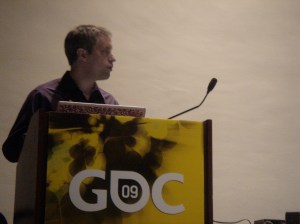
In front of a packed room, Blair skips the typical introduction to augmented reality (he knows his audience) and dives right into demonstrating how fun AR is. What better video to explain it in a game conference than showing Roku’s Reward.
blair-gdc-1
Blair explains the essence of AR play:  tight integration between the real and the virtual. He then shows examples of existing handheld AR games: The invisible Train,  a Gizmondo game, and of course his own baby: ARf running on an iPhone.

He’s excited about the next generation of handhelds (e.g. from Nvidia Tegra, TI OMAP) which are going to make the experience more pervasive and popular.

But why do AR at all?
How can you go beyond just an eye candy?

You have to use the new game mechanics that are made available. And as always create compelling stories and game play.

Now a little bit of technology for the geeky audience:
how do you do tracking?

He quickly goes through various types of techniques: markers, natural feature tracking, and 3D tracking. Daniel Wagner from Graz is mentioned multiple times.

Handling camera and lighting is mentioned as key for a good experience.

And of course graphics. In order to create a more believable and tangible look don’t forget shadows, occlusions, physics, and how about a rotoscoping-like look?

Now for some more examples of games developed by his students:
There’s a whole category of table top games which emphasize interaction between players. It’s fun to see when players get into the game, they point into thin air, refering to the virtual objects.

Blair describes the game Bragfish: using a Gizmondo, multiple players around a game board navigate virtual boats to capture fish in a pond. Interesting social interactions emerge such as pushing and obstructing each other…

Art of defense: a co-op game for 2 players running on Nokia 95.

ARf: a virtual pet toy on the iPhone. where you can interact with a pet that walks on your table. Scratch the table and the cute virtual dog will sniff it.

Joe Warpin: flying in a helicopter and shooting terrorists in a building. Only the building is really a chair covered with markers…

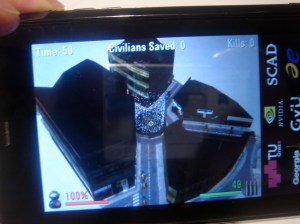
AR Zombies (just finished this Saturday): running on Nvidia Tegra – this time – shooting Zombies. Graphics are nice. Lighting changes to reflect the themes.
blair-gdc-2

Outdoor AR and large area AR will become reality in the near future and will be really cool.
And with that optimistic note, he’s opening the floor for questions.

Question: How can you go and play in a ad hoc site and play with no pre-prep?
Blair: in the future games will be able to recognize with no prep. Example is SLam which maps the environment while playing and then allows to play there.

Question: Are you using other sensors such as infra red?
Blair: I don’t do that stuff – but others do…there are some expensive sensors systems that work well and open up very interesting stuff.

Q: you could solve the problem of outdoor modeling with a captive audience (I am an ARG guy…)
Blair: absolutely. See what Microsoft is doing with Photosynth. Military has done that in submarines to track people in case of emergency.

Q: You mentioned that AR could be exciting and terrified…what did you mean?
Blair: When you can see an alternative reality it could be really fun (and scary)…that’s what I meant.

Q: Could we use the same indoor markers for outdoors purposes?
Blair: too much work…too many markers are required. They’re ugly. But you could overcome thee challenges with clever design.

The time is up but a long line is stretching in front of the podium – people want to hear more.

blair-gdc-3

After the talk, I had a couple of hall conversation; folks were totally intrigued with the new opportunities.

I have seen the future of games and I wasn’t alone.

Such a shame this is the only AR session at GDC. I am back to my pursuit of more AR vignettes.

Did I just see Ron Azuma (one of the fathers of AR) in the room?

GDC 2009: Why the iPhone Just Changed Everything

Robert Tercek Chairman of GDC Mobile kicks of the Mobile summit with “Welcome to the Next Level! ”

He speaks about the state of the mobile gaming world (looks much better than last year) and even spends a moment on our favorite topic: Virtual layers superimposed on a fictitious reality. He admits it has only been done for advertising so far.

Next is a session I have been looking forward to: “Why the iPhone just changed everything” by
Neil Young founder of Ngmoco :)

When it comes to mobile games, everything before the iPhone was lame. Mostly because of the carriers, the devices, and their usability.
With the iPhone a new Everything was born.

As a game machine it’s so much better than anything before.

4 major Changes:
1) The market – iPhone has more installed based than the Nintendo DS and Sony PSP. 165 new apps per day.
Short term problem: Clutter + pricing pressure.
Long term – awesome opportunity.

2) The games – Graphics are better. The experience is better.
And it’s always connected. new opportunities for social, multi players.

3) Game making – fantastic SDK and a much faster development cycle.

4) and Publishing.
There’s never been a better time to be an independent developer and to create a closer relationship with customers.

Then comes the Ngmoco plug: they help create hits by focusing on largest audience appeal, superior execution, and making sure it’s native to the iPhone
There other job is helping games get in front of as many people as possible.
The Ngmoco platform helps is that endevour: analytics, silent download of levels and episodes, promotions engine.

The session ends in high note: iPhone is current the top dog.

Off to a coffee break.

Is the Future of Games Lurking at the Game Developer Conference?

I am on a flight to San Francisco, barely dodging a thunder storm, for what I expect to be an inspiring week at the Game Developer Conference .
I have been to hundreds of conferences in my career – GDC is one that usually satisfies the crave for inspiration – big time.

Here’s what I’ll be looking for:
The Mobile Games Summit has a bunch of sessions focused on the iPhone such as “Why the iPhone just changed everything”. It also features probably the first major session about Handheld Augmented Reality in the history of GDC (can you believe that?). Blair MacIntyre is best equipped to shoulder the challenge.
You’ll surely find me at the intriguing session: “Beyond the Screen: The Principles of Pervasive Game Design“. Although when Markus Montola speaks about ARGs he means Alternative Reality Games – not Augmented Reality Games – I believe it will be a treat.

Other sessions serve as stepping stones in my pursuit of the ultimate augmented reality game:
Get Smart About Smartphones: Insight Into the Future of Mobile Gaming
Bringing Meaning to Mobile Entertainment
Getting Serious About Alternate Reality: Designing a Different Kind of ARG
The Human Play Machine

Experimental Game Play Session is always fascinating. I wonder what year an AR game will be featured.

Jonathan Blow, Clint Hocking  and Jesse Schell are among the top reasons I am here this week. They’re super smart, artistic, entertaining, yet humble. They remind me why I am so attracted to this industry.

I also wish to ask Will Wright after the session “Stretching Beyond Entertainment: The Role of Games in Personal and Social Change”  if he’s doing anything related to his (celebrated among the AR community) quote: “Games should increase our awareness to our immediate environment rather than distract us from it”

Of course, I’ll be looking for green inducing tips (not what you’re thinking) in sessions such as “Early Stage Funding for Video Game Start Ups”.

The exhibition area usually feels like a SyFy convention. I’ll be looking for the future AR hardware from Vuzix, Nvidia, Microvision, and other contenders (Microsoft?).

Most importantly, I wish to meet like-minded folks.
My first stop is an AR dinner (plotting next year’s AR-attack on GDC) on Tuesday.
I would like to think that among the more than 5,000 attendees, there are at least 50 with a strong interest in Augmented Reality Games. I’ll be in their pursuit…

If you’re at GDC – please give me a buzz.
If not – use me as you’re eyes and ears – what would you have looked for?

So Is the Future of Games Lurking at the Game Developer Conference?

We’ll find out this week.

2020 Games Look Mostly Augmented

Gamasutra recently announced a competition for best game ideas. Games of 2020.

The winners are already in and their games are mostly…augmented.

Check out these 4 games:

House Chores by Wesley Wiebe.

It builds on the idea that if you cleverly use game pleasures people would be willing to tolerate almost anything – just to get the built-in reward. The same dopamine system in our brains that handles addictions.

In this case, the game controller is a broom. And your challenge: sweep the floor.

The setup is your “everyday” augmented reality game: your own house is modeled into the game, you wear see thru digital goggles with built in cameras, you interact with the real world (your living room) blended with virtual elements (water splashes)…

Intrigued?

Keep reading the next game:

Appliance Gaming By Daniel Cook

The concept in Daniel’s own words:

Cloud connected household appliances combined with simple games and an augmented reality feedback system. Hook up some inexpensive sensors and a wireless connection to assorted dishwashers,vacuums, refrigerators and washing machines. Add a feedback device in the form of a vision aware monocle.

The game device looks awfully like Yanko‘s Monocle (who’s first?):

I also like the punch line:

The resulting consumer boom is widely credited with ending the economic malaise of America’s Lost Decade.

Play Everywhere By: Angie Oikawa

Here is what every Augmented Reality fan dreams about

a diverse collection of casual, social gaming experiences that integrate easily into a persons everyday life. PE! is a mobile “game platform” that allows people to choose virtual “Smart Game Objects”, customize them, and place them into real world locations for friends to find and play with.

What’s this mobile platform like?

…an evolved smart phone with a high resolution holographic display, or glasses that allow a person to superimpose virtual objects into the real world

And a game play example shows an inspiring woman’s touch: leaving sexy clues for your spouse to find on your anniversary:

…she is greeted by a flock of doves who sing to her and drop rose petals across the hall way into the bedroom where you are waiting for her.

Chow Time By Trevor Paradise

The (wacky) concept: eat healthy food in reality, while the game makes you think you eat your favorite junk food.

Scratchy.

If you like these – there’s a whole bunch just like these at Gamasutra.

The only remaining question is: why wait for 2020?

Edutainment is Dead: Long Live Learning Games!

Eric Klopfer, Scot Osterweil, and Katie Salen have just published a paper: Moving Learning Games Forward.

With 60 pages strong, it’s more of a mini book than a “paper” – but hey, who’s counting?

I argued before that Learning Games should be the first pin we target in the Augmented Reality bowling alley (taking a page from Crossing the Chasm). I base my arguments largely on Eric and the Learning Games Network team’s work.

In this paper they speak about the role of play in learning and the freedom it entails:

game players regularly exhibit persistence, risk-taking, attention to detail and problem solving skills, all behaviors that ideally would be regularly demonstrated in school.

And they touch on how Augmented reality games could contribute to the goal:

Augmented Reality games that embed students in realistic real world scenarios

Overall it’s a very well crafted case, with the breadth and depth to convince skeptics that games can, and should, change the way kids learn. It’s complemented with a fantastic set of references for related work.

Highly recommended.

Augmented Reality Today – Ori Inbar Speaks at WARM 2009

Games Alfresco is celebrating the first year on the air.

Among the festivities, I am sharing a talk I gave at the Winter Augmented Reality Event (WARM ’09) at Graz University (Austria) this February.

It makes the case for unleashing Augmented Reality into the mass market – Today.

The best part was the post talk conversation with a group of AR enthusiasts at the University. I guess I managed to get their juices flowing.

Hope it will have a similar effect on you.

Here it is: a year of research distilled into 16 minutes of uncut, fast-paced presentation – with a twisted voice over.

Vodpod videos no longer available.

Many thanks to the augmented reality community for your contribution. I couldn’t have done it without you.

Are you in?

Total Immersion Breathe Life Into Baseball Cards With Augmented Reality

New York Times unveils this story about Total Immersion‘s new foray into trading card games.

Total Immersion partnered with Topps to add 3D animation on top of their baseball cards using your web cam.

Rouli and Tobias have already mused about it this morning (Old World folks always wake up earlier…). Here’s the video video…

Judge it yourself:

Vodpod videos no longer available.

Kudos to Total Immersion: once again you managed to lead the pack.

But do we really want to be glued to the PC all day; when will you offer this experience on mobile devices?