Apple Files Patent for Mobile Augmented Reality

The buzz around our open letter to Apple hasn’t subsided yet, and lo and behold, Apple has filed today a patent related to augmented reality .

Although the term Augmented Reality (AR) is not explicitly mentioned in the patent – it describes very common mobile AR scenarios.
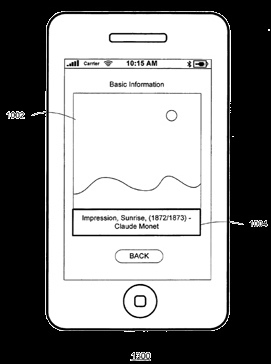
Apple patent-090709-1

Technically speaking, you typically need 3 capabilities to enable a mobile AR scenario: sense, overlay, track.

Sense – use sensors to find out what’s in your immediate surroundings (such as visual, GPS, RFID, wifi, IR, etc)

Overlay – Graphically add information that relates to real objects in your field of view

Track – register the graphics so that the virtual elements are aligned with the real objects

Apple’s patent deals with Sensing and Overlaying.

Apple Insider describes it as:

a new identification application apparently under development by Apple that would help identifying objects in a user’s surroundings so that their iPhone can present additional information about the identified objects.

The patent describes scenarios such as:

“the portable electronic device can allow the user to select a mode based on the types of objects that the user wants to identify. Based on the selected mode, the portable electronic device can adjust parameters used for searching an identification database. For example, if the user selects to identify an object in a “MUSEUM” mode, the portable electronic device can search the identification database for objects that are commonly found in a museum. In some embodiments, the portable electronic device can determine the location of the user to help identify an object. For example, if the user is determined to be in Las Vegas and the portable electronic device is set to a “RESTAURANT” mode, the device can limit the search of the identification database to restaurants in Las Vegas.”

As much as it’s encouraging to see Apple’s interest in this domain, it sounds awfully similar to augmented reality research published over the past 10 years.

Moreover, it actually describes the functionality behind existing AR browsing applications already in the market such as Layar, Mobilizy’s World Browser, Tonchidot’s Sekai Camera, Nru, and more!

And how about augmenting Museum experiences? Has anyone at Apple read our roundup of AR museum experiences?

Is there anything new in this patent? Can Apple defend it against previously published AR work? What do you think?

Battle of the AR Browsers

Three weeks after its launch, SPRXMobile’s Layar partially opens up its layer creation API to developers. It’s not freely available online (bad decision?), however, interested developers can register here, and may be among the lucky 50 to get access keys to the API. The press release is here.
Meanwhile, Mobilizy (creator of Wikitude) is not keeping silent. They congratulated SPRXMobile on their twitter account, and placed a comment on Layar’s press release:

On behalf of Mobilizy GmbH the developers of the original Wikitude AR Travel Guide we would like to congratulate SPRX Mobile in their efforts to help shape the Mobile augmented reality landscape.

Good Job!

Mobilizy also put this picture depicting Wikitude on the iPhone 3GS, and released the following advertisement video

and commented about AcrossAir’s Tube Locator application, saying “you can tell it is fake if you look closely”.

All this while both SPRXMobile and Mobilizy are founding members in the new AR Consortium. So, am I making a lot of noise out of nothing? Probably, after all I’m a blogger!

Update: Mobilizy just announced that they will let user add their own tags to the world via Wikitude.me and that they open up their API in a closed beta. And thus begins the battle to control the mobile AR world!

Blink-182 Perform in a Doritos Bag

Doritos had several augmented reality campaigns we previously covered (here and here). Now, they let Blink-182 fans watch a virtual concert by the band using a bag of Doritos, a Webcam, and setting their web browswers to this site.

“An online 3-D performance was something we just had to be a part of,” Hoppus said in a press release. “As big technology guys, we’re pumped that people can now experience a little bit of our summer tour through something as accessible as [a] bag of Doritos and a computer.”

It’s like nothing we have seen before!

More info on Wired, via The Future Digital Life.

AR for the Environmentally Aware Shopper

This next augmented reality concept , named FoodTracer, comes to us from Italian Giuseppe Costanza, as his final year project for MA Communication Design at Central Saint Martins. And it’s quite an impressive final project!
Aimed to give consumers more information about the food products they are buying (such as their carbon footprint and where they were produced), while minimizing packaging, FoodTracer is a bright idea on how AR can make the world a tad better. Users would be able to access the information that concerns them, compare and bookmark several products, and later examine their shopping history at home. Here’s one of Costanza’s imagined use cases:

When Susan goes shopping in her usual supermarket she knows where organic products are placed so she can quickly pick the right products, but today she went shopping in a new supermarket where products are displayed in a different way, she doesn’t have the time to check on the packaging which product is organic so she uses FoodTracer to easily spot organic apples.

Costanza even built a demo application for the Symbian mobile operating system, using embeded markers and d-touch nice looking markers that hide in the products’ logos, as can be seen in the following video:

Many more details over here.

Weekly Linkfest

This week wasn’t defined by cool videos and nice looking demos, but on the bright side, there were a couple of interesting articles and interviews that will surely tickle your mind:

This week’s video is a silly augmented reality tribute to Michael Jackson (please don’t get offended if you are MJ fans, I don’t say he was silly, I just don’t think highly of this tribute). You can try it yourself over here.

AR Goes Underground

That is, to London’s subway system. Most tourist facing augmented reality applications are focused on landmarks. But, there’s an even more important issue affecting a tourist’s visit to an unknown city – how to get around. The city’s residents know perfectly well where’s the closest subway station that will serve their needs, but a tourist needs to constantly look at maps and look around herself.
To the rescue comes AcrossAir, a British mobile application development company. They have created a simple, yet useful, iPhone application, that shows you where’s the nearest tube station. When held horizontally, the application behaves quite like a map, but when the phone is tilted upwards, bubbles signifying stations’ presence are overlayed on the video feed. Obviously, this only works on the new iPhone 3GS, since it requires a compass reading.

Here’s some obvious further directions from the top of my head, this kind of app could follow:

  • Add more cities around the world, New York should probably be the first.
  • Add more public transportation options, such as buses and regular overground trains.
  • Add route planning, so the application will also recommend which station best suits your needs.
  • Some real time info will be great, like knowing when the next train is due.
  • Make it work underground (using cellular tower triangulation in lieu of GPS read), so commuters can be advised where to get off a train, and which line should they take next.

So there’s much room to innovate, even in such a niche application.

Virtual products with Augmented Reality

Dutch website (what’s with all those Dutch companies lately?) YouTellMe.com, which specializes in social shopping online (e.g. recommendation engines) has just launched a new augmented reality application, letting you see how your favorite electronic products look like in the palm of your hand (or in your living room).
By harnessing the power of your webcam, Flash, and probably FlarToolKit (though, I failed to prove it), you can now try the new iPhone, or that Canon camera you always coveted:

Actually, since style and appearance play a big part these days when we are out to buy a new gadget, I can imagine such an application would have a market (much like those magic mirrors that let you try on jewelery and accessories). Though, IMHO, it could be much improve if instead of simply printing a marker, you would be able to print a simple paper-craft box with markers on its sides, that although will require some folding, will give you some more “hands on” experience.

Open Letter to Apple: Let us Augment Reality with the iPhone!

A letter sent to Apple Developer Relations.

Dear Apple,

We are a collection of augmented reality (AR) enthusiasts and professionals (from business and academia), who have been working on a multitude of AR apps for the iPhone. These apps are poised to change the way people interact with the real world.

But here is the rub: we are currently unable to publish these apps on the app store because the iPhone SDK lacks public APIs for manipulating live video.

We are asking Apple to provide a public API to access live video in real time, on the iPhone.
We will be happy to offer additional technical details.

The impact of augmented reality (AR) on our lives could be as significant as the introduction of the PC.
In 10 years, we believe augmented reality will change the way everyone experiences travel, design, training, personal productivity, health care, entertainment, games, art, and advertising (videos).

Looking back just a few years, AR pioneers had to hack a slew of components into ridiculously large backpacks and HUDs, and be confined to rigged environments. Nowadays, it comes in friendly, affordable packages and the iPhone is one of the first devices to have it all – except for a public API.

The battle to determine the winning device has already begun; a public API to access live video will give the iPhone a lucrative ticket to compete.
We believe Apple has a window of opportunity of about 3 months before developers start looking elsewhere. If Apple decides to publish the API in that time frame – in the next 10 years, everyone might be using the iPhone as the preferred device to interact with the real world.

Here is how augmented reality could open up new opportunities for the iPhone this year:

Arf (Georgia Tech)

a virtual pet you take anywhere

ARghhhh (Georgia Tech)

first person table-top action game

Sekai Camera (Tonchidot)

AirTag the real world

Kweekies (int13)

a portal to creatures in a parallel world

Layar (SPRXmobile)

Browse the world with an AR browserDetails

Artoolkit for the iPhone (Artoolworks)

the most popular AR kit now on the iPhone

StudierStube ES (Imagination, Graz TU)

the only AR engine designed for mobile devices, now on iPhoneDetails

PTAM on the iPhone (Oxford University)

next generation AR tracking with no markers or images

Wikitude (Mobilizy)

a travel guide that “tells you what you see”

Virtual Santa (Metaio)

interactive Christmas application using the augmented reality

Augmented Reality Sightseeing (Fraunhofer IGD)

Historic photographs overlaid on your field of view while strolling in a street

These are apps that are practically ready to go. There is a whole bunch of apps and games that are just waiting for the API to be available.

…And Apple, we know you can’t share your plans…so please surprise us soon!

Many many thanks for your consideration –
Sincerely,

Signed:
Michael Gervautz – Managing Director Imagination GesmbH
Robert Rice – CEO Neogence
Georg Klein – PhD PTAM creator from Oxford University
Stephane Cocquereaumont –  President & Lead Developer Int13 (Kweekies)
Maarten Lens-FitzGerald – Founder & Partner SPRXmobile, developer of Layar
Ori Inbar – Author of GamesAlfresco.com and CEO and founder – Ogmento (formerly Pookatak Games)
Philippe Breuss – Lead developer, Mobilizy
Philip R. Lamb – CTO, Artoolworks
Noora Guldemond – Metaio
Takahito Iguchi – CEO, Tonchidot
Blair MacIntyre – Associate Professor, Georgia Institute of Technology

Bruno Uzzan – CEO, Total Immersion
Michael Zoellner
Fraunhofer IGD
Andrea Carignano – CEO,  Seac02

If you are developing an AR app for the iPhone and wish to join this effort – just let us know.

Special Message from Mark Billinghurst: Introducing FLARManager – Can Building AR Apps in Flash Be Easier?

July 1st 2009  Press Release

ARToolworks Releases Commercial License for FLARManager

ARToolworks is very pleased to announce that it is able to offer commercial licenses for the popular FLARManager software. FLARManager is a software framework developed by Eric Socolofsky that makes building FLARToolKit Flash based Augmented Reality applications easier.

FLARManager decouples the marker-tracking functionality from Papervision3D, and provides a more robust event-based system for managing marker addition, update, and removal. It supports detection and management of multiple patterns, and multiple markers of a given pattern.

Most importantly, FLARManager sits on top of FLARToolKit and makes it much faster and easier to develop flash based AR applications, typically half the time or less of developing a straight FLARToolKit application.

Philip Lamb, CTO of ARToolworks, says “We are delighted to be able to provide commercial license for this outstanding tool. This will enable FLARToolKit developers to build Flash AR applications quicker than ever before, and is the perfect compliment to our existing product line.”

FLARManager will continue to be freely available under a GPL license from http://www.facebook.com/l/;http://transmote.com/flar/, but ARToolworks has the exclusive rights to sell commercial licenses to those companies that do not want to share the source code of their applications as required by the GPL license.

The developer of FLARManager, Eric Socolofsky, says, “I’m excited to be able to offer FLARManager to both the commercial and experimental community.  FLARManager began as an effort to bring FLARToolkit to a wider audience, and this commercial license will help to expand the reach of augmented reality and new interfaces to the web.”

For a limited time, ARToolworks is selling FLARManager for a reduced price of only $295 USD for a single product license, and also selling a discounted bundle of FLARToolKit and FLARManager licenses together. FLARToolKit is required to use FLARManager.

Please contact sales@artoolworks.com for more details.
——————–

Weekly Linkfest

This week on the linkfest, it’s trains, snails and mobile phones:

In last week’s linkfest I reported about the strange event named “The World Series Of ‘Tubing”, where two players play card war with Youtube videos render via augmented reality. Surely, such description doesn’t make the event any clearer, but luckily the guys behind it have put the following video on Youtube to explain it all: