The Vuzix Wrap 920AR aren’t the sexiest of specs, but they do perform the function of AR glasses. I got a chance to see this setup at ISMAR09 which they’re now showing at CES 2010.
The specs for the glasses look like:
The stereo camera pair delivers a single 1504 x 480 side-by-side image that can be viewed in 3D stereoscopic video, while the video eyewear provides an unprecedented 67-inch display as seen from 10 feet. The Wrap 920AR also includes a 6 Degree-of-Freedom Tracker, which allows for absolute accuracy of roll pitch and yaw and also X, Y and Z positioning in 3D space
• 1/3-inch wide VGA Digital Image Sensor
• Resolution: 752H x 480W
• Includes 6 Degree-of-Freedom Tracker
• Frame rate: 60 fps
• Dynamic range: >55dB linear; >80-100dB in HiDy mode
• Shutter efficiency: >99%
• ADC Resolution: 10-bit column parallel
• High-speed USB 2.0
• PC and Mac compatible
• System requirements: Windows XP SP2, Windows Vista, Windows7, Mac OS X 10.4.9 or higher
• MSRP: $799.99
They probably won’t be worn in public anytime soon, but some creative programmers could create interesting house-only interactive avatars or AR spaces. While some might scoff at this idea, see this video from Georgia Tech last year to see how even semi-cheesy graphics can make augmented reality immersive. Having played the old VR game Dactyl Nightmare in the 1990s, the head-tracking really creates the illusion of reality.
We haven’t seen any developers put together a product that takes advantage of these $800 glasses, but hopes are that exposure at CES 2010 will bring more interest. The only thing I’ve seen using the setup is the Whisper Deck from Craig Kapp.
Maybe later this year we might see some products that would entice the hard core AR enthusiast to fork out the cash for these un-sexy specs.
Thursday begins the Consumer Electronics Show 2010, the gadget-head show of the year. While the Nexus One has all the buzz going into the show and 3D TV will probably be the talk of it, readers of Games Alfresco will want to know what to expect from CES2010 for augmented reality.
Overall, there’s not going to be any big surprises for augmented reality, but there will be some products that will help further the cause.
AR Drone
The combination of self-adjusting mini-helicopter and augmented reality interface has turned this little toy into quite the buzz maker pre-show for the device maker Parrot (so much so the website is currently crashed due to traffic.) The drone has two cameras that can connect to an iPhone or iTouch through a wi-fi network.
The Drone was introduced Tuesday and attracted the biggest crowd. This creative application of AR really shows what’s possible using well placed cameras and some ingenuity. The price or released date hasn’t been announced but it’s expected in late 2010.
Tablets
Microsoft & HP are expected to release a tablet during the 2010 show while Apple plans to release theirs afterwards. Tablets are interactive stylish screens that are supposed to be the next wave of portable computers. Their built-in webcam, wi-fi, processor speeds and portability will give augmented reality the option to upside the “magic lens.” Redmondpie website has supposed leaked specifications that include a projector which would allow Sixth Sense type AR.
The supposed iSlate or iPad (really how hard is it to sound like you’ve found leaked Apple information by adding an “i” in front of a random techy word) will need to have GPS, accelerometer, and a compass to truly be AR ready. Otherwise, the only thing the tablet will be able to do is object recognition and marker-based AR.
TVs with Cameras
The stealthier possible boon for augmented reality might be in the form infusing TVs with computer sensibilities. The Skype tool is looking to add webcams to HD TVs for video-calls. With TVs having wi-fi access, computer processors and downloadable widgets, TV-apps could be a huge market for augmented reality. The technology would have to be marker and object recognition based, but the stationary setting could allow for creative products like the Sony EyePet without having to fork-out $400 for the PS3. I’m sure the furry-crowd would love to talk to each other on video-Skype, augmented to look like their favorite animal.
In general, we’re not going to have an OMFG moment from the CES 2010. There could be a few surprises similar to the AR Drone, but mostly we’ll grind out more processing power, camera speeds and other un-sexy improvements that will help make augmented reality better.
I was going to expand on my predictions that Rouli had posted on Games Alfresco because, frankly, they were pretty lame (mine and not the other nine, those were good.) But decided that there have been enough predictions for 2010. So instead, I want to go over the things I want to happen in 2010 in regards to augmented reality.
1. I want the Nexus One phone from Google to be untethered, cheap and make AR apps fun.
2. I want to be surprised by an AR ready HMD.
3. I want to see fun, creative AR games that are across all platforms and come at an affordable price.
4. I want the AR inspection assist project I’m working on with Metaio to go flawlessly and for it to revolutionize the way we do difficult inspection job at Toyota and make it easier on our team members.
5. I want Google Goggles to be a database that other programs can use for pattern recognition and markerless tracking.
6. I want to attend ISMAR10 even though its all the way over in South Korea.
7. I want the ISMAR09 presentations to be put up on YouTube so we can see all the great things that happened.
8. I want Apple to free their live video API for better AR on the iPhone.
9. I want to know what Neogence Enterprises has been working on all these years.
10. I want to continue to make Games Alfresco the hands-down, defacto source for all your augmented reality news.
So for all you programmers and entrepreneurs working on the latest in augmented reality tech, even though I may put up your YouTube video or link to your webpage and make semi-snarky comments about its usefulness or how its so-2009, I certainly appreciate your hard work. Unless you were just mailing it in hoping to capitalize on the AR buzz, then you deserve it and then some. For all of you in the former category, I leave you with my two favorite quotes to keep you going when things get tough:
All courses of action are risky, so prudence is no in avoiding danger (it’s impossible), but calculating risk and acting decisively. Make mistakes of ambition and not mistakes of sloth. Develop the strength to do bold things, not the strength to suffer.
— Niccolo Machiavelli, The Prince
IT IS NOT THE CRITIC WHO COUNTS: not the man who points out how the strong man stumbles, or where the doer of deeds could have done them better. The credit belongs to the man who is actually in the arena, whose face is marred by dust and sweat and blood, who strives valiantly, who errs and comes up short again and again…who spends himself in a worthy cause; who, at the best, knows, in the end, the triumph of high achievement, and who at the worst, if he fails, at least fails while daring greatly.
In my pursuit of the ultimate augmented reality game – 2009 was a landmark year. From 0 to 30 selling games in 4 months is nothing short of stunning (and makes my 2010 prediction of 10x more AR games – not too bold…;)
Games on my iPhone
2009 was the year AR games broke from the lab into the hands of consumers – and this post celebrates that achievement.
So how to start reviewing the flood of AR games?
By Platform? By Genre? By commercial success? By Game Mechanic? Let’s try these out.
By Platform
Augmented Reality games have been developed for a multitude of platforms such as PC/Mac, Nokia phones, Windows Mobile phones, Android phones, PDAs with cameras, Nintendo DSi, and the Gizmondo. But, in 2009, the most lucrative platform for developers, with the broadest distribution by far was…surprise, surprise – the iPhone. In fact, all games on our list – save for one exception – were developed for the iPhone.
So the traditional way of reviewing games by platforms won’t do for this year’s review.
By Genre
Another popular approach to group games is by genre. When it comes to AR games genres, there’s a bit more variety than platforms: this year we have seen mostly shooters, but also horror games, a treasure hunt, and even one driving game.
Still, the limited variety this year does not merit a breakdown by genre, just not yet.
By Commercial Success
I would have loved to provide you with a sorted list of games by revenue. Unfortunately, this information is not yet public. My guesstimate is that the most commercially succesful AR game of 2009 was in fact released for the PSP – not the iPhone. You guessed it: Sony’s Invizimals (Developed by Novarama). Lay traps (markers) around your real environment, and use the PSP Camera to hunt down invisible animals and capture them. Simply described by users as “like having a real life pokemon…”
In addition to introducing a unique experience, Invizimals boasts a high production value and critics have been raving about it with a 7.7 average rating.
A quick look at Amazon’s rankings (UK only) reveals that this game is #1 among PSP simulation games (and that is before it has even reached the US!)
However, comparing these indicators with Apple’s app store rankings will be like comparing apples to oranges (pun intended). Hence, this year I resort to slicing and dicing the AR games of 2009 – by game mechanic.
By Game Mechanic
The term “Game mechanics” is defined by game design scholars as “a construct of rules intended to produce an enjoyable game“. What fascinates me in Augmented Reality is that it enables a whole new set of mechanics never before seen in video games. In 2009 we have barely scratched the surface. No one knows what new game mechanics AR will unleash next, but it will surely be a lot of fun, alfresco.
Following our Letter to Apple, a new iPhone SDK was released (a coincidence?) with the ability to overlay graphics on live video. This, enabled a totally new game mechanic for the iPhone, and although Apple failed to offer public access to the iPhone’s live video (an essential capability for analyzing pixels for aligning graphics with real world objects) – the iPhone became overnight the preferred device for Augmented Reality Games.
So what’s the crop so far?
A quick search for augmented reality games on the app store reveals this amazing list:
Let’s make sense of it.
360 Shooters
The top game mechanic of AR games on the iphone uses the compass and accelerometer (3GS only) to compute your orientation and overlay graphics on the iPhone screen as if the action is happening all around you in 360 degrees. Bottom line: it makes you move! (and no need to print markers…)
Kids would love it, right? It’s actually a double edge sword. When I asked my daughter (12) to test such a game she raised her head from facebooking in her immobilized position and asked: “will I have to move”?
This is typical to gamers. Take one of the gaming world luminaries, Tim Schafer, who recently told Wired: “When I’m gaming, I like to sit on the couch and move as little as possible”
Here is a chronological list of 360 shooter games on the iPhone. The first game to take the plunge and be accepted on the iPhone app store was:
1) Fairy Trails
Released by Freeverse on September 26
Vodpod videos no longer available.
As a developer of best selling apps for the iPhone, Freeverse decided not to go for the obvious shooter and delivered a fairy tale based theme with pleasant visuals and sounds. A clever design choice given the technical limitations: flying fairy things tend to fly slowly, all around you, and grabbing them with fairy dust (by tapping) is not as intense an action as shooting spaceships.
Turn your iPhone into a magical creature-detector with Fairy Trails! This augmented reality game opens a window to the fairy world, revealing fireflies, colorful butterflies and the ever elusive fairies. Shake your device to power the detector and then scan your surroundings…to merge the real world and game world in spectacular ways! Simply tap the creatures to collect them in your jars.
Reviews are enchanted by the new mechanic but are largely neutral (“a novelty?” by PocketGamer).
One element missing from Fairy Trails is a radar view that shows where the creatures are located around you – an element that was added in subsequent games.
2) Arcade Reality
Released by ToySpring on Oct 9th 2009
(Originally released in 2007 on Palm Treo and previously reviewed on games alfresco)
Toyspring didn’t go too far with the theme choice: shooting aliens. Once you overcome the tacky-wacky design it can get pretty addictive. It has a functional HUD (with a radar view showing alien ships in 360 degrees) and is reminiscent of classic Arcade shooters: the center of the screen is the cross hair – press the shoot button to kill. For my son (16) it is a throw back to the good ol’ days of Chuck E. Cheeses.
For over 30 years millions of aliens are slaughtered daily in video games. Until now they could not attack us in the real world…
Unlike most games where you only train your fingers, you must actually move to play Arcade Reality!
Arcade Reality is a low-brow shooter game with addictive qualities and it led the way for other variations on the theme.
Is it a game? Or is it a simulation of real life mosquitoes hunting?
Mosquitoes is a bare-bones game that uses the compass+accelerometer mechanic to overlay mosquitoes (and their annoying buzzing sound) on live video in 360 degrees. Tap a mosquito to kill it. That’s it.
Some people thought it was a sham. Just riding the AR wave.
However, the key issue is the mechanic. It doesn’t work in a believable way. There is no proper coordination between player movement, visuals on the screen, and the consequence of tapping the screen. It feels somewhat random.
The theme is compelling: Hunt for ghosts in the real world.
Use your iPhone as a set of Ghost Goggles to see into the ethereal plane. Ghosts actually exist in specific locations everywhere. Using Augmented Reality technology, ARGH determines where you are and where you’re facing, and shows you what ghosts exist around you.
Ghosts themed games land itself very nicely to the 360 shooter mechanic; ghosts don’t have to be perfectly aligned with the real world to look believable…
But is it fun?
Reviews weren’t too favorable. The best Wired.com found to say about it was: “ARGH festively debuted on this glorious Friday the 13th” and “could double as a fitness app”…but summed it up as “felt like a short-lived gag”
Still, ARGH was a brave attempt and we couldn’t wait to see what augmented reality games emerge next.
Fun fact: A similar game (Ghostwire) was previously developed for Nokia phones and won awards.
5) Fire Fighter 360
Released by Presselite Nov 10th 2009
I was excited to see the game announcement by Presselite, a creator of prominent AR applications. I was especially intrigued by the choice of theme: instead of shooting aliens, let’s use AR to do good (fight fires)!
The graphics and sound track seemed polished (90’s style), and the story was to die for. But was it any fun?
Here are snippets of my son’s reaction while playing:
– “I can’t lose a half baked game like this” (huh?)
– “ahhh…!” (when getting “burned”)
– “Just doing my job” (when succeeded in putting out a fire)
– “I can hear it but I can’t see it!” (missing radar view)
– “nice dramatic effects” (always positive…)
And here is his verdict: “it felt like I was nursing the game…please work for me game…” or in other words…he felt pity for the game.
Why so harsh?
Because flames – unlike mosquitoes, spaceships or fairies – do not just float in mid air, but usually come out of a specific object. The game mechanic limitations (inability to perfectly align graphics with objects) just didn’t work out for this game. Great attempt; bad game design choice.
XMG was able to generate nice buzz in the media during the game launch, and delivered high production value to support the hype. It also introduces multiplayer support (over Bluetooth or Wi-Fi) so that players can work together as a team to dominate and destroy the aliens.
A new design choice in the game was introduced: you can tap anywhere on the screen to shoot an alien ship.
Pandemica transforms your device into a sub-field bio-scanner that can see the invisible alien organisms that are all around you. Your mission is to eliminate the enemy before they get you—and you get gooed. Unlock weapons such as: Missiles, CEB (Continuous Electron Beam), and the BFB (Bosonic Field Bomb) to complement your trusty standard-issue Laser.
Here’s my gamer’s perspective: robust game play, movement made sense, wasn’t a hassle to play…
The game was also a media darling with positive reviews: 5 stars by AppStore HQ and A+ by SlapApp
8) Cam Wars
Released by Gamedokan Japan on Dec 8th 2009
One more spaceships shooter, this time from Japan…
Spaceships attacks the earth.
You can shoot the lasers by touching.
Sweep away the enemies and save the earth!
Besides the Tokyo tower in the backgroung – there is nothing new about this game. In fact it’s a step backwards from previous attempts with this game mechanic.
And there’s more of the same from Gamedokan: SplatCam and Virtual Slingshot – all variations on the same mechanic. 9) 0ghost and 0santa
Released v1.1 by 0cog on Dec 9th 2009
Yet another Ghost themed game, this time from a self proclaimed leader in Augmented Reality (AR) and advanced software development located in Silicon Valley…
zeroGhost will turn your iPhone into a ghost hunting tracking device allowing you a glimpse into their plane of existence. While you hunt them, they try and steel your life energy until either you or they are dead. Problem is, there are many more of them, than you.
Couldn’t find any reviews or videos about this game, and the game site is very laconic. I typically buy and try games I review, and I would have tried 0Ghost myself, but not for $4.99!
A second game from 0Cog uses a similar mechanic – but this time – with a Christmas theme…meet ZeroSanta:
When you see Santa, throw snowballs at him and receive gifts in return. Be careful not to hit the reindeer or they will return to the North Pole with Santa.
10) Augmented Reality Dimension Invaders
Released by Rapidito Games on Dec 16 2009
The latest game to make it to the store has a nice screenshot, but doesn’t surpass the previous games in any other way.
They have broken the barriers between dimensions to come to our reality.
They are coming to kill the human race. They are coming to kill you!
But you have the most powerful weapon. You can see the enemy spaceships through your iPhone camera. You can look for them in the app left bottom radar, point them with the cross hair and shoot touching anywhere on the screen.
Tap anywhere on the screen, but you only shoot the alien in the crosshair.
Overall – I give it a “meh…”
Some reviews were more generous with a 8/10 by i4U
That concludes the list of 360 shooters launched in 2009. Best games in this category: Arcade Reality and Pandemica.
———————————————-
Photo Augmenting (or Phogmenting)
What other AR mechanics are possible on the iPhone?
Several notable companies thought that overlaying graphics on a static picture taken by the user – is cool.
I want to believe these apps were originally conceived as true AR apps (overlaying graphics on real life objects) – but since Apple didn’t make the elusive video API public – they had to settle for a workaround: take a picture of your real live object – and then overlay AR as if it were the real world…
This mechanic did have an advantage. It didn’t rely on overlaying graphics on live video – a feature that became available on the iPhone only in September. The first game appeared as early as June.
Here is the lowdown of the next mechanic I like to call – phogmenting.
11) The Hidden Park
Released by Bulpadok originally in June 2009
A brilliant use of the photo augmenting mechanic:
The Hidden Park is a magical adventure that your kids will love. It’s an afternoon out for the whole family that won’t break the bank. It’s a groundbreaking blend of fantasy and reality. Enjoy.
It uses nice graphics and a story to get the young (and young at heart) outdoors to play a treasure hunt-like game.
It’s tied to specific parks – but the Park Builder allows you to localize the adventure for your own local park. Although it’s not using augmented reality in the scientific sense – it’s inspired by AR concepts and could transform one day into a magnificent AR game.
Bulpadok reused the technology developed for The Hidden Park to create another (free) app:
Briefly spotted in Apple’s top 25 application for kids games?
Fairies Everywhere reveals magical creatures in your own photos. Take a photo and you’ll see that fairies live all around us! All the time!
It’s an entertaining game for kids that creates memorable portraits for everyone – from dad to grandma and beyond. Get discounts to order prints of your fairy photos online.
As much as Hidden Park hit the spot – Fairies Everywhere was disappointing: how many times do I want to see the same fairies superimposed on my living room pictures…?
(Unlike the Hidden Park it didn’t really give any incentive to go alfresco)
13) – Drift
Released byHIT Lab NZ on Nov 5th 2009 (independent company from HIT Lab NZ Research center)
I tried hard to have fun with this game – but besides the believable engine roar and the cool music – I did not succeed…
To be fair, it’s likely this game was originally conceived as a true AR app – overlaying muscle car CG making doughnuts – on live video). It’s probably reverted to a static image to be allowed on the app store.
I can imagine this game being a tad more fun if played on dynamic video; players would be manipulating the iPhone to control the car around the marker-card laid in the middle of your own room.
While at it – HIT Lab released another game with a similar mechanic (photogmeting) – this time it’s a revenge against bugs dubbed: Splatter Bugs
One user comment I caught online says it all: “whew, the video saved me from getting this.”
Go geochasing friends and strangers with your iPhone. Play it inconspicuous like an agent, hidden like a ninja or offensive like a pirate. GeoChaser uses GPS to locate you and your opponents. Your positions will be displayed on a map.
Unfortunately, the GPS+compass combo isn’t accurate enough to help you identify targets. But it’s probably more fun than matching tweets with tweeters – as many apps do today.
“Laser tag meets urban paintball in an epic battle against your friends, a heart pounding adventure that puts you and your iPhone directly in the line of fire.”
The game looks awesome in the video. In reality, the players generate the fun – not the game. What’s its “added value”?
When shooting a photo of your opponent, it recognizes the color of your opponent’s shirt. If it’s a hit – it will make your opponent’s iPhone vibrate. Neat? Yes! Augmented? Ah…who cares. Is it enough to become a best selling game? It will have to do more than vibrate.
AR history buffs among you will remember this game was originally conceived way back in 2007 for the Android phone; does Wifi Army ring a bell? Or the Lumix Battle commercial?
The world is the battlefield, your phone is your weapon. Players organize in 2 teams armed with cell phones with the goal to locate and take pictures of their opponents. The phone compares captured pictures against a database of player faces and awards points for correct hits.
Nevertheless, Stage Two deserve kudos for thinking about fun before technology – and making it happen.
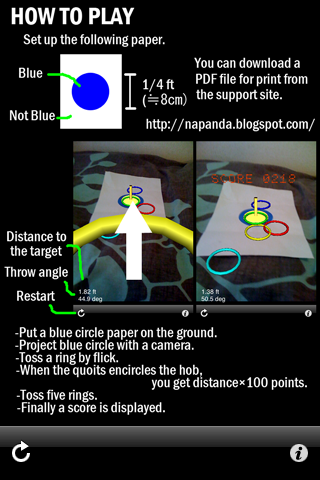
Toss virtual rings by flicking your finger onto a blue circle (drawn on on a white page). The circle is overlaid with an upright peg. Try to hit the peg. The farther the distance – the higher the points you score.
This was a huge surprise. The app is poorly designed, and it seems like it was put together in a haste. However, this is the only app on the store that actually analyzes the pixels on the screen (looks for the blue circle) and overlays graphics (the yellow upright peg) so it’s perfectly aligned with the circle. Yes it’s blinking, the tracking is far from being robust, and the game play is definitely not much fun…but it’s the closest thing to augmented reality you will find on the app store in 2009.
———————————————-
A bunch of other games on the app store claim to be “Augmented Reality Games” as well. They weren’t. But they weren’t fun either, which is where I draw the line. Here’s the list of…
Games that didn’t make the list
Overlaying flying bullets aimlessly on a camera view doesn’t cut it for me. Not even if I have a bunch of switch weapons to choose from. And yet, such games sprung up like mushrooms after an October rain: MGD (Most Dangerous Game), Assassins FPS by Differentium, iPew by Wumbitz, Firepower by Todd Hopkinson, VRArsenal by Quickdecay, First Person Shooter by Blueriversa, HandsUp by Assaf Waisler (introducing a new weapon – kisses). hiBubble by BorderTown and Snowglobe by Maverick, get a special mention for breaking away from weapons, and blowing bubbles and snow respectively, instead. Does anyone play these games, or are they just too tempting to build?
Wanted Dead or Alive by Poulet Maison (House Chicken in French) has style. I admit. The sound track sets the expectations for a AAA game – but sending friends photos of my appliances riddeled with bullet holes – isn’t my kind of fun.
Games to inspire Augmented Reality Games
Location-based games could be considered the older cousins of augmented reality games. Together, they could form a very powerful gaming experience. Here are some inspiring location-based games:
iSpy by SplitP is based on an extremely simple yet clever concept: take photos of real world objects and challenge other people to try and find it – it’s all about getting out and experiencing the real world – games alfresco style.
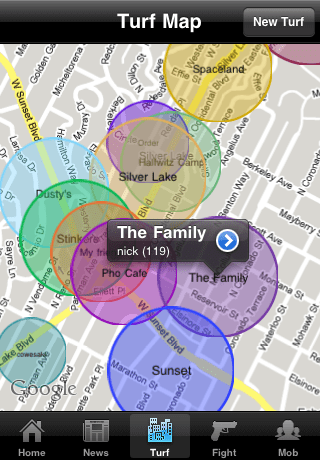
Turf Wars by MeanFreePath is a very ambitious game that takes Zynga’s Mafia Wars to the streets – literally. Nurture a mafia family and gain turf in your hood. Imagine what could happen if added a pinch of AR to this scenario…
Take over real-world territory in your neighborhood with Turf Wars, the new GPS-enabled crime game for your iPhone and iPod Touch! Turf Wars is the massively multiplayer online game where you claim and defend real-world territory from other mobsters.
Parallel Kingdom is a mobile location based massively multiplayer game that uses your GPS location to place you in a virtual world on top of the real world.
Through this game, you can almost see how MMOs and virtual worlds will look like after migrating from PC screens to the real streets.
Booyah by MyTown – location-based games meet monopoly.
Get away from your pursuers in an augmented reality survival. Turn your everyday life environment into a playing field : you’re tracked down by ennemies’ satellites, escape from the area watching over, in the time alloted.
Eye Hound pulls you in with great graphics, sound effects, and promising a unique interaction – but the action is soooo000 repetitive that it wipes out all the positive points. It might be an alternate reality game – but not an augmented one.
Apps to inspire Augmented Reality games
Sometime apps can inspire games as well; watch out for these wanna-be-games apps as they evolve. They look like apps, they talk like apps – but when you do something good like checking into a bar – you get points, badges, or if you’re a frequent patron, you could even become the mayor of your favorite pub. These apps marry social networks with GPS to help you explore your city in new ways.
– Foursquare – introduced at SXSW in March 2009: earn points and unlock badges for
discovering new places, doing new things and meeting new people
– Gowalla – a more playful take on Foursquare
– CauseWorld – same mechanics with a socially responsible spin: points you earn transform into sponsored donations to important causes.
Put a Spell (Developed by Arballoon; Published by Ogmento)
Have you been rejected from the app store? Tell us your story.
———————————————-
That concludes our review of Augmented Reality games in 2009. Overall, we have reviewed more than 20 AR games, and identified several highlights and a handful of disappointments.
The biggest achievement of the year: tens of thousands of players got their hands dirty with AR games for the first time in history. And the promise is much bigger. Prepare for 10x more games in 2010.
And keep in mind: to make these games 10x more fun, we’ll need better design – not necessarily better technology.
Wanted! Game designers! Game designers! Game designers!
Happy New Year to our devoted readers and contributors. A million thanks to our own Rouli for an amazing coverage of the augmented reality scene. And finally, welcome to our fantastic new author – Tom Carpenter.
I thought the purpose of Sudoku was a time killer and exercise for the brain. If you’re more interested in having a filled out booklet on the coffee table to impress your friends and family then this augmented reality iPhone Sudoku Grab can quickly analyze the board and give you the answers.
When AR computing technologies become more ubiquitous, you won’t ever want to let your friends wear their AR glasses during any board game because there will certainly be helper-agents to plan the next move. And I for one am waiting for the Scrabble-helper so I can quickly figure out what seven letter words I have.
Our new project has been revealed today, we are very proud to announce a new Augmented Reality game called Firefighter 360 for the iPhone 3GS.
We actually used our Augmented Reality engine developed for Bionic Eye application to create this little game.
In this life-saving fire-person shooter, you play as a firefighter, rather than gunning down enemies, you will have to douse virtual flames spreading very fast in your real environment. As you physically turn around 360 degrees with your iPhone, you have to methodically extinguish the flames you see, thanks to the camera. The fire itself isn’t just a static “enemy” to be dealt with. Flames will propagate and spread if you don’t put them down completely, the fire itself is capable of doing you harm if you’re not careful.
OK, nuff said. Let’s get it on the App store pronto.
The buzz continues, this time shooting alien invaders in a room near you.
We have seen similar (semi) Augmented Reality game mechanics with the addictive Arcade Reality and Mosquitoes.
The new game by Visual Impact System Flaw launched this week – has a much slicker interface, and the second DSi screen does add finesse (though I’d rather play it with just one hand on the iPhone):
The mission is to hunt down alien invaders – the Flaw – who are only visible through the DSi, and the radar tracker screen gets the player gyrating and spinning from room to room or running outside in pursuit!
With its US launch this week and UK and Europe scheduled for February 2010, System Flaw is the first game to come from new family-oriented publisher Enjoy Gaming.
One question remains: since the DSi has no compass – how does the tracking of aliens around you work? Optical flow?
Oh, and by the way, it was already awarded the “Best Innovation” nomination by Agence Francaise pour le Jeu Vidéo.
Vincent Verwey is happy to report that his new augmented reality game has just been approved on the app store. It’s called Mosquitoes.
It lets you kill pesky mosquitoes flying around you in virtual space.
Watch through the camera and you see tens of mosquitoes around you. On the
ceiling, hovering above the floor, on your left and to your right.
The game uses the compass and accelerometer (works on 3GS only) for a realistic augmented reality effect. The animated mosquitoes are projected in the real world,
which you see through the camera lens.
There are two modes:
1) Shoot Out. Kill as many mosquitoes as you can in just two minutes.
2) Precision. You get only 10 bullets and 10 mosquitoes. Don’t waste your ammunition and don’t waste time.
Here is more info about Mosquitoes from Makayama Software.
Or for just 99 cents you can get it yourself on the app store.
I did.
I can’t get enough augmented reality games on my iPhone.
Mosquitoes is based on a similar game mechanic as we have seen with Arcade Reality: alien space ships (or here mosquitoes) appear randomly around you, seemingly registered in 3D space (but not truly aligned with real life objects). It’s pretty addictive and sure makes you move (as well as behave like a deranged monkey ;)
Arcade Reality is very low brow, reminiscent of early arcade B games (and parents tend to ban it from their kids for safety issues), however it’s radar view makes the game a tad more interesting than Mosquitoes. Plus I’d rather listen to an 8 bit sound track than to mosquitoes buzzing nervously around me…
AR history buffs among you would remember that Mosquitoes is not the first AR game to use, um…mosquitoes.
Mozzies (also known as Mosquito Hunt) was developed for the Siemens SX1 launch in 2003. The mosquitoes were superimposed on the live video feed from the camera. Mozzies was awarded the title of best mobile game in 2003.











 Games Alfresco