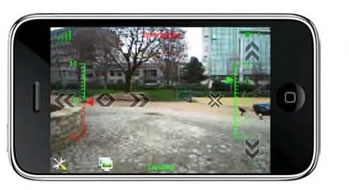
The iRiS (Intuitive/iPhone Remote Interaction System) allows you to paint a multi-media facade on your favorite building. Assuming it’s hooked up with a psychedelic projector. But hey, we’re talking art here, not convenience.
The gamer in me wants it to be a game of Tetris on that building, but I’m sure that’s the most obvious way to utilize it.
The beauty of this is that its projected luminance can be seen by anyone, regardless if they have a smartphone or not. But those with one get a remote controlled Lite-Bright building to play upon, making the others envious. It’s easy to imagine this kind of art in an AR space and modifiable by anyone, though not everyone has an artist’s eye. To each his own.
While we augmented reality aficionados would like to believe that AR has hit its stride, the nascent technology is no where near the level of 3D movies and TVs. This all may change in the future, but for now the 3D movement far outweighs AR.
This isn’t so bad as I believe, and will try to explain, how the change to 3D TVs and movies will help augmented reality:
1) Augmented reality is just 3D unhinged from a screen
The first and most obvious reason is that augmented reality by its nature exists in a three dimensional space (though in its current iteration we often see 2D sprites hovering in the air.) So products like 3D movies, TVs, and games will help drive interest in bringing an immersive 3D experience like augmented reality to consumers, as opposed to the 3D view within a flat screen that current 3D offers. Why be stuck with a screen when you can enhance the whole space around you?
I’m having a hard time imagining what an augmented reality movie would look like. It seems extraneous to add that space in the theater to the story telling medium because that space is a part of your life rather than the story in the screen.
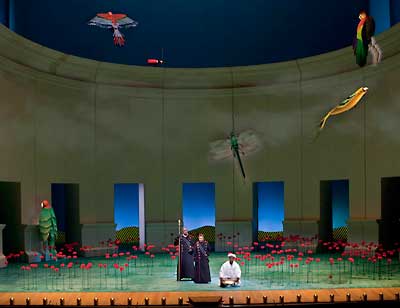
Plays on the other hand could benefit greatly from augmented reality. What 3D is doing for the movies, I could see AR doing for plays. Theater typically breaks the fourth wall during its performances, letting the audience in the secret or involving them, even if its just through thunderous applause.
So what if every seat had AR glasses (they could be a little bulky for a two hour experience right?) and the players interacted with this 3D immersive medium? The type of material presented in that format could be wildly expanded and new forms of storytelling could emerge.
Let’s be real. Ten years ago, someone with a PDA (Personal Digital Assistant for those that don’t remember the 90s) was considered pretty nerdy. Wearing one on your belt was the equivalent of the pocket protector.
Flash forward to 2010 and one of the big concerns for AR glasses is the style. Does anyone remember the early versions of the Blackberry? I felt like I was wearing a frisbee on my hip or that I had a side-holster with a six shooter in it. If it’s functional and not too bulky (i.e. – neck ache) then it’ll be a hit.
The 3D glasses we start buying for our TVs and games will help bridge that fashion gap. Who cares what you look like when you’re used to wearing them at home in front of the TV? Just convince Lady Gaga to wear a pair of bulky AR glasses as a fashion statement and Vuzix will be trying to make them bigger (which brings me to the thought that Lady Gaga is probably just dying to get freaky with some AR.)
Augmented reality is the technology of illusion. So what better way to celebrate it than with our favorate augmented reality magician Marco Tempest. He casts himself as the ‘virtual‘ magician. I say we do our own trick and change that to the world’s best ‘augmented‘ magician.
Marco will be attending the ARE2010 event, so if you don’t have plans to go yet, make them now!
“Look, I’m telling ya, there’s somethin’ movin’ and it ain’t us! Tracker’s off scale, man. They’re all around us, man. Jesus!”
“Hicks: Remember, short controlled bursts. Hudson: 9 meters, 7, 6. Ripley: That can’t be, that’s inside the room. Hudson: It’s reading right man, look. Hicks: Then, “you’re” not reading it right. Hudson: 5 meters, man. 4, what the hell?”
Never look in the egg… all I’m saying… never look in the egg.
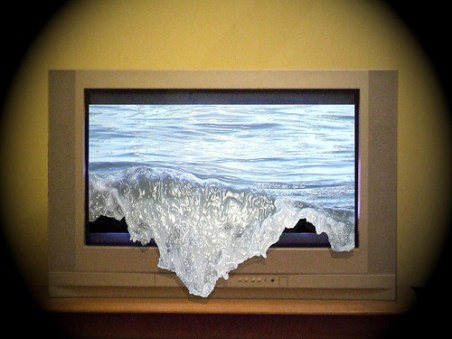
Augmented reality isn’t just webcams and smartphones (or really weird haptic floors.) Sometimes they’re windows into other places like this Winscape. While the name is unimaginative and makes you think it’s a Microsoft product, the idea is spectacular (albeit for only one person.)
Using an iPod, a Wii remote, and some other gadgetry (see this video for the how-to), the setup gives you a window into another place. We’re not talking a fireplace on your TV, but an interactive illusion. The views they choose were pretty mundane.
Though if I’m going to take the time to set all this equipment up in my living room and carry an iPod around my neck all the time, I want a panoramic view of a distant planet like Mars or the bottom of the ocean. Or give me a mock-up of my favorite science fiction and fantasy novels. What LARP’er wouldn’t want to have a window that looks out of Minas Tirith?
The makers of this call it Situational Telepresence. I’d call it a ‘window into another world.’
The ISMAR10 committee is currently putting the word out that the deadline for submissions has been extended to May 31st. This year’s theme is “Borderless.”
The 2010 ISMAR Arts, Media and Humanities chairs invite artists, scholars, media practitioners, who can shed new light on emerging new relations within the future of Mixed and Augmented Reality. We would welcome musings, probings, discourses, insights, and imaginations to be presented in Seoul Korea October 13-16, 2010 in the form of long and short papers, art installations, panels, workshops or tutorials.
This theme of this year’s ISMAR conference is “Borderless” sparked by the convergence of Mixed and Augmented Reality, ubiquitous technology and global connectivity. In the rapidly emerging application of Mixed and Augmented Reality, how do we make sense of time and space now?
With no clear-cut boundary between what is natural and artificial, we are faced with ambiguity, transience, and contingency. How will melting the boundaries between real, virtual and imaginary realities transform our world?
For any questions about the Call for Participation contact the AMH Media-Communication Chair, Julian Stadon (J.Stadon@curtin.edu.au).
That’s the tagline of the new iPhone app Gigaputt from Gigantic Mechanic. Instead of clubs, you swing your iPhone in a Wii-like manner (though the accuracy is no where near the same) and hit your ball. Unlike most AR iPhone games, this one actually requires you to interact with your surroundings rather than just spin in place and hit random buttons. I’m sure there’s some way to include drinks and bar hopping into the game for the adult readers of GA.
A group of students at Technische Universitat Munchen, under the direction of Gudrun Klinker, created this augmented reality racing game. The setup is similar to the AR Drone game in that it uses a real vehicle, however, using the illusions of AR, they turned their LEGO Mindstorm robots into cars.
The students had two (analog) radio cameras and mounted each on one Lego Mindstorm Robot. With this constellation the player was presented the view on the world from a robot’s perspective. The students also placed markers on top of the robots which were being used to calculate the pose of each camera in relation to a common coordinate system (using one ceiling mounted camera). With this pose, the view of the virtual camera was matched to the real camera’s view. The students augmented the real camera images with virtual graphics such as the race course and some special items (speedup, rockets, etc). The goal was to drive as fast as possible four laps or to hunt down the other player before he can finish the race.
The calibration of the tracking system and the tracking itself was done using Ubitrack and its MarkerTracker Component developed at our chair.
We think because of some aspects this game is very special:
– The game is a twoplayer game, so you share the same virtual (and real) world between the two players.
– There are no markers in the camera view of the player since the cameras for showing the graphics and doing the tracking are not the same.
– The (real) robots are being overlayed with car models in the camera images so you do not get the the impression of playing against Lego robots. (O.K. sometimes you can see the robot due to a lag in the tracking or since it is not overlayed completely)
– And best: It was playable and is not only a concept :-)
Good job Christian Waechter, Eva Artinger and Markus Duschl. I think you’ll have a career in augmented reality.
Augmented reality has come a long way in a years time. Last year I got excited by research projects and gimmicky AR webcam advertising, but that quickly faded on the tenth plus iteration. It wasn’t until July that we starting having real AR products in the form of apps. Nearly a year later and still early in the development of the AR ecosystem, we’re seeing a more diverse use of the technology and that has me excited again. So I want to take a moment to go over ten cool things going on right now in augmented reality.
1. Battle of the AR Browsers
Wikitude, Layar, Tonchidot, Junaio, TagWhat and others hope to be the standard for the AR browser market. Layar has recently upped the ante with an AR content store and TagWhat takes it in a new direction by combining lessons learned with Foursquare and Twitter. I suspect one of the big boys like Google, Twitter or Facebook will eventually either create their own or co-opt the ideas from these early browsers into their current products. I’m not sure which horse to bet on in this race, but in the end we customers are the winners.
Using an Eye-Trek video headset, the guy at Tailormadetoys made a pair of AR glasses. I love the DIY culture and while they’re not see-through, I think all the right parts to make one are out there. This post from Team Hack-a-Day proves that the DIY makers are getting close, so why can’t one of the big makers get it done?
3. The AR phone – Ouidoo
The specs on this Ouidoo QderoPateo smartphone are in the WTF!? zone. While the phone won’t be out until the fall, the company claims it’ll have a 26-core CPU capable of 8-gigaflop floating point operations and include 512MB RAM, 4GB ROM, 28GB of built-in storage, microSD expansion, Bluetooth, WiFi, GPS, built-in 3D map, accelerometer, digital compass, 5-megapixel camera with flash, 220 hours of standby battery life, and a sharp 3.5-inch 800 x 480 screen. Whew.
While I’m not completely believing the hype, and it could end up being vaporware, it certainly looks promising. Though it’ll have to work hard to compete with the likes of the iPhone and Droid.
Bionic eyes and augmented reality. It’s like peanut better and chocolate! Rob Spence is putting a camera into his eye to make movies with (and because its just plain cool.) And he’s also interested in combining augmented reality with his eye camera. They’ve come up with a promotional AR eyeborg t-shirt in the meantime.
Bruce Sterling, Will Wright, Marco Tempest, and the list goes on. It pains me to say that I won’t be able to make the inaugural event. I had a work conflict with that week, so I have to bow out of hosting the panel on AR glasses. But for the rest of you, I hope you’ll be able to make it. With AR on the rise and viable business options a-plenty, it’s a good time to network and see what everyone is doing with the nascent technology. This is the “can’t miss” AR event of the year.
Our favorite interviewer Tish Shute and longtime commenter Thomas Wrobel have been sheparding the AR Wave project and collaborating with people all over the globe. While it’s still too early to tell, this could end up being one of the most important AR developments out there if they can truly create an open source way of using AR. As they’ve been telling everyone, they’re trying to make a system that:
* Anyone can make content
* Anyone can make a browser
* Anyone can run a server
7. iPhone OS4.0
It almost pains me to get excited about an iPhone update that promises video access to make real AR work on that smartphone. We got fooled last September with the OS3.1. I’m hoping we don’t get fooled again (unless you’re the Who.)
I’m not even entirely sure if haptic floors fit into the augmented reality spectrum, but it’s so crazy weird and true, that I had to include it. I seriously doubt we’ll be seeing a commercial product anytime soon though (or ever.)
9. AR Drone
While the news on the AR drone is a stale few months old, I still think it warrants inclusion because it was a great product. The hovercraft alone was worth the price of admission, but the AR added a creative twist to it. I have no idea if it sold well, but it sure did capture the imaginations of a lot of geeks.
10. You choose!
Let us know what you think is the coolest thing going in augmented reality right now. Whether it’s a product only hinted at or one currently residing on your smartphone, we’d like to hear it. So let us know here at Games Alfresco in the comment section!
When someone falls down and begins grabbing at their chest. How many people would stop and try to help them? Psychology experiments show that most will walk by, hoping the next person will stop and help the struggling person. Witness apathy in the face of need is wired into our brains and difficult to overcome.
An interactive billboard campaign in the Netherlands hopes to break the cycle of apathy by putting people into the fake event using augmented reality and then giving them tips on what to do. The billboards are in Rotterdam and Amsterdam.
I wonder if future image context recognition apps will be able to shake people out of their mob think and let them know to take an action? Or maybe they’ll just turn their AR glasses to standby instead.










 Games Alfresco