A few months ago Staffan Dryselius made a splash on Team Hack-a-Day with his DIY data glasses. Since then he’s been working with a team to improve his design and would like to form a larger partnership with anyone interested in working on or owning a pair of AR glasses. Having a working HMD for augmented reality would help the technology gain wider use. Currently, we’re stuck with magic lens or web cam AR if we want to play with our favorite technology, though both have come a long way since early 2009.
The group is calling the glasses Maxcware (website not fully functional yet, but contact Staffan below if you want to join.) If you’re not familiar with the reference in the name, I’ll give you a hint. The name is from a science-fiction novel from this decade and if you haven’t read it, I highly recommend it (and it’s in the AR reading list.) If you’d like to contribute to the group, contact him at staffan (at) maxcware (dot) com.
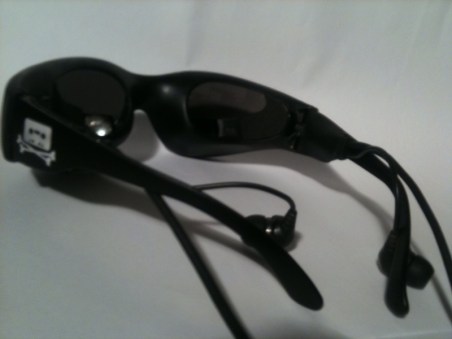
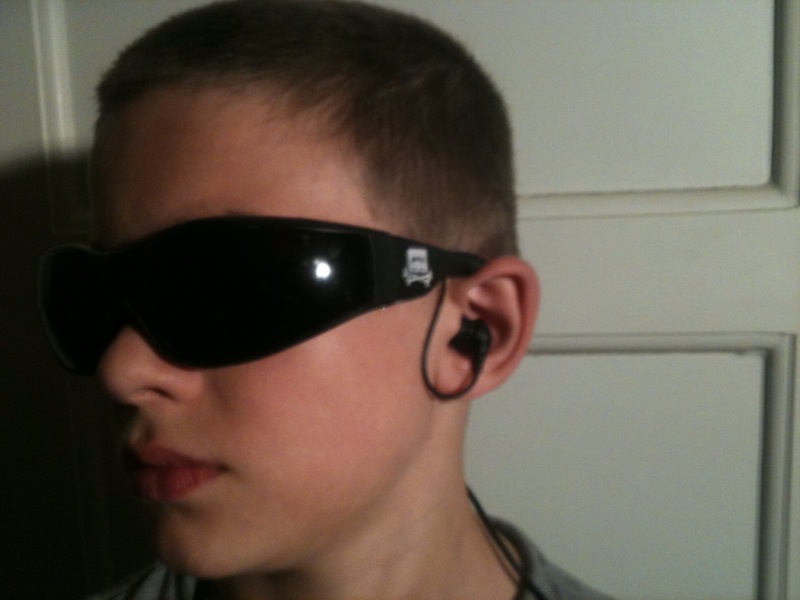
So to learn more about the project, I sat down to interview the man behind the vision (pun intended), Staffan, and since we’re talking about a visual medium here, I’m going to show you the glasses before we get to the interview.

Tom:
Interest in commercial HMDs has increased with spread of
smartphones. Why did you decide to tackle this problem that the glasses
makers have failed to deliver on?
Staffan:
I had more or less despaired about any non-heinous, high-resolution
see-through HMDs emerging in my lifetime when Vuzix showed off their
new Wraps at CES 2009. When all they finally delivered to the market
turned out to be an opaque lump of plastic, I had finally had it. I
started to suspect that the public would continue to be spoonfed
incremental yesterware more or less forever. No single maker would
have the guts to make their inventory unsellable by launching anything
really nice and new unless forced at gunpoint. I would never get the
glasses I wanted unless I made them myself.
I first got excited about HMDs some time around 1995. There was lots
of interesting research done at the time, and also quite a few
companies advertising products “soon to appear in a store near you”. I
think it was around -96 something that Sony actually launched their
Glasstron model, and there was also the “Olympus Eyetrek” soon
afterwards. I however decided to wait a bit, great things seemed to be
just around the corner. Especially one company, Digilens had an
awesome idea for optical see-through AR-type displays using switchable
Braggs gratings in 98-99… I was very excited at that one especially
(the company has by the way resurfaced as SBG Labs with yet another
vaporware design).
Then the dot.bomb exploded, and everything digital died. “Virtual
Reality” became “Definitive Nonexistence”. The headsets by Sony and
Olympus were phased out, and the Digilens homepage died shortly after
they decided to do fibernet switching chips rather than HMDs… That
was more or less the situation for many years, and I was very
disappointed and soon promised myself to try and forget all about
HMD:s until I saw an advertisement for something really good I could
actually buy in a shop.
Since then, I have read several science fiction books featuring HMDs,
seen the developments in smartphone AR emerge and again felt
frustrated about the non-existence of useful HMDs.
Enter 2009 and CES. Vuzix were showing their new Wraps. Wow! At last!
I couldn’t wait for the release date for their fabulous new optical
see-through displays! The disappointment was what made me do it. Even
though I didn’t really know how, I had to give it a shot.
Tom:
From the picture, the screens appear to be non see-through. Is there any
possibility of making them see-through so true augmented reality can be
accomplished?
Staffan:
Yes. And that is the plan too, of course. The first step is to add a
camera to the glasses to feed the display ambient video blended with
digital content. It is much neater not having to point the camera of
the phone itself around to use AR applications in the glasses, as must
be done today. As soon as possible we will also want to add
accelerometers and magnetometers to the glasses.
The top half of the glasses will continue to be completely clear.
There is no need to expand the physical screens any further, only the
virtual screen estate. Those two are quite separate entities, but it
is only when keeping the optics sufficiently close to the eyes that
this becomes really obvious. It’s like peeping through a keyhole: Keep
your eye close enough and the aperture lets you see the whole room.
From the beginning I saw the “see-around” (or rather “see above”)
design combined with “really near eye” optics as just a pragmatic way
to make something useful with available technology. However, a very
nice aspect of the “really near eye”-design is that the physical
movements of the eyes can actually become useful instead of being just
another engineering obstacle. It is especially useful that the eyelids
work as natural shutters, switching to the view that is most
appropriate for the moment. When looking straight ahead or upwards,
the lower eyelids completely block the screen so that light from the
displays doesn’t disturb the natural vision. When looking down, the
upper eyelids block lots of the ambient light that may otherwise
bleach the screen.
Apart from a convenient way to keep alive when traversing a street, it
also means that camera see-through becomes practical. At first, the
mere thought of camera see-through made me shudder. Although that
solution can more or less immediately be used together with Layar and
all the rest of the applications for smartphones, both limited field
of view and latency are fierce problems to combat without a
possibility to momentarily switch to complete see-through. The latency
may not seem too bad at first, but try and navigate while walking at
any speed using only the viewfinder of a video camera. Fixing a camera
to the glasses is far worse and reacts to every jerk of the head. To
keep the screen from bobbing about, you have to take it real slow… If
motion sickness is not enough to make a person reconsider, then the
inevitable robotic choreography should inspire second thoughts about
testing the concept in public.
Tom:
How do you envision the use of these glasses? Hooked up to an iPhone or
Android (or whatever smartphone you use) to project the screen realtime? Or
some other usage?
Staffan:
All that is needed is connectivity and some basic sensors. They’re all
there in today’s smartphones, so yes, the glasses will hook up to
them. As many different makes as possible and as easily as possible.
As for uses… Wow! Where to start?
…Humanity is a little like the first amphibians. We’re popping our
heads above the surface of the primordial soup right now. There is a
completely new digital world in the making out there. We are just not
very well adapted to take part in it, and the interfaces we use today
are laughably inadequate for interaction. With AR glasses we may at
least get up from our asses and shut the door on the cubicle. Reading
company spreadsheets can be done just as well on the way to the beach.
The best ideas may come to our mind when we are in the supermarket,
only today we forget before we’re back at the computer. No more so. A
digital post-it or email is quickly edited in the corner of the eye.
But work and “productivity” is boring… Instead Google should be there
with us when we see a new butterfly in the park. Getting lost in the
city in the age of GPS? –That’s laughable! Directions should be where
they belong, as AR overlay. No more getting scammed in a shop. The
barcodes should trigger balloons with user tests and best prices on
the go. Blogger? -Updating the skateblog should be done when we are
actually up and rolling, complete with action footage and biometrics.
Why make do with just the normal senses? Nightvision? –No problems.
X-ray vision may come in handy while sharking by the pool, just pop
out the IR-filter if you are so inclined. Bad-hair-day? –Put on a
digital wig and a happy face. Bored? –Just connect to a robocam in a
Tokyo bar. Going to a meatspace party? Bring your avatar buddy along…
Starting to sound outlandish yet? SciFi? I say all this is very close
at hand, and we just need to light the match to set the digitality
ablaze. It is long overdue…
Tom:
You mention on the hackaday post that the image is doubled on the two
screens. Have you figured out how to split the image to get the true 1280
width?
Staffan:
More or less. We will probably want to device a completely new
graphics card instead of doing too many hacks on the original MyVue
PCB, but it is doable even on that one. I’m just afraid that we may be
wasting valuable time going down that alley too far. I think it will
be better to put something together that doesn’t require un-human
soldering skills to work. I want to put together a more manageable kit
instead so that as many people as possible can get involved. The Kopin
displays are however well documented, and there is no magic involved
in interfacing with them. I have a friend working on it, but don’t
want to push it. In the Hackerspace groups I also mention, we are
getting better organized. There is now a webspace up and running (for
our internal purposes as of yet), and we are putting together a
“to-do”-list allocating work-packages for the different members. The
front-page of Hackaday gave some new contacts too, and I’m having
serious pangs from my conscience for not handling them yet! I’ve been
lazing away with the family doing things like sailing and the like…
Tom:
How much would it cost if someone wanted to make their own pair?
Staffan:
A pair of MyVu glasses cost about $150 on eBay. Add some Fimo putty
and a pair of oversize-sunglasses (the kind that fits over regular
glasses) plus a couple of days work (depending on skill), and you have
a crude but passable pair.
If you want something better, you may download the meshes for the pair
I have and order better frames from an online prototype maker. I don’t
have the figures for how much that would be, but that is a quite
expensive alternative. Better then to wait until I can fill an order
with a Chinese factory. A box with a 100 pairs will cost about $100 a
pair.
There is then the video card, better battery and case… No figures there yet.
Tom:
Why are you going about this as an open source project?
Staffan:
Further, those who do understand say I’m either mad to disclose
everything on the net and to loose an excellent business opportunity,
or call me names for destroying the patentability for others. I
usually retort that the industry hasn’t moved at all for a decade, and
why do they believe I would fare any better? I also try to line out
the difficulties with classical innovation processes. I’ve been there,
on both sides of the fence. As inventor and as executive in a joint
industry-governmental innovation system. I know how bad it can be.So
much time and creative drive can be lost in anger over incompetence,
greed and dishonesty that you simply don’t want to think at all about
your project.
I believe that instead of getting entangled in patenting processes, VC
negotiations, hunting for (competent!) technical consultants,
marketing and manufacturing partners, it would be far better to copy
some applicable concepts from open source software development. With
the glasses, I want to perform an experiment. I would so much want to
put together a really nerdy team of developers that are driven by the
fun of problem solving and a feeling of contributing to a community
rather than for direct economic benefit. Not that there may not be a
chance to make some cash one day for everyone involved, only the money
should not be the driving force.
Here is a good clip to illustrate what I mean:
http://www.youtube.com/watch?v=u6XAPnuFjJc
Naturally, hardware is much more difficult to develop in a community
than software. However, I believe the time may be ripe for a test of
the concept. If any project can succeed, I think AR glasses is it. The
time should definitely be ripe for technologically inclined people to
want those for themselves. I know I definitely do. The basic concept
is also in place, and both PCB:s and plastic/mechanical components are
quite cheap to manufacture these days, even in singular quantities.
Many of the potential combined early adopters and developers will be
able to make their own glasses and feed the loop.
I can see an emerging ecosystem where different participants can
specialize and even start to make some money from selling
non-complicated sub-systems. There is also potential for spin-off
projects and services that will benefit from AR-glasses. There are
many angles to this experiment…
** End of Interview **
Whew. I agree, Staffan, the time is ripe for a technologically savvy group to tackle the AR glasses problem. And given the importance of this little piece of hardware to the overall AR ecosystem, I think it’s worth our time and hopefully worth your time to join this project if you have something to give in the way of knowledge, expertise or time.
So stop by Maxcware or contact him at staffan (at) maxcware (dot) com if you’d like to contribute. Or at the very least, sound off your encouragement at Games Alfresco.
Filed under: Uncategorized | Tagged: AR Glasses, augmented reality, DIY AR Glasses, Maxcware, Staffan Dryselius | 4 Comments »






 Games Alfresco