Augmented Job Board

Looking for a position at a leading AR company?

Metaio’s  is looking for an iPhone developer for its San Francisco offices:

Your tasks include the analysis, the design and the transfer of customer specified Augmented Reality solutions.
Task profile:

  • Application development on iPhone / MacOSX
  • Working on customer projects
  • Requirements analysis / engineering
  • Application design
  • Project communication
  • Collaboration with the core development, research and product development
  • Customer and service orientation

You can find this and many other available positions at Games Alfresco’s Job Board.

If you happen to look for the right person to fill an augmented reality related position, why won’t let us publish it over here? There’s nothing to lose, it’s free!

Freaky Friday – Nude It

I’m sure that such an application would be a killer-app for augmented reality. “Augmented reality? I’m only using it for the articles”. Via @u2elan.

Three More HMDs to Consider

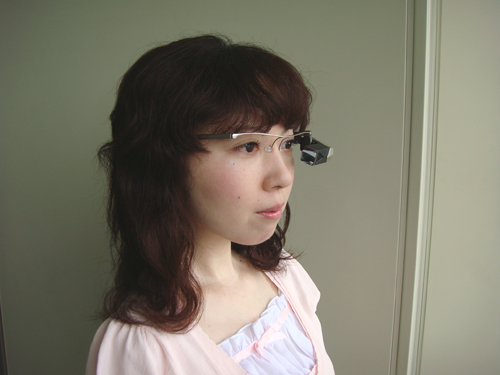
Cool NEC is developing a head mounted display named Tele Scouter which it hopes to begin shipping somewhere in 2010. The eyepiece shown in the image below has some really neat features like front facing camera and eye tracker. This enables a remote server to see whatever you’re looking at, and send you some relevant content to be displayed on the little screen. Not so cool- it’s going to cost a small fortune, and NEC is only planning to sell about 1000 of those in the next three years. More details on SlashGear.

Cooler Fellow Japanese company, Brother Industries is not left behind. Apparently they developed a light-weight HMD (by light-weight I mean 350 grams including batteries) that should also hit the stores in 2010. Like in Tele Scout’s case this unnamed HMD superimposes the image it generates over reality, not blocking the user’s view. So why is it cooler than NEC’s device? Well, they use terms like “green diode lasers”, and if that doesn’t make you blind, it’s surely very cool. More details on TechOn.

Coolest Now you can make a HMD right in your own home (though you’ll need an iPhone and some cardboard):

Though none of those devices (certainly not the last one :)) is aimed for the AR crowd, I guess that enthusiasts will find way to harness them for cool demos. Don’t forget to read Tom’s review of more concrete offerings from ISMAR.

Augmented Reality – Now Comes in Banners

For their latest campaign, promoting Burger King’s one dollar menu, ad agency Crispin Porter + Bogusky chose to break the mold of former AR campaigns. First, there’s no mini-site, the whole experience is neatly contained within a single banner ad. Moreover, there’s no need to print a marker. You simply show this ad a one dollar bill and it shows you an item from BK’s one dollar menu. You flip the bill and it shows you another item. Finally, when you hide the bill from your web cam, your face is covered by a king’s mask.

Apparently it works with other bills and even white sheets of paper, so you can give it a try. The banner is featured over here.

Augmented Teddy Bear You Can Touch

Researchers from Tokyo Institute of Technology and the University of Electro-Communications may have created the cutest AR creature to date. In the last SIGGRAPH conference they have presented the following poster, discussing a haptic ring that let you pet virtual creatures (VC) and enable virtual creatures touch you.

We installed models of optical / touch sensation into our VCs. It
enables VCs to react for user’s actions to VCs in various and appropriate
ways. For example, they express attention by looking back
when they are hit from backward. They express happiness when
they are stroked gently, and they step away after a strong hit.

(if embedding does not work for you, video is here)

More details can be found here. Via Development Memo for Ourselves.

Halloween Augmented Reality Special

Following are some AR tricks and treats I’ve collected over the last month, which make me think this Halloween should be declared as the first augmented holiday. Judge for yourself.

First we have the interactive Halloween mirror from Instructables. This little do-it-yourself project will let you and your party guests try out gory and scary masks without spending money or buying makeup. Just remember to turn-off the screen saver before installing it in your living room. (Note, you can stop watching this video after the 1 minute mark, it just repeats itself)

Taking the same face detection approach, Disney lets you become one of the villains from their animated movies. However, their Halloween Time application spice things up by including a mini-game, so kids may find it interesting:

While that Instructables project used OpenCV for face detection, HIT Lab NZ has opted for a simpler solution – just wear a marker on your forehead and turn yourself into a skeleton. On the upside, it’s in 3d. Quite a memento mori moment:

Last but not least, Meijer, an American retail chain from the mid-west bring us what is probably the most attractive Halloween application. Meijer chose to promote its line of products for Halloween by letting visitors to this site try on 3d masks without the need of wearing markers, though you do have to install a plugin from Total Immersion. They even let you record yourself wearing the virtual mask, and make it possible to alter your voice (which according to them is an AR first). Sadly, they don’t let you upload videos to Youtbue, fearing inappropriate videos, and they don’t have a public gallery of user-made videos (which didn’t prevent users to upload about 1300 videos) so I’m left with putting a screenshot:

Here’s a direct link for one of the upload videos, to get a better idea.

Know of any other Halloween related augmented reality project? Tell us about it in the comments.

Weekly Linkfest – ISMAR Edition

Back from my short hiatus. As I wasn’t able to attend ISMAR, I had to follow the conference via the impressions of others:

  • If you hadn’t read it yet, you sould – Ori’s ISMAR summary: “Top 10 tidbits reshaping the augmented reality industry“. I’ve found his sixth bullet point, the shortest of them all, the most interesting. Microsoft is pursuing augmented reality, and they have a plan. Also check out Ori’s impressions from the Mobile Magic Wand seminar.
  • By far the most numerous reports come from Gail Carmichael who covered rather extensively the “Falling in Love with Learning” workshop (part two and three). She also had a post on the Handheld AR Games workshop, and a post covering a bunch of ISMAR papers that revolve around human factors and user interfaces (which is my favorite, touching on some surprising results). Gail also made a video summary of some of the demos presented.
  • Thomas Carpenter had an excellent review of the head mounted displays presented at the conference. Above all, it’s Tom’s enthusiasm that makes me feel depressed that I missed ISMAR.
  • And of course, Robert Rice shares his impressions from ISMAR. His post made me wonder whether there’s a place for another AR conference, dedicated to the industry (while ISMAR will mainly be for the academy). If augmented reality really takes off, I bet O’Reilly will set such a conference.

I’m pretty sure more posts will come later this week (I’m looking at you Tish), and I’ve probably missed a few that were already published, so feel free to add links in the comments. In the meanwhile, today we have not one, but three weekly videos, all coming from ISMAR.
First, here’s conference attendees playing with Sony’s EyePet, the mini-games look like a lot of fun:

Next is the winner of best demo award, Cambridge’s “ProFORMA: Probabilistic Feature-based On-line Rapid Model Acquisition“, showing, well, rapid 3d model acquisition:

Last is a demo for Carnegie Mellon’s “Dynamic Seethroughs: Synthesizing Hidden Views of Moving Objects” paper, presented at ISMAR, courtesy of New Scientist, showing a neat transparent wall trick that could one day be incorporated into cars. I cannot embed the video over here, but do check it out at the link above.

Have an excellent week!

Augmented Job Board

Short note – Layar is looking for Android developers.
As always, you can find this and many other open positions at Games Alfresco’s Jobs section, and you are welcome to tell us about open positions in your company, we’ll post them for free.

ISMAR 2009 Epilogue: A New Augmented Reality World Order

ISMAR 2009 is over.

It was the best of times. Augmented to the Nth degree.

How does the world of Augmented Reality looks like in the morning after?

Eager, revolutionary, strong, creative, responsible, loving – with a speck of a hang over.

Does it feel any different than before?

Well, a few tectonic plates have shifted overnight.

Here it is, my

Top 10 tidbits reshaping the augmented reality industry:

1) AR Browsers make peace not war
Augmented reality browsers and navigation apps have been the media darlings of 2009. They have been depicted as gladiators battling to the death (we take some of the blame). ISMAR, on the contrary, was all about love and peace. On Monday’s Mobile Workshop, Robert Rice and I had the privilege to moderate a session about collaboration in the AR industry. Picture this: Layar, Wikitude, Junaio (from Metaio), and Across Air sitting around a table planning a communication standard for augmented reality information. I had a tear at the corner of my eye.

Missing in action: Presselite, Tonchidot, RobotVision, GeoVector…

2) Mobile is king, and the iPhone is the emperor’s new clothes

In 2009, ISMAR organizers decided to feature Mobile Augmented Reality (driven by Christine Perey) as the highlight of the event (duh!). The event guide explains: “much of the media and consumer attention is on mobile AR…because AR is increasingly with users where ever [they go].” The intention manifested itself allover the place: in workshops (“Present, Future, and the Roadmap to Mobile AR”, “Outdoor AR”), tutorials (Introduction to Handheld AR), sessions (Human interfaces, Human Factors, Tracking on mobile devices), announcements (Junaio, Artoolkit on the iPhone), posters (Streaming on mobile phones, In-situ outdoor geo models, Clinical Training experiences, Egocentric space distortion for environment exploration, Learning on the iPhone, and EyePly – mobile AR for sporting events), and demos (first panda ever to appear at ISMAR, PTAM on an iPhone.)

And all this hoopla around a phone that requires you to access a private API for live video?

3) Vuzix leading the pack in AR glasses

Photo Credit: Ron Azuma (Nokia)

Photo Credit: Ron Azuma (Nokia)

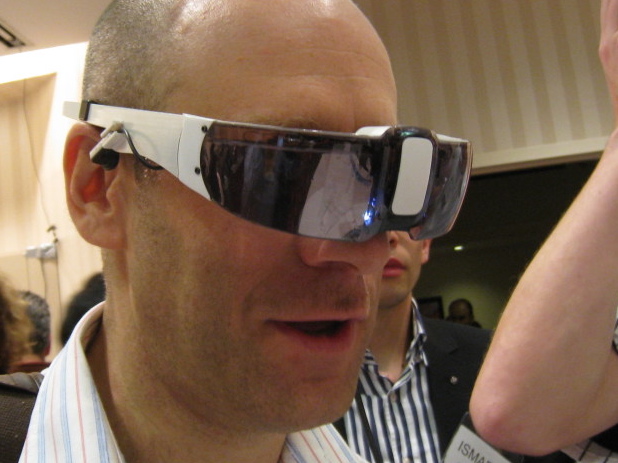
Mobile AR was all the rage, but AR aficionados in-situ were hungry for new AR glasses that will truly unleash its power. ORA Lab and Canon still offer huge-expensive HMDs; Microvision is focused on thick military grade monocle, and Nokia tries to leapfrog with way-cool gaze tracking but poor display (check out Thomas Carpenter’s post for more on ISMAR HMDs.)

This leaves Vuzix lonely at the top with with the only see-around, semi-dorky, inexpensive glasses (the envy of any Panda)

PandaVuzix

Missing in action: Lumus

4) Sketch is the new marker

Oriel_Nate

Best student paper award went to Oriel, Nate et al. for AR Sketch (which featured in our top post and popular video). Their work is revolutionizing the AR world by avoiding the need to print markers – or any images whatsoever.

Two other winner were Steven Henderson (with Steven Feiner) for “Augmented Reality for Task Localization in Maintenance of an Armored Personnel Carrier Turret” and honorable mention for the lovely Susanna Nilsson (with Bjorn Johansson) for “AR to support cross-organisational collaboration in dynamic tasks”(read: disaster relief) – but both would have made scarry headlines: “Tanks Take Over ISMAR” or “Fire sweeps ISMAR”

Missing in action: Daniel Wagner – who delivered his best paper yet: con-graz on your new baby!

5) Qualcomm spearheads as the most aggressive chip maker in AR

As diamond sponsor of the event, and with its own Jay Wright painting the vision for AR in 2012, as well as bravely moderating the controvertial “Past and Future of ISMAR” Panel –  Qualcomm leapfrogged the other chip makers to become the most sincere contender in the future of AR devices.

Missing in action: Nvidia

6) Microsoft – the new big player to watch

Georg Klein, inventor of PTAM-on-an-iPhone (and the smartest Computer Vision guy on the block) joins Microsoft to make Mobile AR. Look out for Microsoft.

7) Minority report VFX designer is looking for the next big thing in AR

The mere presence of guy with the most enviable AR credentials in the world (the guy who designed VFX for minority report), Kent Demaine, signaled the entrance of AR into the major leagues. Now he just needs to convince J.J. Abrahams to make a movie out of Vernor Vinge’s Rainbows End.

8) New ARtist in charge

At ISMAR 2008, only one artist was present at the show and easily grabbed my Most Beautiful Demo award. In 2009 with a whole new tarck for Humanities, Arts and Media – the competition was more intensive. One artist came above all with commercial-quality, entertaining-yet-sophisticated pieces – and proved that with good design today’s technology is ready for prime time. Helen Papagiannis is the new AR artist-in-charge.

9) The AR ivory tower has been shaken
The fearless Pattie Maes presented, in front of an AR-only crowd, her popular off-mainstream augmented reality project the Six Sense making the point that with simple technology, low cost components, and clever design –  it may be easy to bring the digital world into the physical one.

Although they all saw it coming – the audience was stumped.

Just check out who asked the questions:

Mark Billinghurst – “have you evaluated the user experience with users?”
Steven Feiner – “It won’t work on large buildings, would it?”
Bruce Thomas – “What about privacy?”

Nuff said.

10) AR goes commercial
This was already the 10th ISMAR yet since the first – multiple attempts were made to bring AR to consumers – but the market has been elusive. This year, was the first time were consumer-oriented products were introduced. From Layar to Wikitude to Across Air and the just-announced Junaio, and learning games like Ogmento‘s Put a Spell – ISMAR became the breading ground for commercial AR. Christine Perey even dares to estimate Mobile AR revenue in 2009 to hit $10 Million. The tsunami is coming, prepare your surf boards.

~*~*~*~

If you feel this list is lacking or biased, I kindly refer you to the Heisenberg uncertainty principle which states that one can not measure both position and momentum in precision, because the mere observation affects the results. Beat that excuse – brainiacs.
(thanks Noah for the pointer)

By the way, I finally discovered why Korea is at the epicenter of the Augmented Reality world: How do you say “good morning” in Korean?

To find the answer you’ll have to come to ISMAR next year in Korea!
(hint
: 증강 현실)

How did ISMAR change YOUR view of the AR world?

~*~*~*~

Other ISMAR 2009 posts you mustn’t miss:

ISMAR Demo preview

Our ISMAR 2008 link collection

Stay tuned for links to videos and presentations here and at the ISMAR society site.


Live from ISMAR 2009: Starts Today with Innovation Workshops – Mobile Augmented Reality

ISMAR 2009 is starting Today. Woo-hoo!
Looks like a true conference. Beyond the strong presence of researchers – many start ups, game developers, artists, press. The augmented reality industry is forming in front of our eyes.

Multiple interesting innovation workshops are on the agenda for today. I am joining the Mobile Magic Wand workshop.

Christine Perey kicks off the workshop with a dry definition of what Mobile AR: is a catch all Mobile AR apps, services, hardware, content  for consumers, professionals, prosumers, both indoor and outdoor.
What does a capable mobile device need to pack in order to play in the AR world?CPU 600 mhz, camera, GPS, compass, and some more goodies depending on the target application…

Today’s mobile AR users: more than a thousand and less than 1 million (90%+ on Android and iPhones)
These are early adopters, avid users of social networks, mostly located in western Europe, north America and south east Asia.

Who’s in the audience? Mobile network operators and mostly content and application developers. Dirk from Layar confirms they have shared 1000 developers keys. This is starting to look like a solid community.

Perey presents  usage scenarios that will be tackled by 4 of the AR companies on the workshop (Layar, Mobilizy, Across Air, Metaio):

1) Entertaining in teen town

2) College fresh on campus

3) Assisting a tourist

Peter Meier CTO of Metaio is first on stage (self described Dinozaurs in the AR space) starting with an introduction to Junaio: take pictures of locations and post in 3D in a physical location that are stored on a Metaio server – so that both mobile and home users could enjoy.

He bravely demos it live, posting a 3D object at the end of the room. Peter: “It’s always a hard one…we rely on a bad GPS signal…”

Peter then switches phones and starts playing a zombie game, slashing zombies hidden among the audience “I hope you are all over 18 because there is some explicit content here”…

Anyone can create Junaio enabled games using web APIs. It’s for programmers and non-programmers, it will includs marker tracking and markerless tracking.

Peter wraps up with a display of his excitement about the public awareness to AR: ” I have been explaining AR for so long now, that I am so happy with recent developments in the space.”

Markus Tripp from Mobilizy, joined the founder Philipp in the very early days of this start up (currently 10 employees).

He starts addressing the first use case: coaching a college freshman, by touting Mobilizy’s proposed markup language – ARML. It makes it easy to customize the content for the aforementioned freshman (writing XML). He describes the developer API and the architecture behind the scenes that enables the content development and user experience (including search, bookmarks, filters , etc.)

The SDK is free for developers (developers have to pay when they publish an app based on Wikitude).

Next is David Murphy from Nokia. David starts with the news: “There is more to life than Android and iPhone…”

Nokia has been in the space for a while and the underlying OS Symbian is being open sourced.
N97 is a great device for augmented reality scenarios. But there are many moe cheaper phones that can do AR.

David dives into a technical recipe of Nokia’s elaborate capabilities to address the scenarios covering: Camera. display, sensors and network.  Important considerarions include location acquisition API (compensating for inaccurate GPS signal with existing POIs), user interface (has to be flexible), networking (multiple standard protocols), and even translation to other languages support. On screen augmentation: multiple options are available such as OpenGL (though Nokia phones have no 3D acceleration in hardware.)

David wraps up with a caution: “be realistic with your applications – accuracy will be iffy…so aim to annotate building size objects. And don’t forget AR services are very power hungry – the battery is finite afterall…;)”

Last on the roundup is Chetan Damani from AcrossAir.

Established 2008, a free AR browser (planned to be released in December.) not as advanced as some of the other players so far.
Across Air browser will be completely 3D with angles and dimension. Keeping a simple user interface.

The use case: learning entertainment app. The proposal is about Dinosaurs AR with 3D animation.
AccrossAir has put together a massive back-end infrastructure that could be used for this scenario. The tool for developing the content seem well defined. AcrossAir is always there to give a hand…

Shows a video of 3D dinosaurs walking around you in a park!
(result of about 8 hours of work)

Chetan wraps up with success factors to consider for the app such as keep the UI simple, take advantage of the features, keep data dynamic (web access), and make sure the location is valuable to the app – and don’t forget to promote your feed and notify users. How much can you make out of it: you could charge $1.99 to ativate feed and rev share for advertising network, affiliate programs.

Augmented Reality in 2012

After a quick break “fluid adjustments” Jay Wright, responsible for business development at Qualcomm, comes on stage to talk about the vision of Augmented Reality for 2012. Exciting.

Jay is responsible for the commercialization of AR at Qualcomm. That’s music to my ears!

He starts with a statement: Wireless will bridge digital and the physical worlds. What deos AR have to do with it? it’s a new UI paradigm. The links get richer and richer the smarter the devices are (make sense coming from a mobile phone chip manufacturer.)

Jay sees the future of mobile AR as moving from a compass based (Wikitude, Layar) to vision-based approaches.

Some of the existing barriers for mobile AR such as limited computational power and power consumption will have to be addressed by phone manufacturers.: more MIPS (like with SnapDragon that offers 1GHz!), programmable GPUs, multimedia accelerations, and integrated chipsets (helps optimize power consumptions) , new classes of sensors with dedicated processors, new displays with higher resolution that work better in sunlight (OLED). Jay even hints at including advance gesture recognition into hardware.

Head-mounted displays – we are all waiting for see-thru displays which are aparently very difficult to achieve with today’s technology, and we need to think about new interactive and intuitive UI paradygms.

Location services accuracy will improve by fusing multiple location engines.

Batter life – AR is a very hungry for battery power, which are only advancing 8% a year. Manufacturers are looking at new simpler ways to charge devices (by dropping the wires).

Cameras – we’ll need wider field of view,fast and efficient programmatic retrieval of image frames, moving into HD etc.

Additional considerations for the future: operating systems will introduce AR specific capabilities, ubquitious WWAN broadband, smartphone peripherals, peer to peer capabilities (e.g. for games), and location aids.

Standards bodies: OGC, AR Commons (in Japan), Khronos for rendering standards (OpenGL, WebGL, OpenCL, Collada) and for image signatures: ISO (JPEG. JBIG)

Jay wraps up with a quick look out of AR platforms: they will consist (like in many instances in the past) of player and content, supported by authoring tools.

Christine touches on domains that will become infused with AR capabilities such as navigation, education, games, commerce, social media…

How will the total industry revenue in 2012 will be broken up?  AR developers for technologies and tools, corporations spending on products and services, and eventually end users will pay for premium apps and services.

Now a switch to Social Augmented Reality (AR 2.0) presented by Tobias Hollerer (along with Mark Billinghurst and Dieter Schmalstieg)

Content for AR browsers will include public sources, premium content authored by agencies, and crowd sourcing. To get a sense of the potential – in the last few weeks Tobias tracked about 3000-5000 twits a day about Augmented Reality.

Business models that could work for AR 2.0 (similar to web 2.0): ads, affiliate, pay per view for premium content.

Ways to publish content: stand alone apps (not scalable), AR browsers (is now very popular), AR widgets (more modular).

Dieter picks up the discussion and dives into user created content for social augmented reality (building on the success of  web 2.0): bottom up process of rating and tagging information by the crowds.

AR infrastructure will consist of big content providers and personal content providers.

Authoring : today is mostly happening on the desktop. In situ authoring will become more prevalent and efficient at capturing real time, location-specific information.

Dieter ends with a tongue in cheek: Google cars will not go into your bed room (to create street view like images) – so there will be a need for individuals to capture content indoors.

Mark Billinghurst comes on stage at lunch time and proposes a social experiment…”if you are hungry – go eat. If not – stay with me and listen up…”
Nobody leaves…is nobody hungry or is Mark that good?

How is the AR experience affected with AR 2.0?

AR 2.0 stages will follow the stages in social media:
1. Establishing online profiles
2. Functionality – platform for social interactivity
3. Colonization – single identity
4. Context
5. Social commerce

How do you deal with thousands of twits in your area?
The answer is of course through information filtering.

Designing for individuals is very different than designing for crowds.
Mentioning an example of Carlo Ratti from MIT – which tracks location of people over a city scale.

Mark wraps up with a bunch of remaining questions that the industry will have to tackle…

Now, off to lunch.

Stay tuned for exciting breakout sessions after lunch.