Weekly Linkfest

Pizzas, Ghosts and Robots, all making augmented reality news this week:

Quote of the week comes from that WSJ article:

Madison Avenue has high hopes for the gimmick. “It’s the new bright and shiny object that marketers want,” says Tom Bedecarre, chief executive of AKQA, a San Francisco digital marketing firm that created the Postal Service campaign. AKQA is currently pitching several of its clients’ campaigns that include the technology.

Which means we should expect more bad novelty augmented reality ahead.

And to start off the coming week, here’s a nice clip showing projected pong game, made by two students from the IT University of Copenhagen. Here you can find out how they did it, and see some behind the scenes pictures.

Useful AR from the US Postal Service

The USPS has a very neat AR application, which is also surprisingly useful. Using FLARToolKit, you can now see if the stuff you intend to send fits in any of the flat-rate boxes. As the novelty augmented reality fad becomes old very quickly, I hope more companies will favor a more useful approach to AR.

usps_ar

Try it yourself here, via Living in Augmented Reality.

Future Lions Love AR


Future Lions is a yearly competition that allows student to show off innovative concepts in the world of advertisement. Winners are honored at the Cannes Festival but all participants get free exposure to leading agencies. This year’s concept was to “develop an idea for advertising a global brand in a way that would not have been possible five years ago”. Naturally, many students picked augmented reality. Here’s a quick scan of some of them (as surely more will surface in the coming days). You do have to remember that all videos featured below are just concepts, and no “real” augmented reality was involved. It does show how young advertisers (or at least some of them) are trying to go beyond Novelty-AR, and look for true ways to complement their campaigns via augmented reality (unlike say, the guys behind the Papa Johns campaign).


Geepseed – an augmented reality Tamaguchi for Greenpeace

It’s like int13’s Kweekies with an environmental saying behind it.

Try out IKEA furniture before you buy
When Meaio created their iLiving application, I was a bit skeptical, but somehow this next clip makes me see what a great idea this is after all, especially for a company like IKEA. If I were IKEA, investing in such technology would be the first item on my schedule. Update: There’s a live demo for you to play with, here.

Gatorade virtual coaches
I had a similar idea once, it looked better in my imagination :)

Yo!Sushi Augmented Menus
This falls in the novelty category. Why would anyone want to see sushi in 3d?

Augmented tee-shirts for United Colors of Benton
We’ve seen a similar (working) demo from Squidder, and it better suits Threadless anyway.

Disney’s Up characters come to life
What Topp’s augmented baseball cards should have been.

Facebook world
We all had that idea sometime, now Alex Hachey shows us how it would look (you should not use AR when crossing a road)


Honorable mentions:

Augmented Reality at Where 2.0

A video of the mobile reality panel at last week’s Where 2.0 conference, featuring Raven Zachary (raven.me) Mok Oh (EveryScape Inc.) Will Carter (Nokia Research Center Hollywood) Ori Inbar (Pookatak Games, Inc.) Anthony Fassero (earthmine, inc.).
Though Ori is the only one showing any real AR examples, and readers of this blog probably have already seen them, I still think it’s worth while to watch:

Ori, your accent is much better than what you had us believe.

Weekly Linkfest

Well, a very slow week in terms of augmented reality comes to an end. Though the Where 2.0 conference was held this week, there is still no video of the mobile reality panel Ori attended. The slow week also explains why the top post on Game Alfresco was “Top 10 augmented reality demos that will revolutionize video games” for the third week in a row, and on Augmented Times it was the post about the new SREngine video.

Anyway, here are some more augmented-reality related news from around the web:

  • South Korea is investing twelve billion won on augmented reality research. It translates to about 10 million US dollars. Interestingly, South Korea is behind 24% of the world’s AR related patents (just after the US and Japan, and twice the number of EU patents). Thanks David for the tip!
  • New Scientist: “Innovation: How cellphones will enhance reality“. Nothing really new in there (Enkin, Nokia’s MARA and Wikitude are mentioned).
  • Julian Perretta has a whole clip accessible through FLARToolKit for his song “Ride my Star“.
  • New video of Tonchidot’s Sekai Camera surfaces.
  • From the Where 2.0 – “Wearable Sensory Substitution Devices for Navigation“. Augmenting other senses (other than sight) for those who are vision impaired or suffer from Alzheimer. One of my first posts was about this topic, and I’m glad to see that AR is used for helping others.

Finally, the video clip of this week comes from this Coca Cola campaign, making the rounds on Twitter. Looks fun, I guess:

New SREngine Video

Sein has just posted a new video on his blog (in Japanese, though an English version is apparently in the workings). I think it’s really amazing what one man can do on his own:

I’ve covered SREngine before, and so did Ori, and from video to video you could really see how this application takes shape.

Though using image recognition makes it a bit slow (for the meanwhile) in comparison to systems based purely on GPS and compass positioning , it allows it to identify smaller things, at shorter distance and within close quarters. I really can’t wait to see it available on the appstore.

Weekly Linkfest

This week’s top post on Games Alfresco was, for the second week in a row, Top 10 augmented reality demos that will revolutionize video games“. On Augmented Times it was my old rant about using AR to market cars.
Here are some other weekly augmented reality news from around the web:

  • Thomas Carpenter had some great posts this week (he is a fierce contender for the top AR blogger spot), but his best was surely this one, where he interpolates current trends to come to the conclusion that Augmented Vision will be available circa 2015.
  • ReadWriteWeb discovers augmented reality.
  • LittleProjectedPlanet takes Little Big Planet and translates it to the projected AR format, or so they say.
  • Not only Star Trek, Night at the Museum 2 (what were they thinking?) , uses AR for promotion (in Australia), but in a tired “novelty” way. Best of all, they claim it’s the “first time ever in the world that it’s been done with newsprint” (source). Obviously they come from a different world than I do.
  • McCANN New York brings us an augmented reality pencil application to scribble on our screens.
  • BMW took its augmented reality campaign to promote the Z4 model to the streets of London, and actually got a cool video.

And, as usual, here’s a short clip to welcome the next week. Using augmented reality British Football fans (soccer) can see themselves lifting the FA Cup using this web application. And here’s a nice quote from this clip’s Youtube page – “FA Cup sponsor E.ON has applied the latest military technology known as Augmented Reality to the oldest domestic cup competition in the world”. Apparently, FLARToolKit is a military technology :)

X-Ray Vision via Augmented Reality

The Wearable Computer Lab at the University of South Australia has recently uploaded three demos showing some of its researchers’ work to Youtube. Thomas covered one of those, AR Weather, but fortunately enough, he left me with the more interesting work (imho).
The next clip shows a part of Benjamin Avery’s PhD thesis, exploring the use of a head mounted display in order to view the scenery behind buildings (as long as they are brick-walled buildings). If understood correctly (and I couldn’t find the relavant paper online to check this up), the overlaid image is a three-dimensional rendition of the hidden scene reconstructed from images taken by a previously positioned camera.

The interesting thing here is that a simple visual cue, such as the edges of the occluding items, can have such a dramatic effect on the perception of the augmented scene. It makes one wonder what else can be done to improve augmented reality beyond better image recognition and brute processor power. Is it possible that intentionally deteriorating the augmented image (for example, making it flicker or tainted), will make a better user experience? After all, users are used to see AR in movies, where it looks considerably low-tech (think Terminator vision) compared with what we are trying to build today.

Anyway, here you can find Avery himself, presenting his work and giving some more details about it (sorry, couldn’t embed it here, even after several attempts)

More Core Tools for Augmented Reality

Last week Microsoft held an “Enabling Innovation Through Research” event at its Cambridge research labs, and demoed many of its projects. Core Tools for Augmented Reality was one of those projects, presnted by Simon Winder:

Well, there’s nothing in this video we haven’t seen before, to be precise, two months ago at Microsoft’s Techfest (click for my previous blog post). Even the same bubble oriented treasure hunt game was shown then. The technology itself is based purely on image recognition, using the same concepts behind Microsoft’s Photosynth. Some more details (but not too many) can be found on the project’s web page.

Via The Future Digital Life and Developement Memo for Ourselves.

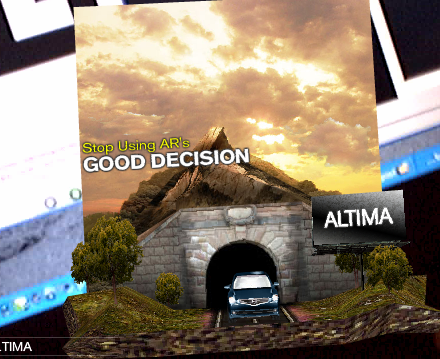
Stop Using AR to Sell Cars – Part Two

Nissan has a new augmented reality campaign to promote their cars. It’s much better than their old campaign promoting only the Cube, but it’s still meh. But don’t you think that they didn’t consider my plead to stop using AR to sell cars (go there to see their former use of AR, as well as many other augmented car campaigns). They actually think that’s the right decision. Here, see for yourself:

stopusingar

No video this time, sorry. Via Twitter, on every other mention of augmented reality.