Doritos had several augmented reality campaigns we previously covered (here and here). Now, they let Blink-182 fans watch a virtual concert by the band using a bag of Doritos, a Webcam, and setting their web browswers to this site.
“An online 3-D performance was something we just had to be a part of,” Hoppus said in a press release. “As big technology guys, we’re pumped that people can now experience a little bit of our summer tour through something as accessible as [a] bag of Doritos and a computer.”
Dutch website (what’s with all those Dutch companies lately?) YouTellMe.com, which specializes in social shopping online (e.g. recommendation engines) has just launched a new augmented reality application, letting you see how your favorite electronic products look like in the palm of your hand (or in your living room).
By harnessing the power of your webcam, Flash, and probably FlarToolKit (though, I failed to prove it), you can now try the new iPhone, or that Canon camera you always coveted:
Actually, since style and appearance play a big part these days when we are out to buy a new gadget, I can imagine such an application would have a market (much like those magic mirrors that let you try on jewelery and accessories). Though, IMHO, it could be much improve if instead of simply printing a marker, you would be able to print a simple paper-craft box with markers on its sides, that although will require some folding, will give you some more “hands on” experience.
Los Angeles based, but Japanese named interactive marketing agency Zugara has launched a couple of days ago a new application named “The Webcam Social Shopper“.
Basically, it’s a magic mirror application that let’s you try on different clothes. But, there’s so much more to it – the user interface is engaged via motion detection, and you can take a photo of yourself with your new virtual clothes, and share it on facebook with your friend. However, one thing this application fails to do, is to show you whether any of the clothes fit, as they all stay static and don’t interact with your body movements. I don’t expect this application to improve the 3.57% conversion rate state in the next video.
Now, this application is only in alpha state, and a lot can change until it goes public. And admittedly, Zugara has some nice ideas on the future use cases of such application (e.g. shop together with your friends, online). Nevertheless, I think it’s too early for it to become useful. Maybe when Project Natal matures, but not now.
Oh, and lest I forget, this technology is patent pending. Great.
It was bound to happen. As augmented reality becomes more and more prevalent, it was all a matter of time till someone took credit for something he is probably not entitled for. Enter Chris Hughes best known for jailbreaking the first iPhone. Last February, at TED palmsprings, Hughes briefly showcased his work that “makes creating ‘augmented reality’ a cinch”.
(video was pulled down by TED, but here you can still watch it)
If this demo looks familiar to you, you are not alone. Ralph Hauwert, a Papervision3d developer, took offence at Hughes talk, and subsequent interview. According to Hauwert, Huges is taking credit for porting ARToolKit to flash, while he only took FLARToolKit and “followed a tutorial like this one from the FlashBlog, then gathered all his courage and energy to work with 2 opensource projects and take credit for it” (source).
Apparently, TED folks are working to fix things up. Till then, you can find more details over Hauwert’s blog.
[author comment: I published this post a few days ago at Augmented Times, and deemed as uninteresting enough for Games Alfresco. Per Ori’s request, I repost it here as well. Since a few days have gone by, you might want to check the featured links for more up to date information]
Remember the days when new films were promoted using alternative reality games? Well, it’s got old fast, and this summer there’s a new technology in town. In the last month or so we already covered the following movie promotions:
Now, Transformers 2 is joining the party (do you need to be a sequel to get your own AR campaign?). Users can go to WeAreAutobots.com and try out an activex application that uses face detection in order to place a virtual Optimus Prime mask onto your face. You can also print a black and white marker in order to play with a virtual Bumblebee at the palm of your hand.
It was developed by creative marketing agency Picture Production Company using the technology provided by Total Immersion (and that’s why it’s not a simple flash based application). Decepticon leader Megatron refused to comment.
Do you want to play with AR, but too afraid you don’t have the required programming knowledge needed? Now you have two applications to play with from the comfort of your own home.
First is Metaio Unifeye Design. Available freely in an (almost fully featured) demo version, this tool is far from being a toy. You can create elaborate scenarios of marker based and marker-less image based augmented reality without writing a single line of code. You can test your creations with your web-camera or using a prerecorded video clip of a marker. There’s even a tool for creating new markers.
However, such flexibility does come with a price. I had a hard time working with the user interface beyond the basic functions, and I’m quite sure I only scratched the surface of what’s possible with this tool. That’s why I had this application installed for about a month now, but I was hesitant about writing anything about it.
Metaio claims that video tutorials are coming shortly, and I think they are very much needed (and I’m a programmer in my spare time :).
In more somber news, you can’t use your own 3d models, or export your scenarios as a stand alone application. You probably have to pay for those features.
Now, if Metaio Unifeye Design was a bit too complex for you, the next application is truly augmented reality for beginners. It’s called Atomic, and it wraps ARToolKit to give you the basic functionality of augmenting markers with VRML 3d objects when you examine them using your webcam. The application source is available to download as well, so eager programmers may add more features to it in the future. Another advantage of this tool is that it allows you to import and use your own models. However, don’t expect to amaze any AR veteran using it.
The USPS has a very neat AR application, which is also surprisingly useful. Using FLARToolKit, you can now see if the stuff you intend to send fits in any of the flat-rate boxes. As the novelty augmented reality fad becomes old very quickly, I hope more companies will favor a more useful approach to AR.
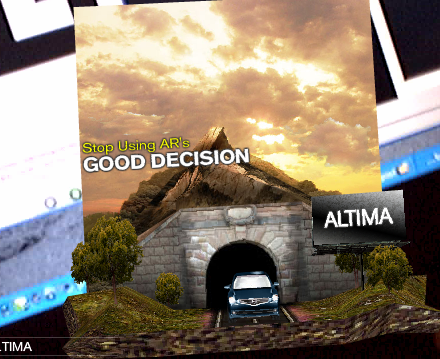
Nissan has a new augmented reality campaign to promote their cars. It’s much better than their old campaign promoting only the Cube, but it’s still meh. But don’t you think that they didn’t consider my plead to stop using AR to sell cars (go there to see their former use of AR, as well as many other augmented car campaigns). They actually think that’s the right decision. Here, see for yourself:
No video this time, sorry. Via Twitter, on every other mention of augmented reality.
The Augmented Environments lab at Georgia Tech (AELatGT) has recently uploaded to Youtube videos showing off many games developed as projects in the “HAR: AR Game Design Studio” class last year. Blair MacIntyre‘s students came up with some interesting ideas (some would say unconventional), but in my view, there’s one clear winner –
Candy Wars is a physics oriented game, played with your fridge magnets, where the goal is to feed a frog until it explodes. Things couldn’t be better:
Many more video goodies can be found on AELatGT’s Youtube page. Just a little tip – don’t be tempted by the name, GuitAR hero, is nothing more than a rickroll in AR disguise.
It’s old news, but I’m allowed to be late since I had to overcome a language barrier. Since 2008, Le Futuroscope, which is a really cool theme park in France with many cinematographic related attractions, has a ride named “les Animaux du Futur” (animals of the future). Based on the BBC show “The Future is Wild“, this ride, created by Total Immersion, takes you through futuristic landscapes and lets you interact with the animals occupying them.
Since its inception, the ride had a home version, that enabled you to see some animals come to life on an AR marker. To welcome a new version of the ride, launched last month, the home version went one step further, and enabled users to play with the dreaded “octopus monkey”, without any need of printed markers. It looks like great fun –




 Games Alfresco