Coca Cola Augments Our World at Super Bowl XLIII

Lenny Raymond just unveiled this  sneak peak of an augmented reality commercial by Coca Cola about to air tomorrow during  Super Bowl 43.

Vodpod videos no longer available.

For Lenny this is a proof that augmented reality has made it to the mainstream:

If a Coke commercial during the Super bowl isn’t mainstream, I don’t know what is

For me, it’s mostly a source of inspiration: we are all getting lost in virtual worlds and we need something to help us rediscover reality.

In this case, a coke does the job…

I immediately added it to my AR commercial hall of fame: TV commercials that will inspire your next augmented reality experience

Now, who’s willing to bet on how many augmented reality commercials will air during the Super Bowl?

Hint: there will be at least two counting this one…

Vodpod videos no longer available.

The results are in. How many augmented reality commercials apeared during Super Bowl XLIII?

A lot!

In addition to the 2 mentioned above, here are some more:

Bud Light Drinkability – Ski Lodge

…draw graffiti anywhere with your finger and change reality…

Bud Light Drinkability – Lime

…and why not a weather changing augmented reality app?

(Oh, that was already invented in Australia – see ISMAR demos and scroll to “the most down under demo”)

Coke – Heist

…sure smells augmented…

Pedigree – You should have a dog

…looks realistic but when you think about it – why not augment your pet to look like a Rhinoceros?

A New Platform for The Next Generation of Augmented Reality Games

Today we are celebrating!

Ohan Oda from Columbia University in New York just released his new version of Goblin XNA. Kudos!

Goblin XNA is a development framework for Augmented Reality apps with a focus on games. It is based on Microsoft’s popular XNA Game Studio 2.0 that enables game developers to be successful on Microsoft gaming platforms (i.e. PC, Xbox, Win Mobile)

Ohan built it as a one man show (under the supervision of Steven Feiner and with help from his lab colleagues) as part of his PhD research project.

Has anyone tried it so far?

Ohan says he just released it to the public, so as of now, only he and his lab members have. However, the framework was used in 3DUI and Augmented Reality course, so approximately 60 students have used it so far.

What can you do with it?

Check out these demos created with the framework:

AR Racing Game

AR Electronic Field Guide

Want more? Check out the AR Domino on MSDN.

Here is the announcement in Ohan’s own words

We would like to inform you that Goblin XNA is finally released, and
it’s downloadable from http://www.codeplex.com/goblinxna .

We apologize for those of you who waited very long (some of you
probably waited for almost a year).

Source code, API documentation, user manual, installation guide,
tutorials, and a relatively large-sized project (AR domino game) is
included with the release.

For questions and bug reports, Please do NOT email me directly, but
instead, please post your questions and bug reports through Codeplex.
I won’t be able to guarantee quick response since I’m the only
developer of Goblin XNA, but I will try my best to answer your
questions and fix bugs.

Thanks
Ohan

Ohan will be working on the framework for his research at Columbia for another couple of years – so until then you can count on him to continuously update the framework for both bug fixes and new feature additions.

Try it and show us what kind of reality experiences you can build.

I Had A MID Night Dream

The US celebrated Martin Luther King’s day last week, which above all reminds us to keep dreaming – sometimes dreams do come true.

I had a dream too…and in my dream, an amazing Mobile Internet Device (MID) was released for our augmented reality experiences.

(See a list of existing MIDs)

my ar device

Here is a first take at defining the dream MID for augmented reality (2009-2010 time frame):

  • Manufacturer – a credible leader, with a friendly content distribution channel
  • Price – Ideally sub $200. Initially not more than $400.
  • CPU – Dual core 1.3 Mhz, with a Floating Point Unit, SIMD extensions
  • GPU – integrated with performance similar to TI’s OMAP3 and NVidia’s Tegra (the competition!)
  • Screen – 4.5 Inch, Min 800×480 resolution, Multitouch, and a very bright screen
  • Camera – A GOOD CAMERA with a quality lens, video recording at 320×240 or preferably 640×480 (VGA) at 30fps at a good quality (noise, contrast, colors, etc) even under low lighting. Zoom and auto focus a bonus. Front camera – bonus.
  • Low latency for getting the the camera image to the CPU/GPU and in turn to the display
  • Zero-latency video output from the device for a head-worn display (digital or analog)
  • Low-latency inputs for external sensors (such as a tracker on the head-worn display) and cameras (on the head-worn display).
  • GOOD graphics drivers, Open GL 2.0 (unlike the current Intel OpenGL drivers on Atom which are almost a show stopper for many projects…)
  • Device size – roughly 130x70x12mm (so that there’s little margin around the screen)
  • Weight – less than 200g
  • OS – The best Mobile Linux out there, with C/C++ based SDK and a good emulator. Also as an alternative: Win Mobile support (better dev tools)
  • Buttons – Very few. QWERTY keyboard is a nice to have.
  • Connectivity – 3G/GSM, WIFI, Bluetooth
  • Sensors – A-GPS, accelerometer, 3DOF Gyro sensors
  • 3-axis compass
  • Storage – 8G and expandable
  • Memory – 1G RAM
  • Battery – Min. 3 hours while in full use of camera and network
  • Extensibility – video out for an HMD, USB port on it.
  • Openness – open source…

So what do you think?

This spec was actually a swift response to a challenge presented by Intel’s Ashley McCorkle.

Many thanks for the contribution by Daniel-Good camera!-Wagner, Steven-don’t forget latency!-Feiner , Bruce-a couple of extras-Thomas, and Charles-Very bright screen-Woodward.

In ISMAR 2009 in Orlando, we are planning to organize a round table discussion for this very purpose. Would you be interested in participating?

***update***

The experts and enthusiasts are weighing in, and as it usually is in reality (as opposed to dreams) remind us that we need to consider trade-offs.

Charles for example says he would trade off battery time for a lighter device. He also suggests that for professional use – a higher price ($1000 range) for a higher quality device would be reasonable.

Augmented Reality Helps Solve the Rubik’s Cube

The Cult of Mac just uncovered the new iPhone app: CubeCheater.

It helps you decode your Rubik’s cube.

Take pictures of the cube’s faces with your iPhone and it will guide you through the shortest number of moves required to solve it.

Now, take it a step further and imagine the iPhone (or better yet – goggles) continuously watching your cube and cleverly guiding you on every move – for the fastest solution ever.

Wouldn’t it be cool?

Well, at least for Cube obsessed kids, it would.

In any case, I’d mark this app as an important milestone towards putting augmented reality to use for the good of mankind.

Today it teaches us how to solve the Rubik’s cube. Tomorrow it will teach us everything else.

Reality Isn’t What it Used to Be

Obama’s administration is promoting augmented reality.
Really?

How else would you explain the “Get Up and Play” campaign launched by the department of health & human services ?

“Go online, just don’t stay too long” says the ad. “Be a player, get out there and play” it presses on.

Now, why would a 21st century child go out there and play, confront reality and deal with its harsh limitations when she can Wii in or stay inside the Xbox?

Here’s how the drama unfolds:

On the one hand, kids are not stimulated by reality as their forbears were. It’s not as fun.

Reality isn’t what it used to be.

On the other hand, kids need to spend less time in front of the screen. Parents always knew it in their gut – but now, it’s scientifically proven – thanks to a mega study of 173 other studies by the National Institution of Health which  concluded unequivocally:

Too much TV, games, and internet harm kids’ health.

So, how do you resolve this conflict?

That’s where the augmented reality industry comes to the rescue.

We’ll make them go out, interact with their real surroundings – and they’ll totally think it’s all fun and games.

How are we going to do it?

Reality is actually pretty cool as it is, we just need to make it a bit more significant to them. Add a little spice. A sparkle. A challenge. A dream. A new dimension or a hidden depth. A reward for an unnoticed deed.

All these would make them do anything – even go out there and play.

The Health Department dreamed it up to the extreme with an animated donkey; what an

inspiration for augmented reality designers!

If the clip doesn’t run click here.

[The author: the “Get out and play” campaign was reportedly launched by the Health department 2 years ago. I only noticed it now…on Hulu…while watching the Colbert Report…I trusted the Obama adminstration to have not only inherited but embraced this campaign both in practice and in spirit]

Ab Fab Lab in a Street Near You

While we are on the topic of touristic applications, LastMinute.com labs, a travel site, has found a new way to tackle the problem of interfacing with an augmented reality world – for tourists. It is uncovered in an article on FastCompany.

The application Nru (pronounced Near You) uses  the GPS, compass, sensors and other goodies available on Google’s G1 phone. As you point it to different directions while strolling on a London street – Nru will display signals about your surrounding attractions; the usual suspects include restaurants, movies, shows.

Now, here comes the interesting part: the user interface. Hold it parallel to the ground and it displays a radar like view of your touristic targets. Hold it vertically and it transforms into a purple-black “heat” sensor highlighting worthy targets in your front.

To get more info about a selected target use the “old” gesture: just touch it.

They claim to pull information from a number of sources including Qype and fonefood. Not surprisingly – both are London focused information services.

Some will argue that since it doesn’t overlay (register) the signals on top of what’s in your field of view – it’s not a pure augmented reality implementation, but rather a location-based app.

But the British accent certainly masks that thought and adds a certain Je-ne-sais-quoi to the demo. Absolutely fabulous.

Nru is now available on the android marketplace – but only for UK customers. Top bollocks.

The One Eyed Man is King

In a land where what you see is what you get, those who can see more – even with one eye – are kings.

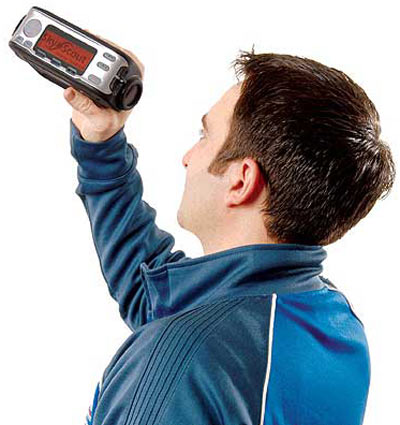
Kijin Shin from Yanko design believes in it and makes a point with this interesting concept design. He calls it the “Third Eye concept designed is for travelers.”

See something interesting? Just place the Third Eye up to your eyes like a monocle and the device pulls all relevant historical, travel, shopping, and tourist information.

Augmented reality lends itself well to touristic applications. When people explore new places – extra (augmented) information in context is highly sought after.

Multiple concepts focused on tourism have been thought of and implemented before: Museums apps, Wikitude, YDreams Sightseeing, Archeoguide, and many others.

What’s interesting in this one – is the form factor and the user interface.

Sometimes you have to reduce features (one eye only) to achieve simplicity. That has the potential to drive massive adoption.

If you are into the pros and cons, check out the interesting discussion on the site featuring the usual supporters vs. skeptics. One commenter compared it to the Celestron SkyScout:

We’ll see if Kijin’s design raises interest among hardware manufacturers. By then we’ll realize if the one eyed man becomes king – or whether he’ll be facing a land populated with 2 eyed specs.

Metaio Offers Flash Forward for Lego Buyers

From Metaio‘s press release”

LEGO, the Danish toy manufacturer will test launch its “DIGITAL BOX” in selected toyshops and LEGO® stores worldwide. This interactive  terminal will utilize innovative technology supplied by Metaio in the form of a software  program specially-developed for the LEGO Group by the Munich-based experts in augmented reality solutions. Together with a camera and display screen, the software  lets LEGO packaging reveal its contents fully-assembled within live 3D animated scenes.

lego_digital_box_showcase

The press release continues:

The partnership between Metaio and one of the largest toy manufacturers in the world is a truly  major milestone in the history of the company.

Indeed, Lego is associated with playful, innovative toys and will certainly expose the concept of augmented reality to many kids around the world.

Kudos to Metaio for a great splash at the onset of the AR year.

Now who’s going to post the first video of this experience?

Passionate About Augmented Reality and Not Afraid to Blog About It

Tish from Ugotrade interviewed Robert Rice about his latest Sekrets AR endeavors. It was an unmissable opportunity to rant about everything augmented. Check out the blog of one passionate AR fan.

What moves you in AR?

Mobile Augmented Reality Goes Way Beyond Markers

The dust from CES 2009 has barely settled over many shiny new devices, and new advancements in Handheld Augmented Reality software are already emerging from Vienna.

Daniel Wagner and his team at Graz University have come up with new and improved capabilities.

High Speed Natural Feature Tracking on a mobile phone

We saw an early implementation of Studierstube ES at ISMAR 08, so I asked Daniel what’s new about this capability, besides being faster and more robust.

Daniel: We can now track multiple images and switch arbitrarily. I believe it is now at a level that it can really be used in practice.

Games alfresco: Looks great. Based on the video it seems that it runs on Windows Mobile 6 (ASUS p552w, iPAQ 614c). What about other platforms?

Daniel: Not bad! It is written in C/C++, [but] since this is pure math code, it could be ported easily to any platform. Our AR framework is still Windows Mobile only, although we now also have Linux support (desktop only since we lack a Linux phone). MacOS and Symbian are in the making and should be available in a month or so.

Tracking of Business Cards on a mobile phone

Daniel: On January 20th we have the official opening of our “Christian Doppler Lab” (founded by the Christian Doppler agency). For that purpose I created a small demo for tracking business cards. In the future we’ll replace the 3D content with something more useful…

I can’t talk about Daniel without mentioning WARM ’09; He is the main organizer of this Winter Augmented Reality Event on 12th-13th February 2009 at Graz University, Austria. Registration is over, but if you really want to go and have something cool to present – you may be able to convince Daniel to let you in.

Should you get your hands on this powerful technology (assuming Imagination makes it available for licensing soon) what would YOU do with it?