Has Augmented Reality Arrived to the iPhone ?

Fellow augmented reality enthusiasts!

Checkout the news in the iPhone 3.1 Beta 2 SDK (you need to login.)

It may treasure what we’ve all been waiting for. The elusive API. The holy access to  live video on the iPhone.

We will never know if the Open Letter to Apple had any dent on Apple’s decision to introduce the new APIs – but for a moment – we are blissful.

By tomorrow we’ll know for sure if it works. What ever the outcome, at least we made a lot of friends and discovered a swarm of AR developers eager to bring the augmented reality experience to the masses.

Thank you all for the overwhelming response!

And let me challenge you:

The first to confirm the above theory will be indicted to

Games Alfresco’s Hall of Fame.

Thanks Mike for the tip!

Reblog this post [with Zemanta]

Mobilizy Responds

I have been warmongering last week, with a couple of posts that mainly target Mobilizy of Wikitude fame (“Battle of the AR Browsers” and “Updates from the Front Line“). Mark A.M. Kramer of Mobilizy left the following response to my last post:

Dear Rouli,

Thank you for the round-up of what has happened in the AR world this week. A lot has happened as you are well aware.

First of all, we at Mobilizy do not see ourselves in an AR war. We are just tired of all the attention given to SPRXMobile and Layar when we are well aware that most users of Layar are only in the Netherlands and the whole world is giving its attention to Layar as if it was the first AR application/browser in the world. WIkitude is global and we have over 130,000+ users around the world.

Also, we have worked with SPRXMobile in the past and they are well aware of the outcomes of that working relationship. We are coders, developers, AR techies. WE love crafting software that is useful and makes people happy. One of the many strengths of SPRXMobile and Layar is marketing. In reality, we would make an amazing strategic alliance together with our combined strengths.

With regards to Acrossair: We have respect for their new application even if we did say we thought the demonstration was a mock-up. It still is hard to tell really. We do know that the camera api is not officially open for development on the iPhone from other applications (we are developing onthe iPhone too!) This means that Acrossair is using a hack to accomplish what they have done. Hopefully Apple will change its mind and open the api up for develoment.

This is what we wrote about Acrossair:
@Kjeld @oheckmann The people at acrossair made a wonderful MOCK- Video: http://bit.ly/Vd37Y you can tell it is fake if you look closely.

This is a mock-up of our iPhone prototyping. We have the compass and GPS functioning, no camera API yet! http://twitpic.com/9o7or

We are excited that the field of mobile AR is taking off! We are happy to work with anyone and everyone to advance this nascent field.

Cheers,

Mark of Mobilizy / WIkitude

Weekly Linkfest

And yet another week ends, full with exciting AR news. Some news items were put aside in order to make place to more urgent reports. Luckily, the weekly linkfest is here to mend things up.

This week’s video is of a little application you might have heard about, called tweet TwittAround.
It enables you to see tweets overlaid on top of the video input coming from your iPhone 3GS. Tweets are rendered according to the location they are coming from. Interestingly, this project comes from the same guy, Michael Zoellner, that is behind some other cool AR applications.

Have a nice week!

When an Augmented Reality Experience Goes From Viral to Pandemic

A new campaign for Weet-Bix , launched On July 6th centered around a series of “3D cards”.

Photo credit NBR

When 10 of the series of 43 cards are held up to a web-cam, they trigger a three-dimensional image of the relevant All Black to appear onscreen (see photo above). Fans can rotate the card held in front of the web cam, and the onscreen figure rotates in full-perspective.

This now common augmented reality experience was developed by Total Immersion (creator of the Topps AR game), and Australian company Dreamscape.

The typical reaction you expect from such campaigns (many of which were produced in the past year) is – jaws dropping.

Not this time.

Ben Geek vividly describes the experience as a modern via Dolorosa. Hilarious. From an intrusive registration process ( “[they] demand, my name, my email address and my date of birth? Why exactly?”), to a draconian installation process (“have I broken the computer?”) – it left a strong bad taste among its users.

When Sanitarium, the Cereal company behind the promotion, dumped traditional media outlets such as TV and print in favor of this “futuristic” campaign, they didn’t expect this dystopian backlash. Apparently they reacted quickly and are redesigning the Weet-Bix promotion “after accepting that children might find their hi-tech features hard to digest.”

As Mark Billinghurst pontificates:

there’s a lesson there about how having great AR technology doesn’t guaranteed a successful marketing campaign if you provide a bad experience.

Thanks Mark Billinghurst for the tip

Updates from the Frontline

Continuing my coverage of the augmented reality browser wars, here are the latest news (well, some of them are a few days old, excuse me for procrastinating a bit):

AcrossAir is not satisfied with letting you find the closest subway station in London (where it’s called The Tube), it also has its sights on the NY subway system:

If you remember correctly, Mobilizy, makers of Wikitude, claimed AcrossAir’s application demo is nothing but a mock-up. Seems real to me.
Anyway, Mobilizy is working hard to remind people that Wikitude augmented the world way before SPRXMobile’s Layar. Moreover, one of their tweets suggests that Layar was based on Wikitude’s technology. Indeed, SPRXMobile did cooperate with Mobilizy once, when creating their ATM finder, but it doesn’t prove that Layar is Wikitude in disguise.
Mobilizy also released this video demoing their Wikitude API, and did not miss the opportunity to include some sarcastic remark towards its end:

And in the Eastern front, TechCrunch reports on the almost final version of Tonchidot’s Sekai Camera. Compared this video –

With what we have been promised a year ago:

Well, at least they still have something to aspire to.

TAT Augmented ID is Beautiful/Creepy

One of the oldest concepts in the mobile AR community is using augmented reality to match a person with his/her identity. The Swedish software and design company TAT just unveiled their own take on this “augmented id” with the aptly named Augmented ID. Using face recognition and tracking technology from Polar Rose, TAT enables you to check up one’s web identity by looking at him through your mobile’s camera, as the following concept shows:

It’s very pretty, but just be sure that before pointing your mobile at some beautiful girl on the street, you could out-run her boyfriend. (via engadget)

Apple Files Patent for Mobile Augmented Reality

The buzz around our open letter to Apple hasn’t subsided yet, and lo and behold, Apple has filed today a patent related to augmented reality .

Although the term Augmented Reality (AR) is not explicitly mentioned in the patent – it describes very common mobile AR scenarios.
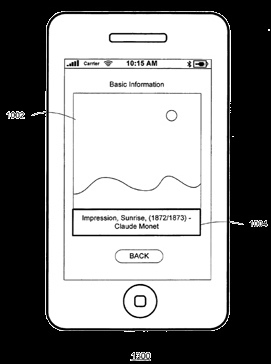
Apple patent-090709-1

Technically speaking, you typically need 3 capabilities to enable a mobile AR scenario: sense, overlay, track.

Sense – use sensors to find out what’s in your immediate surroundings (such as visual, GPS, RFID, wifi, IR, etc)

Overlay – Graphically add information that relates to real objects in your field of view

Track – register the graphics so that the virtual elements are aligned with the real objects

Apple’s patent deals with Sensing and Overlaying.

Apple Insider describes it as:

a new identification application apparently under development by Apple that would help identifying objects in a user’s surroundings so that their iPhone can present additional information about the identified objects.

The patent describes scenarios such as:

“the portable electronic device can allow the user to select a mode based on the types of objects that the user wants to identify. Based on the selected mode, the portable electronic device can adjust parameters used for searching an identification database. For example, if the user selects to identify an object in a “MUSEUM” mode, the portable electronic device can search the identification database for objects that are commonly found in a museum. In some embodiments, the portable electronic device can determine the location of the user to help identify an object. For example, if the user is determined to be in Las Vegas and the portable electronic device is set to a “RESTAURANT” mode, the device can limit the search of the identification database to restaurants in Las Vegas.”

As much as it’s encouraging to see Apple’s interest in this domain, it sounds awfully similar to augmented reality research published over the past 10 years.

Moreover, it actually describes the functionality behind existing AR browsing applications already in the market such as Layar, Mobilizy’s World Browser, Tonchidot’s Sekai Camera, Nru, and more!

And how about augmenting Museum experiences? Has anyone at Apple read our roundup of AR museum experiences?

Is there anything new in this patent? Can Apple defend it against previously published AR work? What do you think?

Battle of the AR Browsers

Three weeks after its launch, SPRXMobile’s Layar partially opens up its layer creation API to developers. It’s not freely available online (bad decision?), however, interested developers can register here, and may be among the lucky 50 to get access keys to the API. The press release is here.
Meanwhile, Mobilizy (creator of Wikitude) is not keeping silent. They congratulated SPRXMobile on their twitter account, and placed a comment on Layar’s press release:

On behalf of Mobilizy GmbH the developers of the original Wikitude AR Travel Guide we would like to congratulate SPRX Mobile in their efforts to help shape the Mobile augmented reality landscape.

Good Job!

Mobilizy also put this picture depicting Wikitude on the iPhone 3GS, and released the following advertisement video

and commented about AcrossAir’s Tube Locator application, saying “you can tell it is fake if you look closely”.

All this while both SPRXMobile and Mobilizy are founding members in the new AR Consortium. So, am I making a lot of noise out of nothing? Probably, after all I’m a blogger!

Update: Mobilizy just announced that they will let user add their own tags to the world via Wikitude.me and that they open up their API in a closed beta. And thus begins the battle to control the mobile AR world!

Blink-182 Perform in a Doritos Bag

Doritos had several augmented reality campaigns we previously covered (here and here). Now, they let Blink-182 fans watch a virtual concert by the band using a bag of Doritos, a Webcam, and setting their web browswers to this site.

“An online 3-D performance was something we just had to be a part of,” Hoppus said in a press release. “As big technology guys, we’re pumped that people can now experience a little bit of our summer tour through something as accessible as [a] bag of Doritos and a computer.”

It’s like nothing we have seen before!

More info on Wired, via The Future Digital Life.

AR for the Environmentally Aware Shopper

This next augmented reality concept , named FoodTracer, comes to us from Italian Giuseppe Costanza, as his final year project for MA Communication Design at Central Saint Martins. And it’s quite an impressive final project!
Aimed to give consumers more information about the food products they are buying (such as their carbon footprint and where they were produced), while minimizing packaging, FoodTracer is a bright idea on how AR can make the world a tad better. Users would be able to access the information that concerns them, compare and bookmark several products, and later examine their shopping history at home. Here’s one of Costanza’s imagined use cases:

When Susan goes shopping in her usual supermarket she knows where organic products are placed so she can quickly pick the right products, but today she went shopping in a new supermarket where products are displayed in a different way, she doesn’t have the time to check on the packaging which product is organic so she uses FoodTracer to easily spot organic apples.

Costanza even built a demo application for the Symbian mobile operating system, using embeded markers and d-touch nice looking markers that hide in the products’ logos, as can be seen in the following video:

Many more details over here.