Total Immersion (TI) may not be at the center of the Augmented Reality (AR) browsers frenzy these days – but when it comes to delivering AR on a large scale – it’s still the 800 pound gorilla.
Nicolas Bapst, responsible for Product Marketing for Amusement Parks at TI – recently shared with me their latest achievements: a totally new kind of interactive 3D live show and an AR goggles experience The Networked City developed for TomorrowCity in South Korea .
The 3D live show is based on TI’s 3D Live Show technology (naming coincidence?):
…a very innovative and interactive screen movie production…This show introduces the U-city in a spectacular method and the audience can participate directly in the story performance.
With the new offering from Total Immersion, spectators share the stage with virtual live performers, playing a guessing game around what’s real and what’s not.
The 3D live show is not all TI had up its sleeve for the U-city. A second project, involving augmented reality (AR) goggles is: the Networked City
To the naked eye, the exhibit looks like a bare bones model of a city. But when visitors put on the special AR goggles a whole new world unfolds – as graphics overlaid on the city model.
How does this new world looks like?
Can’t say…no video of the exhibit was released so far.
Until then, you’ll have to travel to South Korea to see for yourself…
Simply put – it offers a new API that allows to overlay graphics on a live video stream.
This is great news for Augmented reality (AR) browser applications such as Layar and Wikitude (for more examples see right side bar). Although similar applications have sneaked into the app store before – I am sure it’s great to finally be legit on the store.
However, 3.1 provides only semi support for AR apps.
When you want to align graphics with real world things (like markers or other objects) – you need to be able to analyze the live video stream off of the iPhone camera. This functionality is only available as a private API on the iPhone (even with 3.1). It’s technically possible, but Apple may not allow such an app on the App store.
By the way, when I say “support” I do not mean by any means that Apple provides AR capabilities on the iPhone. Some folks in the press got that impression from the flood of headlines announcing support for AR on the iPhone…
To clarify, AR companies still need to do the heavy lifting such as AR detection and tracking; bearing the ripe fruits of many years of research and development.
So AR is not yet totally legit on the iPhone. But we are getting closer.
ISMAR 2009 proudly announces the first Flash AR Contest sponsored by ARToolWorks. The contest is opened to anyone and is part of the inaugural Arts, Interactive Media and Humanities program for ISMAR 2009.
The best FLARToolKit submission wins $1000 USD.
(we know you’re in it just for the money)
Contest rules:
1. Develop a desktop-based AR application using FLARToolKit that can be run from a desktop PC (using no additional input devices other than a Camera, Keyboard, and Mouse).
2. Should be relevant for any subject of Arts, interactive Media or Humanities at ISMAR 2009
3. Submit as a zip file and its originality, style and potentially will be judged by a panel of experts during ISMAR 2009.
4. All the applications will be demonstrated on the ISMAR 2009 website and will be made available during ISMAR 2009 for the attendees.
5. The winner will be announced and awarded at the ISMAR 2009 dinner.
6. At the end of the competition, a selected range of applications will be made available on the ARToolWorks website
Start working – competition entries are due by 5pm PST, Friday October 9th!
Really, Why do people get excited about augmented reality ?
I was stumped by this question in an interview for the NY Times and my first reaction was: duh! ’cause it’s friggin’ awesome!
But when you think about it, people get excited about Augmented Reality because…because they never thought it’d actually become possible…
Science Fiction has been a major part of our culture for generations and is ingrained in our belief system. Even non Sci-Fi geeks, are familiar with concepts such as teleporting, time travel, or X-ray vision.
We were led to believe these things are “Fiction” and impossible in real life.
Well, up until augmented reality has demonstrated otherwise.
Teleporting
Reducing business travel is not only good for the environment; it’s also great for humans. However teleconferencing systems haven’t been able to reproduce the immediacy and intimacy of multiple people actually occupying the same room.
With AR – realtime holograms are possible and teleporting is a snap.
Just like when MR. Rabbit Visits Barcelona in Vernor Vinge’s Rainbows End:
IN DOWNTOWN BARCELONA, three days later:
The rabbit hopped onto the unoccupied wicker chair and thence to the middle of the table, between the teacups and the condiments. It tipped its hat forst at Alfred Vaz and then at Gunberk Braun and Keiko Mitsuri. “Have I got a deal for you!” it said. Altogether, it was an unremarkable example of its type.
Alfred reached out and swiped his hand through the image, just to emphasize his own substance. “We’re the ones with the deal”….
Braun was as ephemeral as the rabbit, but he projected a dour earnestness that was quite consistent with his real personality.
…or as illustrated perfectly in this tongue and cheek video:
OK, we can’t REALLY time travel with AR, but we can certainly see how things looked like in the past, or places will look like in the future. We can experience that reality around us from a first person view.
Larry Niven described such a fascinating scene in Dream Park back in 1981:
“Please stay on the green path,” the soft, well-modulated male voice requested. “What green-” Tony started to say. But a glowing green aisle ten feet across appearred in the middle of the street.
“We need strong magic to do what we do today,” the voice continued. “We are going to visit the old Los Angeles that disappeared in May of 1985. As long as you stay on the path, you should be perfectly safe.”
…”This is the Los Angeles of 2051″ the voice continued, “but only a few hundred feet from here begins another world, one seldom seen by human eyes.”
A banner blocked Wileshir Boulevard. Thegreen path humped and carried them over it. Beyond lay ruin. Buildings balanced precariously on rotted and twisted beams, The were old, of archaic styles, and seawater lapped at their foundations.
Ollie nudged Gwen, his face aglow. “Will you look at that?” It was a flooded parking lot, ancient automibiles half covered with water. “That looks like a Mercedes. Did you ever see what they looked like before they merged with Toyota?”
Here is a (tiny) contemporary proof that it’s not only possible in sci-fi books:
2009 will be remembered as the year augmented reality apps made the news. That was finally possible thanks to a new bread of mobile devices (Google phone, iPhone) that enable the new experience. These new devices pack the gear you need for AR: from cameras to GPS and compasses; they offer both power AND affordability. And the best part is that you already have them in your pocket.
However the fact that these devices are held in your hand is a double edge sword: yes, it’s accessible and intuitive – but at least one hand will always be tied up. Moreover, it offers a very narrow view into the Augmented world. I have dubbed this generation of AR hardware as the “HAND BAG” generation. A necessary stepping stone on the path towards the broader AR vision.
But what we really want is “NO BAG”. Hands free.
We want augmented reality directly in our field of view. Goggles.
Or better yet, cool sun glasses that BEHAVE like goggles.
So, what’s new in AR Goggles?
Vuzix is still the media darling and probably sells more goggles (Video iWear) to consumers than anyone else.
We can’t wait for the leaves on the trees in New England to turn red; that will signal the launch of Vuzix WRAP 920AV – the first commercial see-thru goggles for AR that don’t break your neck OR your wallet – scheduled for fall 2009.
As a reminder, my poll on the GDC post (which showcases yours truly donning the gizmo) shows a ratio of 47%-33% (Dork vs. Cool). We’re not quit there yet…
What else is out there?
I recently talked with Zvi Lapidot, CEO of Lumus, based in Israel and a major contender in the race to deliver your dream AR glasses.
Here’s what I captured from our discussion while wiping tasty humus with a pita bread:
Ori : Hi Zvi, you have significant experience in building optical solutions for Augmented Reality for military use; what was your goal when you embarked on designing a product for the consumer market?
Zvi: The goal was to deliver light weight, cool looking, see-thru glasses that overlay computer graphics on the screen – minus the head ache. We also needed to ensure that the brightness would be high enough for full outdoor, daylight use. We built a working prototype (see image from last year) which got closer to these objectives more than anyone before, plus it made a great impression on the market.
Ori: It does look better than the HMDs I tried in the 90’s. What are the specs of the prototype?
Zvi: From the website:
Display format is VGA 640 x 480 pixels;
Field of View 27.5°
Virtual screen size Equivalent of 60″ screen at 10 ft away; 600″ at 100 ft away
Eye motion box 10 x 10 mm
Displays full color
Transparency >70%
Brightness >400 FtL
Contrast ratio >100:1
Eye relief 22 mm
Input signal Composite video (NTSC or PAL)
Weight <100g
LOE thickness 2 mm
Ori: That’s impressive. And how did you enable AR tracking?
Zvi: By collaborating with AR specialists and Chinese partners we integrated a web camera and a compass (with 3DOF) into the prototype; and connected it to a phone with GPS. AR algorithms analyzed the video from the camera and overlaid graphics while tracking the real world. Several units of the prototype were even sold. Our eyewear has also been demonstrated for interactive gaming. Here is a game KDDI (a major Japanese telecommunications service provider) built with it employing a mobile phone (with built-in motion sensors) as a controller for AR bowling (watch at 0:47):
Ori: Cool. So when can we expect this to hit the market?
Zvi: bringing such a prototype to mass market production requires significant funding which we don’t have yet (so far we had a small funding round by angel investors including myself)
Ori: yes, I know what you mean. VCs still can’t see the huge potential of the augmented reality industry. There aren’t any commercial proof points. It’s the chicken and the egg problem once again: to invest in hardware you want to see demand for apps. Application developers can’t show demand because they rely on hardware…which is not there yet…
So what next?
Zvi: We actually weren’t satisfied with the above achievements. We thought we could do even better. So we have been designing a more ambitious version that further reduces the weight (well below 100g) and significantly increases the brightness (a must for outdoor operation). We’re using smaller-smarter electronics and focusing on aesthetics as well. This one will be really look cool.
Ori: will it include the gear required for tracking?
Zvi: Tracking will come as a plug-in component, like a “goody box” including camera, gyros, compasses etc.
Ori: And how long until we can lay our hands (and eyes) on the new beauty?
Zvi: We are currently in debug mode; planning to have the prototype ready by mid 2010. Mass market will come later.
Ori: So we might need to wait until 2011 until you offer a mass market product…well, at least it could change the ratio of Dork vs. Cool in favor of the latter…
What about cost?
Zvi: In mass market production it will be around a couple of hundred dollars.
Ori: That’s certainly reasonable. How do you plan to compete with Vuzix which reportedly plans to release see-thru goggles for the mass market as early as this fall?
Zvi: We welcome Vuzix to succeed and open the market.
What’s unique about our product is the optics. Our main advantage is the ultra-thin transparent optics that we offer and the high brightness of our display. As a result, we provide the optimal solution for outdoor AR scenarios, while maintaining a natural look and wearing comfort.
Games alfresco: Awesome. You got to demo your goggle at ISMAR this year – you know?
Zvi: We have been there a few years ago and were missing the commercial prospects. We run a business after all.
Games alfresco: oh, you are in for a great surprise this year – ISMAR will expand beyond the academia focus and will introduce new tracks dedicated to interactive media, humanities, arts and a stronger commercial focus.
Augmented Reality has hit the iPhone app store. And we didn’t even have to wait for OS 3.1.
Presselite apps have been updated with a new Augmented Reality functionality called Your New Eye. This only works with the latest iPhone 3GS (compass needed). If you don’t believe it – check out the quick demo here :
In the words of co-founder Antoine Morcos:
Basically, with this application, you are able to see all the metro and bus stations around you (<1km), and also a lot of Points of Interest (Restaurants, etc.) via Augmented Reality, thanks to the camera.
London Bus is available on AppStore. (More details – screenshots, etc.)
Métro Paris for iPhone is also available here.
How come Apple approved an app that uses a private API ?
Does it really matter as long as it did?
Has Apple opened up?
Will it signal a flood of AR apps on the iPhone app store?
From our friends at Mobilizy, this exciting press release:
SALZBURG, Austria: AUGUST 26TH 2009. Mobilizy GmbH introduces WIKITUDE
3 for the Android OS and relaunches a completely new Wikitude.me geo-tagging platform. WIKITUDE 3 is the latest release of the Wikitude World Browser, the premiere mobile AR application for Android, which displays location-based, geo-specific content in a real-time augmented reality camera view on a smart-phone using GPS & gravimetric (compass) sensors.
WIKITUDE 3 is the latest release of the Wikitude World Browser, which presents the user with data about their surroundings, nearby landmarks, and other points of interest by overlaying information on the camera-view of a smartphone bringing information from the internet into context with the real-world. The Mobilizy development team has listened to it’s users and implemented several new features to improve and enhance the user experience within WIKITUDE 3. New features include:
*Full Integration with the Wikitude.me user-generated, geo-tagging platform;
*An enhanced User Interface (UI) which tightly aligns with the UI in
the forthcoming iPhone version of the Wikitude World Browser;
*Improved methods to enhance perspective and depth of perception of POIs (Smaller POIs indicate further distance, larger POIs indicate close proximity);
*The search and viewing-distance for POIs can be regulated by the user with a sleek slider bar;
*New & Improved filter options allow end-users to choose which content overlays and POI categories are displayed;
*Improved methods for locating POIs through search terms;
*An improved radar-overlay displaying the user’s current viewing direction and POIs within a specified radius;
*An entirely new “Beam-Me” feature which tele-ports the user to a pre-defined geo-location, allowing the user to experience a specified geo-data overlay;
Currently, WIKITUDE World Browser 3.0 offers data overlay sources from Wikipedia, *Qype and user-generated content from Mobilizy’s Wikitude.me (www.wikitude.me)
Wikitude.me
Mobilizy GmbH has partnered with Netociety Ltd., a specialist in enterprise social software, to develop an enhanced geo-tagging experience that empowers individuals with the tools to create POIs and location specific, hyper-linked digital content which can be viewed through the WIKITUDE World Browser. According to Markus Tripp, the project manager of Wikitude, “Wikitude.me is the first platform which allows individuals to actively contribute to augmented reality. This is an amazing and huge step forward in the AR industry!”
Wikitude.me provides an open, easy-to-use, free mobile information platform for anybody who wants to access or provide location based and situation-specific information or services via mobile phones. Basically, Wikitude.me can be understood as a platform which encourages community-driven content creation to which anybody can contribute freely, very similar to the philosophy of Wikipedia, but for mobile augmented reality. With regards to intellectual property, Wiktude.me is implemented under a Creative Commons
Attribution-Sharealike 3.0 Unported License.
To get started with Wikitude.me platform users can login through existing 3rd party accounts such as Yahoo!, Google, Twitter and Facebook. The ability to add points of interest and “geo-tag the world” is done through any Internet-enabled device, such as a netbook, laptop, desktop or a smartphone like the Apple iPhone, Nokia N97 and the Android handsets which are available today. For each point of interest there is a title, description (250 chars), category, language, and link to a URL. Each POI that is geo-tagged on the Wikitude.me platform is also cross-posted on Twitter (http://twitter.com/wikitude_me ) to inform the global Wikitude
community of the creation of fresh geo-content.
Mobilizy GmbH believes that the future of mobile augmented reality (Mobile AR) literally rests in the hands of the users. Our team can develop the infrastructure for Mobile AR experiences such as WIKITUDE 3 and platforms like Wikitude.me, but ultimately the end users will determine how mobile AR will be shaped. Mobilizy is constantly researching and developing ways to improve the WIKITUDE mobile AR experience by placing the user at the center of our development process.
NOTE: POI data created by early-adopters of the beta version of Wikitude.me will be migrated to the new platform early next week.
About Mobilizy:
Mobilizy GmbH is an early pioneer in commercial augmented reality and
the creator of the WIKITUDE World Browser, which is the first
practical augmented reality (AR) mobile application. Available on
Android (Coming soon to iPhone). Mobilizy engages in the research and
in-house development of location-based services and augmented (mixed)
reality experiences for smartphones. Mobilizy is one of the leading
innovators in developing new methods and applications for data
acquisition and exchange in the emerging market of augmented reality.
About Netociety:
Netociety Ltd. is a UK-Austrian based software development firm
helping companies customize, implement and adopt social software,
collaboration tools and best practice. Netociety facilitates the
development of collaboration systems for engaging with customers,
employees and partners. Improvements in innovation, change, marketing,
and productivity efforts are focused on.
WIKITUDE: The World IS the Platform!
————————
Mark A.M. Kramer
Product Strategist / Human Experience Lead
Planning to attend ISMAR 09 the world’s best augmented reality event?
If you are…read on.
Not planning to attend? Visit our ISMAR page. Change your mind…and then read on.
Here is a message from Steve Stapleton – the general co-chair of ISMAR 2009 and the mastermind behind the plan to expand this year’s event beyond academia to the commercial world:
We want to capture the ISMAR 2009 experience in as many ways a possible and increase dialogue and discourse. We are planning to incorporate different social networking programs. What social networking tools do you use or prefer? Twitter, Yammer, YouTube, Flikr, DokoDare, Kooaba?
As part of our mobile guide, we will be using DokoDare as an experiment for wayfinding and networking at ISMAR 2009. We will be marking all the exhibits and providing markers for each attendees to help connect during the conference and after hours.
All ISMAR participants can sign up for the special ISMAR Mobile Social Network and Local Search service, called “DokoDare” and operated by Kaywa. We strongly recommend going to the below link and completing the short registration process to receive your personal QR code for use of this no cost ISMAR special feature. It is available to all registered attendees before, during and after ISMAR 09.
The side bar on this blog has been getting much attention recently; I have been receiving emails such as: “Hey would add my name to the list of AR people (here’s my cv)?” and “When will we be featured on your demo list?” and “How about adding our organization…?”
The links categories have been defined last year and the Augmented Reality Demo section grew by far to be the most impressive.
But now AR is in a totally different place.
So without further ado – I am delighted to announce: today we are adding a new category to the sidebar: AR applications.
Demos are so 2008.
It’s mind blowing how AR applications have emerged from thin air into an impressive list in just a few months (OK, some are only in Beta). And I am not going to shock you by predicting that this list will only keep growing.
How many AR Apps will we have by the end of 2009?
And how many AR apps will we have by the end of 2010?
Take your bet!


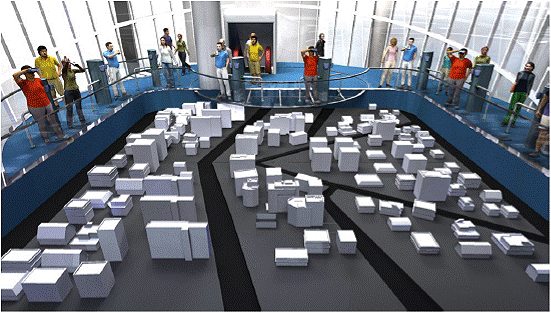 To the naked eye, the exhibit looks like a bare bones model of a city. But when visitors put on the special AR goggles a whole new world unfolds – as graphics overlaid on the city model.
![Reblog this post [with Zemanta]](https://i0.wp.com/img.zemanta.com/reblog_e.png)




 Games Alfresco