Governator vs. Chancellator Play Augmented Reality at Cebit

You got to see this to believe it:

California-Governor-Arnold -Schwarzenegger and German-Chancellor-Angela-Merkel jointly holding a Lego-digital box-by-Metaio.

In the back, a mirror screen featuring an augmented version of California-Governor-Arnold-Schwarzenegger and German-Chancellor-Angela-Merkel holding the Lego-digital-box-by-Metaio, with an exploded view of the assembled Lego toy.

This must have been the highest concentration of top-rank political figures in a single augmented reality scene – ever to be captured on (digital) film.

I have covered the Digial Lego Box when it was fresh news – now see it in video (in German) on the Cebit site.

Next political AR picture challenge:

capture Obama holding hands with Putin while watching an augmented view of a peaceful Afghanistan.

Thanks Jan Schlink for sharing!

Augmented Reality Game in Primetime TV Show

To complete the trilogy covering the Japanese foray into Augmented Reality, here’s a revival of a TV show featuring ARis the Augmented Reality Geisha.

The game creator is a super star; the new scenarios are staggering; give it up to the unwavering, hanky-panky, poke-her doll – ARis the augmented!

The first adult AR game is garnering excitement in Japanese pop culture.

Is ARis really at the center of a this TV game show?

What’s the big showdown about?

Who won this “boss” battle?

“I Think the Graphics of a Punch”

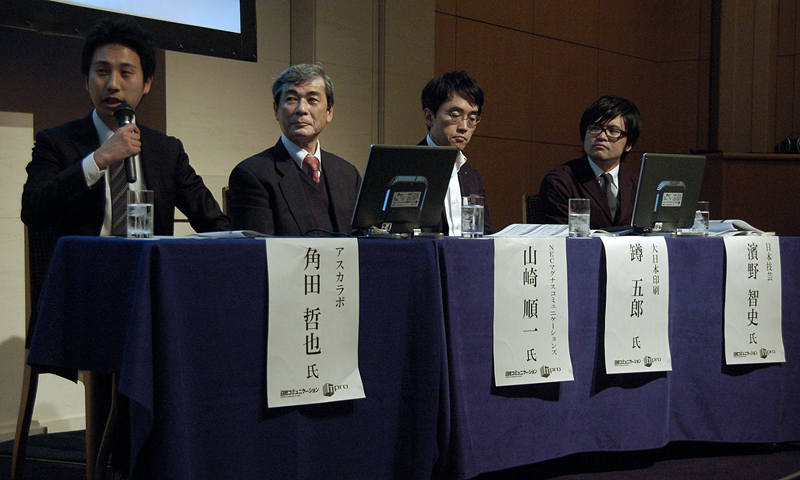
Predicted Mr. Yamazaki during this week’s Augmented Reality panel at the IT Business Pro conference in Tokyo.

The panelists were (from left):

Tsunoda Tetsuya  from AR Lab Asuka – about content production, NEC’s Yamasaki Zyuniti MAGUNASUKOMYUNIKESHONZU about application development for mobile phones, AR DNP (DNP) Goro Nomotai, Mr. Hamano Satoshi of Japan about application development, and panel Chair  Takebe Keniti from Nikkei Communications about the theory of media arts

The panel chair Takebe started with an introduction to the advancements in AR technology.

He continued with examples of applications possible Today: (1) in construction of health care, (2) navigate catalogs, and, (3) communication, social understanding and relationship building using “social AR”

The panel discussion revolved around the business challenges and expectations from this new technology and highlighted the important roles of GPS and mobile phones in its future.

Japanese applications using AR such as the Sekai Camera were brought as current examples.

The panel went on a tangent and mused about an AR scenario that could take place in the very panel discussion they were all part of.

What if we used face recognition software to overlay text on a screen in front of the panel members, that would reveal to us relevant information about individuals in the audience?

That thought triggered a concern about the implications of AR on social ethics,  which evolved into a full blown discussions about the issues surrounding AR: low public awareness, hardware complexity, software scalability, security, etc.

The undisputed climax arrived when Mr. Yamakazi summarized the future of AR with his prediction “I Think the Graphics of a Punch!”


Japanese Augmented Reality Punch Continues

via augmented times, via Sein Blog, thanks to google translator…here are the AR news from Japan.

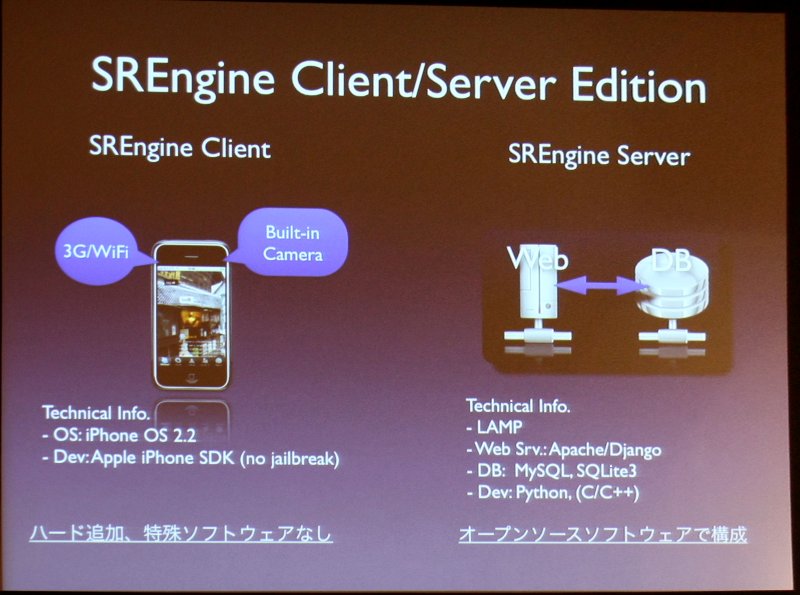
Scene Recognition Engine (SR Engine) demonstrates its ability to recognize buildings, pull relevant information, and display it live – on an iPhone. And it works outdoors – alfresco.

Looks like a marriage between Tonchidot’s Sekai Camera and Mobilizy’s Wikitude.

Interested in a look under the hood?

How does it work?
(loose translation from the creator’s speech in Japanese):

Stores in the city are stored in a database and mapped and tagged with information from brochures and videos. Based on the “scene” caught by the Camera, the app pulls information from its database and tags the actual image, the AR-free sensor networks. It uses GPS, angle variation and image matching, to recognize the targets.

So, I guess it only works when you observe the target from a certain perspective.

Why develop it for the iPhone?

IPhone’s CPU is [not] bad, folks like it…

Who’s behind it?

According to the blog it’s the man with the big name:

Sunday Star Geumchon

have you seen this man?

Who are you Sunday Star?

Toyota Augments its Mini iQ too

We were all impressed by last year’s Mini advertising campaign using Metaio’s Augmented Reality technology. It featured  in the top spot of my Top 10 Milestones in Augmented Reality for 2008

Toyota couldn’t afford staying behind and had “one upped” BMW with a more sophisticated ad for its own mini – the iQ.

In the augmented world, the car drives on a road – and is blown up to reveal all its parts. Or in Toyota’s own words:

interact with the car to discover its agility and interior space.

Neat.

Give it up for the  “iQ_Reality“:

Vodpod videos no longer available.

Now try it for yourself on Toyota’s site.

***update***

Rouli brings to our attention that Nissan didn’t stay behind and just introduced its Cube brochure:

Yet a new update from Le5emeP: another auto maker to play with AR advertising is Citroen with its C3:

Lastly is Ford with its own mini – the Ka:

A new addition (2009) to the AR cars phenomena with an artistic angle for the BMW Z4:

[youtibe=http://www.youtube.com/watch?v=tr66vs5W7as]

Now we have a complete round up, which one do you like best?

Boy Meets Girl Remake: Virtual Boy Meets Real Girl

YDreams’ Flapi will flip your mind.

You all know the classic story: boy meets girl; girl plays with boy; boy falls in love with girl; girl leaves…

Maria Palma just shared with me YDream‘s take on the story, featuring their virtual Mascot, Flapi the cute, and an even more cute – real girl (the Creative Director’s daughter which totally steals the show).

I like the attempt for drama driven by the interaction between real and virtual.

But I’d love to see this on a portable device. The girl should see Flapi in her field of view avoiding the need to turn her head to watch it on the screen.

YDreams response: they’re thinking about it…

This demo (based on their SimVideo augmented reality platform) and others were presented by YDreams’ CEO, Antonio Camara, at the Digital Signage Expo in Las Vegas this week.

YDreams wasn’t the only AR company to present at the event: Total Immersion made a splash as well.

Microsoft to Demo Augmented Reality at TechFest

Technology Review reports the news:

Today, Microsoft researchers will demonstrate software that can, in real time, superimpose computer-generated information on top of a digitized view of the real world.

Michael Cohen,  principal researcher at Microsoft, and his colleagues will demo the augmented-reality technology at TechFest, an annual showcase of Microsoft’s research projects, in Redmond.

Well, we have seen augmented reality running on a Vaio before – but never from Microsoft. This could be interesting. Especially the tools.

Michael spits all the right examples of real life applications using AR, however at TechFest, the software will be used to lead people on a treasure hunt to a hidden prize of a (virtual) pot of gold.

The bubble flow navigation is way cool. Coming up right after the poster demonstration.

Games will lead the way.

***Update***

via KZero: a collection of additional Microsoft-produced videos of the future – featuring largely augmented reality applications.

Vodpod videos no longer available.

Vodpod videos no longer available.

Vodpod videos no longer available.

Vodpod videos no longer available.

Vodpod videos no longer available.

ISMAR 2009: The World’s Best Augmented Reality Event Wants You to Contribute!

This post is directed at you. Yes – you: the augmented reality aficionado.

For those who followed my coverage of ISMAR 2008 – prepare to be blown away by ISMAR 2009.

ismar-2009-wants-you

If you are an AR researcher – ISMAR 2009 is as always the best event to learn about the latest and greatest in AR technology.

If you work in the AR industry – congratulations! Unlike previous years – at ISMAR 2009 you’ll see AR breaking out into commercial success.

If you work in interactive entertainment – come to ISMAR 2009 to experience the phenomen that will revolutionize interactive entertainment forever.

If you are an artist – at ISMAR 2009 you’ll have an opportunity to join this emerging industry and change the way people experience the world, literally.

Interested? Good.

Because all of the above will only transpire – if YOU contribute.

ISMAR 2009 is now officially calling for proposals.

Here are excerpts from the call for proposals. For details check out the official call.

The veteran Science and Technology track will be complemented this year with new Arts, Media and Humanities tracks. ISMAR 2009 will introduce expanded Tutorials, Workshops, Demonstrations and Competitions.

Topics of the Technical Track:

Sensing – Tracking technologies, calibration methods, sensor fusion, vision-based registration and tracking, acquisition of 3D scene descriptions
Information presentation – Object overlay and spatial layout techniques, handling of occlusions or x-ray vision, photorealistic augmentation, real-time augmentation, optical display technologies (HWDs, HMDs, HUDs, mobile projectors), aural or haptic augmentation, combined presentation across several displays (combining mobile and stationary devices), display and view management
User interaction – Interaction techniques and metaphors for MR/AR, collaborative MR/AR, multimodal input and output, tangible interaction, combined interaction with virtual and real objects
Human factors – Usability studies and experiments of MR/AR-based interaction and presentation concepts, acceptance of MR/AR technology, social implications
System architecture – Wearable and mobile computing, distributed and collaborative MR/AR, display hardware, performance issues (real-time approaches), embedded computing for MR/AR, integration of MR/AR technologies into wide-area pervasive computing environments
MR/AR applications – across all areas of personal and professional activities, such as: Personal MR/AR information systems, games, applications in industry, military, medicine, science, entertainment, architecture, tourism, art, cultural heritage, education, training etc.

Topics of the Arts, Media & Humanities Tracks:

Compelling applications of Mixed & Augmented Reality. Applications include artistic expression, experiential-media or interpretive pieces that reflect the study of the human condition.
• Art – The Art program is looking for notable artists that have stretched the boundaries of expression with the use of Mixed and Augmented Reality.  The creative interaction between real, virtual and the imaginary realities to create provoking experiences are highly encouraged.  Written papers and posters are to include position statement with notes and images on approach, implementation and the technology used.  A gallery show will be mounted to support physical entries (see call for demonstrations).
Media – submissions from media practitioners who have stretched the boundaries of the creative impact of Mixed and Augmented Reality.  This venue seeks innovative uses of creative techniques for communication and entertainment to enhance the experience of MR/AR through novel applications of head-mounted, embedded projection, or mobile displays.  Submissions may include new tools, conventions or taxonomies for developing these new media.
Humanities – academic submissions that relate to Mixed and Augmented Reality content that allows for innovative analytical, critical or speculative approaches to reflect the study of the human condition. and digital media.

Call for Innovation Workshops

ISMAR 2009 will have a series of workshops the day before the conference (Monday) to cover the innovative application of Mixed and Augmented Reality to specific industry domains.  Three workshops have been defined.  We invite you to submit papers or panel discussions that will address topics of transferring MR/AR to solve critical real world problems (see web site for details).  If your paper or panel does not fit the existing workshop, you may submit a proposal for a new workshop.
Designing the Future (Design and Manufacturing Workshop):  This workshop will continue the ISMAR legacy of showcasing the pioneering efforts of the auto and other industries’ use of Mixed and Augmented Reality as design tools.
Falling in Love with Learning (Entertainment & Education Workshop):  Entertainment and Education converge in Mixed Reality Experiential Learning Landscapes for museums, libraries, schools and parks.
Transforming Lives (Medical and Military Training Workshop):  Extreme Mixed Reality needs to meet high-risk, high-performance training to enhance human preparation for life and death scenarios.

Call for Pioneering Tutorials

To mark ten years of ISMAR, the 2009 conference will include a three-day comprehensive tutorial program that covers a wide spectrum of topics in Mixed and Augmented Reality.  We are looking for submissions from pioneers to share their experiences and insights.  Formats can be from 30 to 90 minutes.  These tutorials will be video captured and distributed as a series along with special features covering the work of pioneering laboratories worldwide.

Call for Demonstrations

There will be four formats to submit demonstrations.  Demonstrations can be related to papers, posters or panels, but that is not required.  A proposed abstract, floor plan and list of requirements are requested with the letter of intent (see websites for details).  Accepted Participants will receive notification by June 30th, 2009 to start coordination with the ISMAR 2009 Planning Committee.  To accommodate late breaking discoveries, we will accept “Laboratory Demonstrations” until the last minute, pending committee discretion and conference  accommodations (submissions received after August 15th, 2009 will not be included in the publications). Letters of intent are recommended for all submissions to assist in the planning.
Laboratory Demonstrations will provide the opportunity for “late breaking” research teams to informally demonstrate their latest inventions and allow for interaction with attendees and other pioneers.
Research Showcase will be a more formal presentation of innovative Mixed and Augmented Reality content that involve more production support and exhibit design considerations.
Art Gallery will present innovative Mixed and Augmented Reality artwork within a unique gallery format based on a combination of invited and submitted work.
Innovation Exhibitions (See industry/Sponsor relations) will feature the latest commercially available products and services for use in Mixed and Augmented Reality applications.  The exhibition will be available for rental to industry buyers from the entertainment, medical, military and educational markets.  A special “Start-up Park” will be available for small, first time commercial exhibitors at more affordable prices.  Early registration is recommended for the expected increased participation and limited space.

Tracking Competition

The first event of this kind at ISMAR 08 (http://ismar08.org/wiki/doku.php?id=program-competition) caught much attention. A sequel will be organized at ISMAR 2009. Details regarding the tracking task and the rules of competition will be made available on the web site. It is to be expected that only a limited number of teams can participate.

***********************

Don’t be wary.

Even if you do not have a rigorous research paper – you still have an important role in ISMAR 2009.

If you have developed a cool AR tool, app or game, or –

if you have conceptualized an interesting AR idea, or even-

if you just had a vision of the killer AR app  – we want to hear from you!

Don’t wait for the May 16th deadline – you can’t afford to. Submit your proposal today.

**********************

Send your proposals to:

Gudrun Klinker, Blair MacIntyre and Hideo Saito

Science and Technology Program Chairs (Science@ismar09.org)

Blair MacIntyre

Art and Humanities Program Co-Chair (Humanities@ismar09.org, Art@ismar09.org)

Jay Bolter

Humanities Program Chair (Humanities@ismar09.org)

Jarrell Pair

Media Program Chair (Media@ismar09.org)

Charlie Hughes

Tutorial Chair (tutorials@ismar09.org)

Christian Sandor

Laboratory Demonstration Chair (Demos@ismar09.org)

Sean White,

Research Showcase Chair (Showcase@ismar09.org)

Larry Davis

Innovation Exhibition Chair (Exhibits@ismar09.org)

Christopher Stapleton

Interim Workshop Chair (Workshops@ismar09.org)

Daniel Pustka

Tracking Contest Chair (Tracking@ismar09.org)

We want to hear from you!

As a member of ISMAR’s Media track committee – I hereby vow to emphatically review every single proposal in the media track. Your voice must be heard.

Augmented Reality in Flash Now Commercially Available

Mark Billinghurst just shared with me the good news: ARToolworks announces commercial availability of FLARToolKit. He explains:

Basically it means that companies can now get commercial licenses to FLARToolKit and build flash based Augmented reality websites without having to release their source code as required by the GPL license.

Saqoosha (Tomohiko Koyama) was the first to marry AR with flash as open source – a major step in simplifying AR apps on a PC. Now ARToolworks CTO, Philip Lamb, is taking it to a commercial level.

The code is available at the Spark Project site.

To get your creative juices going, here’s a reminder of the kind of things this baby can deliver:

Vodpod videos no longer available.

Vodpod videos no longer available.

What are YOU going to create with it?

The Curious Raven Says: Tonchidot Has Real Demo…But He’s Not Impressed

Robert Rice (Curious Raven) just unveiled this new demo by Tonchidot, and although this time it looks real, compared to the TechCrunch50 concept video of yesteryear – he’s not impressed.

Judge for yourselves.

Vodpod videos no longer available.

What strikes me is the similarities with 2 other apps launched recently: wikitude and Nru.

These apps don’t do image recognition. They rely solely on GPS (for location) and sensors (compass – for direction, latitude – for angle, accelerometers – for pose) – to give you más info about what you’re looking at.

Wikitude’s founder, Philipp Breuss, presented last week at WARM, his simple yet powerful design of an app that tells you what wikipedia knows about what you’re looking at (mostly sites.) He boasts 60,000 downloads so far. Not too shabby.

Nru by Lastminute.com does a similar job with 2 distinct differences: it omits the live video stream for a purpuly radar like UI, and it tells you what Qype and fonefood know about what you’re looking at (mostly restaurants and shows.) Still waiting for the release of the app.

These apps make do with GPS and sensors, and lack visual recog capabilities – but they have one  advantage – they are getting popular by the minute.

Nru