2008 Wrap Up: Top 10 Milestones in Augmented Reality

2008 was a great year for augmented reality.

This emerging technology is on a 15-plus-year-long journey from the lab and into the mainstream. With too many events to list, 2008 marks an important year in that quest.

Here is the countdown of the top 10 most important AR milestones of 2008:

10) Otellini’s CES keynote showcases AR technology

The year started with the largest consumer electronics show CES. Total Immersion’s demo had the attention of the entire consumer electronics community during Otellini’s (Intel CEO) 2008 keynote.

9) Video game gurus recognize AR as the future of gaming

My personal idol in the game industry, Will Wright, delivered the best augmented reality quote of the year. When describing AR as the way of the future for games, he explained:

Games could increase our awareness of our immediate environment, rather than distract us from it”.

Futurist Bruce Sterling made controversial statements about games in 2043 in front of a developer only audience in the Austin Game Developer Conference . Here is one statement that stood above all:

“What do the games of 2043 look like? “I think you would call [them]  ‘augmented reality’”

8) ISMAR 2008

The world’s most important augmented reality event, ISMAR 2008, was more significant than ever. It  demonstrated, above all, the level of maturity AR research has reached.

7) High end mobile AR devices hit the market

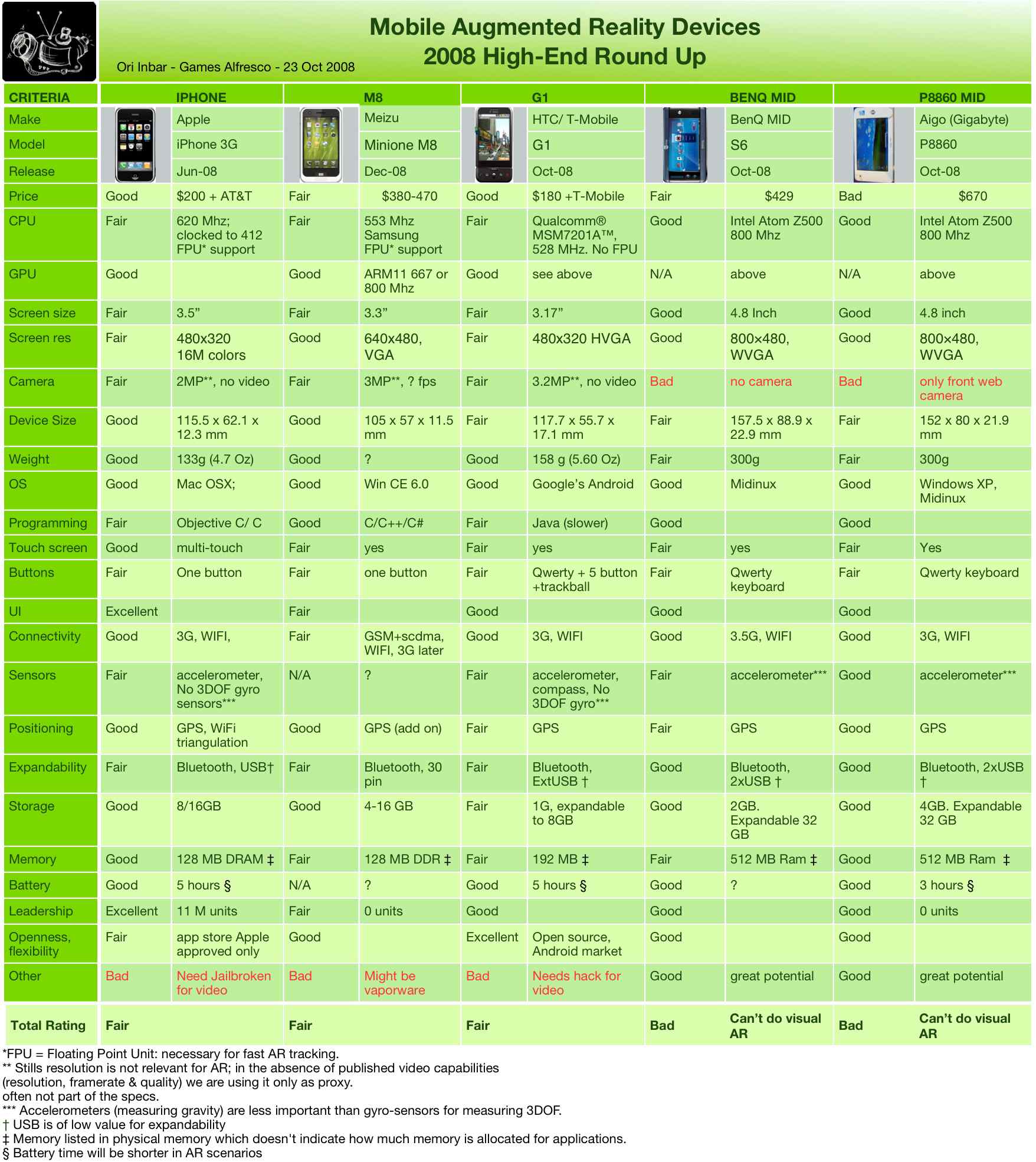
2008 gave rise to a flood of new AR-worthy mobile devices: iPhone 3G (see below), Android based G1, Itelco’s IDOL, HTC’s Touch HD, Blackberry’s Storm, Nokia N97… It also signaled the dawn of hands free AR with prototype glasses and contact lens (see Top 10 devices.)

ar-device-comparison3

6) iPhone and App store

It might not be the best AR device but it certainly has the most buzz. In 2008, the iPhone was highly sought after by game developers and researchers. The App store which amassed 10,000 apps in half a year, offers an instant distribution model for AR games. In 2008, the iPhone was the gadget to beat.

5) Native mobile tracking engines released

AR engines and tools did not stay behind in 2008 and delivered new tracking engines for the hottest platforms du jour. Some notable examples include ARToolkit for iPhone, AR in Flash, and Studierstube ES for mobile phones. See the entire collection of engines and tools.

4) AR apps win acclaim in major competitions

AR made headlines in 2008 with 2 applications that dribbled into top 50 lists: Tonchidot made the Crunch50 and Wikitude made the Android 50 finalists. Total Immersion won another award at NVISION ’08 for Best Application of Visual Computing.

sekai-camera

3) AR games win awards

Ghostwire may or may not be the first AR game to win a game award. But, 2008 was certainly the first year were 6 out 0f top 10 games were selected as finalists in game awards such as Nokia’s Mobile Innovation Challenge.

One AR game did not win any awards this year, but was certainly an audience favorite (the most hits): Cyber Figure Alice – the first adult only AR game.

2) Major investments in AR research

Media Power made significant investments in augmented reality research organizations around the world. If the $5M for GA Tech GVU donnation and $2.7M for NZ HIT Lab donnation don’t speak for itself, the results are already showing:

1) Record commercial deals

The AR market picked up steam in 2008 with high visibility deals such as Total Immersion’s with Six Flags (“magically superimpose clown masks on riders” as their waiting for the Dark Night ride) and Metaio (book deals with publishers ArsEdition and Knowledge Media). Metaio also scored a lucrative advertising contract to promote the MINI.

What, in your opinion, was the most significant augmented reality milestone in 2008?

Whatever you do, don’t miss “If the Augmented Reality Industry Got a Report Card”

Subscribe (top right) to get the complete 2008 wrap up series.

The Making of ARf: Me, My Dog and i-Phone

Blair MacIntyre sent me a nice proof of concept of an augmented reality virtual pet running on an iPhone.

So I thought, why not write about “the making of ARf”?

Shot a couple of questions to Blair and he conveniently turned it into a well structured interview. Thanks Blair!

Here it is for your edutainment.

games alfresco: Hey Blair, I’d like to write about ARf in my blog.

Blair: Great! :)

games alfresco: Is there anything beyond the video that I could share?

Blair: We (my student Kimberly Spreen, really) did this relatively quickly.  She figured out how to get video [on an iphone], and we’d been thinking about doing a virtual pet game for quite a while, so we decided to implement some of the ideas to test out the iPhone.

games alfresco: Could you share a description of the current features?

Blair: Right now, you can interact via the touch screen, and by moving the markers.  Kim did a nice little implementation of multi-marker tracking where you can just add new markers as you feel like and don’t need to preconfigure the multi-marker layout.  You can interact with the dog by touching it (touch its nose and it jumps up to lick, its tail and it chases it, rub its back and it rolls over to let you rub its tummy) or by touching the ground to send it somewhere.  If it gets near its water it drinks, near the other dog it plays, or near a smudge (that you put on the ground by rubbing the ground) it sniffs it (alas, the smudge looks like a little “pile”, which works, but wasn’t the intent).

games alfresco: Plans for a full game?

Blair: This is a project we’ve been thinking about for a few years, going back to our “Dart the Dog” project that we did in Director.  The goal is to explore what it means to let everyone have a virtual pet they can take with them, and interact with through different interfaces (desktop, handheld, handheld AR, etc).  Most importantly, we want the location (bedroom, living room, work, bus, bar, etc) and activity (sound level, light levels, etc) and presence of other pets to impact how the pet develops.

To handle the development, we are talking to some folks at an AI company, who are creating an engine for doing creature AI based on reinforcement learning.  They hope to have something we can use next year.  If we can get that, we will be able to really have pets that grown, change, evolve, etc.

A few company’s who are funding us are interested in this, so I hope we can devote some energy to it next year.  We’ll probably target a few platforms, but obviously the iPhone has a lot of appeal.  From a research perspective, I’m interested in it because there is the potential to release a research game and (with permission of the people who download it, of course), collect a lot of usage data.  Ironically, since the create AI engine is server based, I don’t know if we could handle a big success and provide the AI service to everyone who gets the game, but I’ll worry about that it we ever get there.

games alfresco: Can you share more details about the software? Is it a Jailbroken iPhone?

Blair: Official iPhone SDK, unhacked phones.  I have no interest in working with jailbroken phones;  the appeal of the iPhone is the potential for mass distribution to support broad evaluation and feedback.

Obviously, we have hacked the API to get at the camera, so we can’t release this until Apple creates an official API.

We are using StbTracker for tracking.  The rest of the software was written by us.

games alfresco: Cool. Thanks for showing us “under the hood” of ARf.

For a doggie game, the name ARf works nicely in English.

It could get weird when translated into:

  • Spanish – jau, jau
  • Afrikaansblaf
  • Albanian – ham, ham
  • Arabic – how how
  • Armenian – haf, haf
  • Basque –  zaunk-zaunk
  • Bulgarian –  jaff, jaff
  • Catalan – bau, bau
  • Chinese, Cantonesewow, wow
  • Chinese, Mandarinwang, wang
  • Croatian – vau, vau
  • Danish – vov, vov
  • Dutch – waf, waf;
  • Esperantoboj, boj
  • French – ouaf, ouaf
  • German – wuff, wuff;
  • Greek – ghav, ghav
  • Hebrew – hav, hav
  • Hindibho, bho
  • Icelandic – voff, voff
  • Indonesian – guk, guk
  • Irish – amh-amh
  • Japanese – wan, wan
  • Korean – mung mung
  • Latvian – vau, vau
  • Persian – vogh, vogh
  • Portuguese – béu-béu
  • Russian – gav, gav
  • Serbian – av, av
  • Slovenianhov, hov
  • Thai – hoang, hoang

Top Mobile Devices Compete for Augmented Reality Puissance

One of the most popular posts on this blog has been, and still is, my “Top 10 Augmented Reality Devices“.

Based on the feedback, you appreciated the condensed collection of various categories of devices, as well as the suggested criteria for evaluating upcoming devices. What you were missing is a practical head to head comparison of the top devices.

So ,here it is: the (mostly) complete, (roughly) unbiased, and accurate (at best) comparison of the top mobile devices for high end augmented reality.

How do you become a high-end AR device?

If you’re snug in my hand, have the power to track natural features and objects in live video, while interacting with the overlaid 3D graphics at 24 fps — and all looking good on the display – welcome to the high end club.

Now, take a deep breath, click…and dive right ahead: 5 devices, 22 criteria, rated from bad->fair->good->excellent, with no frills.

Contribution by Daniel Wagner

No big winners on this list.

Some have to be hacked to do AR; some might not see the light of day; others don’t even have cameras.

[What in the world are MIDs with no cameras doing on the list, you ask?

Patience my friends. The MIDs are coming. They will have cameras in no time.]

Have you seen any better high end device?

Should Nokia sneak up there?

What would you like to see next on the list?

These Top 20 Game Publishers Will Disappear – Unless…

Game Developer Magazine just published its Top 20 Publishers of 2008.

How many augmented reality games have these formidable companies published?

Sweet Fanny Adams. Diddly squat. Zilch.

Here’s a summary of the Top 20, with links to individual profile pages:

20. Midway
19. Eidos Interactive
18. Codemasters
17. LucasArts
16. Disney Interactive Studios
15. NCSoft
14. Capcom
13. Namco Bandai Games
12. Vivendi Games
11. Konami
10. Square Enix
9. Microsoft Game Studios
8. THQ
7. Sega of America
6. Take Two
5. Sony Computer Entertainment
4. Ubisoft
3. Activision
2. Electronic Arts
1. Nintendo

The article recaps the publishing landscape:

This year’s list seems to have been influenced somewhat by which companies could adapt with the times…most of the publishers in our top 20 have a decided console focus, demonstrating that the adaptation of new forms of games into the existing model will take some time.

Sure. When a game title costs upwards of $20M to develop (not including marketing) you got to sell a whole load of it. You can’t take risks.

Darvin said that if you can’t adapt, you’ll die. I will argue that in 10 years these publishers (and affiliated studios) will disappear from the list. That is unless they open their minds and wallets to reality games.

I have raved this month about a flood of augmented reality games coming to the iPhone, Google’s Android, and Nokia mobile devices. So what am I ranting about today?

Well, these mind-blowing games are not coming from the above top publishers; they are emerging from the fringe. Tiny boutique studios aren’t trying to predict the future; they are bringing it forward by pushing the envelop of game experiences.

If I were a betting man, I’d say these risk-taking-tiny-boutique-studios will top the charts in the future.

Nokia’s MGIC: Augment Reality – the Nokia Way

Forget the iPhone. Forget Google’s Android. Today is Nokia’s day.

As of Today, Nokia is playing in the big leagues of Augmented Reality. It just announced the top 10 finalists in its Mobile Game Innovation Challenge.

Guess what type of games made it to the top?

Augmented, augmented, and more augmented.

To make my point, I have filtered out the “traditional” games and put on the list only games that smell like augmented reality spirit. Here they are:

1. Active Tecnologia e Consultoria Ltda. (Brazil) with Cinemarena – set in a movie theatre, controlling avatars on the big screen

Sounds pretty augmented to me.

2. CreatePlayShare (India) with Ball – play any ball game on your mobile or even create your own new game

Reminds me the legendary SymBall, one of the first augmented reality games on a phone.

3. Different Game (Sweden) with Ghost Wire – use your mobile device to communicate with ghosts

Blurring the line between real and virtual couldn’t be more spooky.

4. Eclipse Interactive (UK) with Watchers – conspiracy adventure game that uses Nokia Maps and other real world tools to find locations

Sounds more like a mixed reality game, but hey – let it benefit from the doubt. Today, we are celebrating.

5. Int13 (France) with Kweekies – augmented reality virtual pet game

We were expecting Stephan and the Int13 team to come up with great augmented reality games on the iPhone. Well, they have first delivered for Nokia. Wish them success.

6. TechnoBubble (Spain) with Fun Cam – a mixed reality game that connects your camera on your mobile device to the TV

I don’t really get it – but since it’s a self-proclaimed mixed reality game, we’ll include it.

There you have it: 6 out of the 10 top games in Nokia’s “Mobile Innovation Challenge” fit in the augmented reality category. That’s a landslide victory!

And it’s not all: the three most innovative game concepts will be offered by Nokia Publishing pre-production contracts. The first winner will be awarded 40,000 EUR, the second 20,000 EUR, and the third 10,000 EUR.

Congratulations to the top 10 finalists (including the non augmented reality games…). The winners will be unveiled at Nokia’s Game Summit in Rome next week. May the best win.

***

It’s been a good month for AR games; news have been embracing the iPhone, Google’s Android, and Today – Nokia.

Which begs to say: ready or not – here comes a groundswell of games to a reality near you.

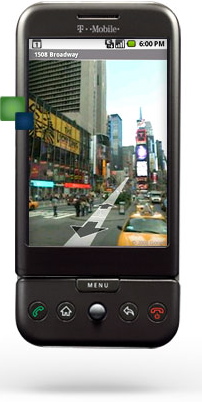
Can Google’s G1 do augmented reality better then the iPhone?

The iPhone hype still rules the augmented reality devices charts, but as Walter Mossberg claims in his in-depth test drive:

that will all change on Oct. 22, when T-Mobile and Google bring out the G1, the first hand-held computer that’s in the same class as Apple’s iPhone.

Google's G1

iPhone

TechCrunch has its own view on the comparison.

Here’s my quick comparison of the two devices through an augmented reality lens:

They both have similar screen quality (480×320 65K color), a nice touch screen, similar CPU speed, GPU for graphics acceleration, accelerometers for sensing movement, and are both in the under $200 price category.

G1’s Screen size is reportedly narrower than the iPhone (3.2” compared with 3.5”) yet is bulkier (weighs 5.6 ounces to 4.7) and is much thicker; but it has a better camera resolution (3.1 mp compared with 2mp), though similar to iPhone – it can’t record video.

A downside for developers is the very low memory allocated for third party apps (128 megabytes) and the 1G storage space (expandable up to 8GB) which would seriously limit/irritate developers.

On the positive side it has 5 buttons, a real keyboard (you care?), a compass… and most importantly it’s built on Android, an open (yet unproven) Operating System  – which means easier to adapt for the specific needs of augmented reality applications. On the flip side, some developers hate the restriction that comes with Android: program in Java.

Bottom line, these are worthy competitors – each with its own advantages and caveats.  The real winner will be determined, as always, based on whoever offers the best content and the best reality experiences.

Remember WIFI ARMY? It was a very promising AR game for Android (made it to the #7 spot in my top 10 AR demos). But they went silent…their website is down. If you see something – say something.

Unveiling Tonchidot: A Cool Parallel World – on the iPhone

Yesterday, at the TechCrunch 50 conference in San Francisco, a small start up from Tokyo stole the show; the name: Technidot, the cool product they unveil: Sekai Camera (World Camera) running on the iPhone.

In their own words, the Sekai Camera is:

…a real-world interface for the iPhone that connects real and virtual worlds, allowing anybody to create, experience and participate in both.

While at your favorite mall, point your iPhone camera at things around you such as food, toys, art, transit maps, and get detailed information about it. More fun for you, more business for retailers.

AirFilter takes care of the customized search to bring you the additional information, based on a database generated by advertizers.

And you’re not on your own; the Sekai Camera is also a social networking environment: leave messages to your friends – in space – so they can see it when they pass by.

Isn’t that a killer augmented reality application?

And Tonchidot’s take on Evolution could become the symbol of the AR revolution…

Here is the coverage of the demo by Anthony Ha on VentureBeat : including enthusiasts and skeptics.

This just in! More skeptics!

Blair MacIntyre finds it hard to believe it’s real. The TechCrunch panelists were amused and confused but blamed it on the language barrier.

What do you think? Is it real? or really augmented?

Filip, many thanks for the tip!

I want my iPhone augmented too!

The buzz continues.

As the coolest gadget around, the iphone is raising a lot of interest in the augmented reality community. This was once again confirmed in an interview with Stéphane Cocquereaumont, President and Lead developer at Int13, a mobile games developer:

“The iPhone is in fact our main target, the next demo we’ll publish will be on this device, this is probably the best device to do mobile AR today, even if its camera is far from perfect.”

Stéphane conversed with me following a post of Int13’s demo on the augmented reality games facebook group titled: “Augmented Reality on mobile devices that just works” 

He added:

“Our AR library should work easily on devices such as Intel’s MID [which is coming out this summer – games alfresco]…but we’re more interested in Smartphones…”

Games alfresco: How central do you see augmented reality in your company’s future?

Stéphane: “We plan to continue working on our AR technology and improve it, we’re especially interested in markerless tracking.”

And here is what I really liked in this interview:

“But our main objective is to create cool games and sell them”

Int13 is among the first pure game developers to dive into the AR space.

“if our current AR projects reveal themselves to be commercially successful then AR could become central for us.”

Cautious optimism, always a good trait for a game developer.

Thanks Stéphane and France from Int13 for sharing your experiences and plans!


Don’t you want your iPhone augmented too?

How do you spell Augmented Reality in iPhonese?

Doesn’t it feel like every other day, a new augmented reality demo for the iPhone hits YouTube?


Here is a play by play of the sequence of events that led the iphone to the top of the AR devices list:

First, on June 20th, “Augmented Reality Navigation” on the iphone hits youtube…


Then the Holotext hoax (on the iPhone) confuses the already confused youtube audience…


Furthermore, on July 18th, Thom York shows up singing as a [tricked] hologram on the iphone…


Nonwistawnding, artoolworks surprises, on July 21st, with the release of arttoolkit 4.4 for iPhone… 


What will they do next?

This just in: updates to "10 best AR devices…"

Hours following the publication of my latest post: “10 best AR Devices…” multiple announcements hit the air supporting my predictions:
1) Enkin: handheld navigation concept for Google Android phone
2) Apple’s patented head mounted display for iPhone
3) Gaming appearing recession proof, with close to a million handheld game devices sold in March 2008.