Governator vs. Chancellator Play Augmented Reality at Cebit

You got to see this to believe it:

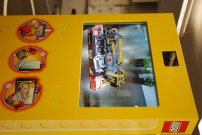
California-Governor-Arnold -Schwarzenegger and German-Chancellor-Angela-Merkel jointly holding a Lego-digital box-by-Metaio.

In the back, a mirror screen featuring an augmented version of California-Governor-Arnold-Schwarzenegger and German-Chancellor-Angela-Merkel holding the Lego-digital-box-by-Metaio, with an exploded view of the assembled Lego toy.

This must have been the highest concentration of top-rank political figures in a single augmented reality scene – ever to be captured on (digital) film.

I have covered the Digial Lego Box when it was fresh news – now see it in video (in German) on the Cebit site.

Next political AR picture challenge:

capture Obama holding hands with Putin while watching an augmented view of a peaceful Afghanistan.

Thanks Jan Schlink for sharing!

Metaio Offers Flash Forward for Lego Buyers

From Metaio‘s press release”

LEGO, the Danish toy manufacturer will test launch its “DIGITAL BOX” in selected toyshops and LEGO® stores worldwide. This interactive  terminal will utilize innovative technology supplied by Metaio in the form of a software  program specially-developed for the LEGO Group by the Munich-based experts in augmented reality solutions. Together with a camera and display screen, the software  lets LEGO packaging reveal its contents fully-assembled within live 3D animated scenes.

lego_digital_box_showcase

The press release continues:

The partnership between Metaio and one of the largest toy manufacturers in the world is a truly  major milestone in the history of the company.

Indeed, Lego is associated with playful, innovative toys and will certainly expose the concept of augmented reality to many kids around the world.

Kudos to Metaio for a great splash at the onset of the AR year.

Now who’s going to post the first video of this experience?

2008 Wrap up: Top 5 Augmented Reality Holiday Greetings

’tis the season for best wishes, and nothing shows your real feelings better than an augmented reality greeting card.

Here are the top 5 AR holiday greetings of 2008.

5. Happy Holidays from Tellart

Vodpod videos no longer available.

If you want to try it yourself – go to Tellart

Thanks Makezine for sharing.

4. Virtual Santa from Metaio on your iPhone

Download from the App store or see the whole story at Metaio.com

Thanks Jan for sharing.

3. A XMAS card from Special Moves

Try it yourself at specialmoves.com

Vodpod videos no longer available.

Thanks Ian Tait for sharing.

2. Augmented Reality Christmas Cookies

This one was the coolest, but unfortunately the video was removed from youtube by the user.

Just imagine cookies that when viewed through the AR software web cam show 3d objects floating on top…

Thanks ARtweets for sharing.

1. AID DCC and Katamari

Step 1: Print this
Step 2: Go to www09.aid-dcc.com
Step 3: Enjoy

Thanks Digital Stew for uncovering.

***Update***

Total Immersion just came out with their own New Year AR Greeting Card

Funky AR christmas greetings accompanied with latin-rap

***yet another update***

This time a Valentine greetings card by the folks from teh Warehouse

2008 Wrap Up: Top 10 Milestones in Augmented Reality

2008 was a great year for augmented reality.

This emerging technology is on a 15-plus-year-long journey from the lab and into the mainstream. With too many events to list, 2008 marks an important year in that quest.

Here is the countdown of the top 10 most important AR milestones of 2008:

10) Otellini’s CES keynote showcases AR technology

The year started with the largest consumer electronics show CES. Total Immersion’s demo had the attention of the entire consumer electronics community during Otellini’s (Intel CEO) 2008 keynote.

9) Video game gurus recognize AR as the future of gaming

My personal idol in the game industry, Will Wright, delivered the best augmented reality quote of the year. When describing AR as the way of the future for games, he explained:

Games could increase our awareness of our immediate environment, rather than distract us from it”.

Futurist Bruce Sterling made controversial statements about games in 2043 in front of a developer only audience in the Austin Game Developer Conference . Here is one statement that stood above all:

“What do the games of 2043 look like? “I think you would call [them]  ‘augmented reality’”

8) ISMAR 2008

The world’s most important augmented reality event, ISMAR 2008, was more significant than ever. It  demonstrated, above all, the level of maturity AR research has reached.

7) High end mobile AR devices hit the market

2008 gave rise to a flood of new AR-worthy mobile devices: iPhone 3G (see below), Android based G1, Itelco’s IDOL, HTC’s Touch HD, Blackberry’s Storm, Nokia N97… It also signaled the dawn of hands free AR with prototype glasses and contact lens (see Top 10 devices.)

ar-device-comparison3

6) iPhone and App store

It might not be the best AR device but it certainly has the most buzz. In 2008, the iPhone was highly sought after by game developers and researchers. The App store which amassed 10,000 apps in half a year, offers an instant distribution model for AR games. In 2008, the iPhone was the gadget to beat.

5) Native mobile tracking engines released

AR engines and tools did not stay behind in 2008 and delivered new tracking engines for the hottest platforms du jour. Some notable examples include ARToolkit for iPhone, AR in Flash, and Studierstube ES for mobile phones. See the entire collection of engines and tools.

4) AR apps win acclaim in major competitions

AR made headlines in 2008 with 2 applications that dribbled into top 50 lists: Tonchidot made the Crunch50 and Wikitude made the Android 50 finalists. Total Immersion won another award at NVISION ’08 for Best Application of Visual Computing.

sekai-camera

3) AR games win awards

Ghostwire may or may not be the first AR game to win a game award. But, 2008 was certainly the first year were 6 out 0f top 10 games were selected as finalists in game awards such as Nokia’s Mobile Innovation Challenge.

One AR game did not win any awards this year, but was certainly an audience favorite (the most hits): Cyber Figure Alice – the first adult only AR game.

2) Major investments in AR research

Media Power made significant investments in augmented reality research organizations around the world. If the $5M for GA Tech GVU donnation and $2.7M for NZ HIT Lab donnation don’t speak for itself, the results are already showing:

1) Record commercial deals

The AR market picked up steam in 2008 with high visibility deals such as Total Immersion’s with Six Flags (“magically superimpose clown masks on riders” as their waiting for the Dark Night ride) and Metaio (book deals with publishers ArsEdition and Knowledge Media). Metaio also scored a lucrative advertising contract to promote the MINI.

What, in your opinion, was the most significant augmented reality milestone in 2008?

Whatever you do, don’t miss “If the Augmented Reality Industry Got a Report Card”

Subscribe (top right) to get the complete 2008 wrap up series.

Live from ISMAR ’08: Latest and Greatest in Augmented Reality Applications

It’s getting late in the second day of ISMAR ’08 and things are heating up…the current session is about my favorite topic: Augmented Reality applications.

Unfortunately, I missed the first talk (had a brilliant interview with Mark Bullinghurst) by Raphael Grasset about the Design of a Mixed-Reality Book: Is It Still a Real Book?

I will do my best to catch up.

Next, Tsutomu Miyashita and Peter Meier (Metaio) are on stage to present an exciting project that games alfresco covered in our Museum roundup: An Augmented Reality Museum Guide a result of a partnership between Louvre-DNP Museum lab and Metaio.

Miyashita introduces the project and describes the two main principles of this application are Works appreciation and guidance.

Peter describes the technology requirements:

  • guide the user through the exhibition and provide added value to the exhibitions
  • integrate with an audio guide service
  • no markers or large area trackin – only optical and mobile trackers

Technology used was Metaio’s Unifeye SDK, with a special program developed for the museum guide. Additional standard tools (such as Maia) were used for the modeling. All the 3d models were loaded on the mobile device. The location recognition was performed based on the approach introduced by Reitmayr and Drummond: Robust model based outdoor augmented reality (ISMAR 2006)

600 people experienced the “work appreciation” and 300 people the guidance application.

The visitors responses ranged from “what’s going on?” to “this is amazing!”.

In web terms, the AR application created a higher level of “stickiness”. Users came back to see the art work and many took pictures of the exhibits. The computer graphics definitely captured the attention of users. It especially appealed to young visitors.

The guidance application got high marks : ” I knew where I had to go”, but on the flip side, the device was too heavy…

In conclusion, in this broad exposure of augmented reality to a wide audience, the reaction was mostly positive. it was a “good” surprise from the new experience. Because this technology is so new to visitors, there is a need to keep making it more and more intuitive.

~~~

Third and last for this session is John Quarles discussing A Mixed Reality System for Enabling Collocated After Action Review (AAMVID)

Augmented reality is a great too for Training.

Case in point: Anesthesia education – keeping the patient asleep through anesthetic substance.

How cold we use AR to help educate the students on this task?

After action review is used in the military for ages: discussing after performing a task what happened? how did I do? what can I do better?

AR can provide two functions: review a fault test + provide directed instruction repetition.

With playback controls on a magic lens, the student can review her own actions, see the expert actions in the same situation, while viewing extra information about how the machine works (e.g. flow of liquids in tubes) – which is essentially real time abstract simulation of the machine.

The result of a study with testers showed that users prefer Expert Tutorial Mode which collocates expert log with realtime interaction.

Educators, on the other hand, can Identify trends in the class and modify the course accordingly.
Using “Gaze mapping” the educator can see where many students are pointing their magic lens and unearth an issue that requires a different teaching method. In addition, educators can see statistics of student interactions.

Did students prefer the “magic lens” or a desktop?

Desktop was good for personal review (afterward) which the Magic lens was better for external review.

The conclusion is that an after action review using AR works. Plus it’s a novel assessment tool for educators.

And the punch line: John Quarles would have killed to have such an After action review to help him practice for this talk…:-)

=====================

From ISMAR ’08 Program:

Applications

  • Design of a Mixed-Reality Book: Is It Still a Real Book?
    Raphael Grasset, Andreas Duenser, Mark Billinghurst
  • An Augmented Reality Museum Guide
    Tsutomu Miyashita, Peter Georg Meier, Tomoya Tachikawa, Stephanie Orlic, Tobias Eble, Volker Scholz, Andreas Gapel, Oliver Gerl, Stanimir Arnaudov, Sebastian Lieberknecht
  • A Mixed Reality System for Enabling Collocated After Action Review
    John Quarles, Samsun Lampotang, Ira Fischler, Paul Fishwick, Benjamin Lok

The End Of Museums As We Know It

As the light at the end of the (summer vacation) tunnel is almost insight, let me ask you a reflective question:

Where do kids prefer to be on a summer day:

(a) Museums

(b) Theme parks

(c) Staying at home and playing video games

Any volunteers for (a) ?…

What if you could combine all three into one?

What if you could transform learning about cultures, art, science, history – into a fun experience for kids? What if museums were as much fun as outdoor adventures and video games combined?

This fantasy is becoming a reality thanks to efforts by pioneers around the world.

Here are my picks of the 4 5 best augmented reality tours that are reinventing museums:

1. Lifeplus in Pompei

Pompei Ladies in an afternoon promenade in front of your eyes

Breathing new life into the ruined streets of Pompei

Visitors stroll in the real streets of Pompei, while watching thru their glasses, virtual scenes of city natives living their lives as if it’s 79 AD, minutes before the eruption of Vesuvius.

This EU funded project was lead by MIRALab – university of Geneva in 2004. See more at Lifeplus.

2. DNP-Louvre Museum lab

A behind the scenes look at exhibits

A mobile device with live video, shows on the display virtual objects such as a balloon that guides visitors through the exhibits. The climax of this tour arrives (1:37) when shards of an antique Islamic platter are virtually reconstructed to create the real platter.

Kudos to Metaio who developed the experience for DNP-Louvre Museum Lab in Tokyo, though they should try trimming the bulky device…

See more at DNP-Louvre Museum lab in Tokyo

3. Mobile Augmented Reality Quest (MARQ) –         Expedition Schatzsuche

Treasure hunt in a museum (in Austria)

A team oriented game where museum visitors play the role of investigators required to solve 3d virtual puzzles surrounding exhibits. Successful completion of puzzles reveal further steps of the story.

Beyond the new type of interaction with museum exhibits, MARQ introduces multi user collaboration: collected virtual items can be shared between groups, and “guided tour replays” can be viewed at any time – on the Gizmondo (RIP) gaming device.

This novice approach to experiencing Museum exhibits was developed by the Graz University team in Vienna, led by Daniel Wagner and Dieter Schmalstieg. It was shot at the Kärner Landesmuseum in Klagenfurt/Carinthia.

See more about MARQ at Studierstube

And here is an older project from the same team: Enigma Rally at the Vienna Technical Museum.

4. Rome Reborn, now Augmented

Undo the barbarians

Rome Reborn is the largest computer simulation of an ancient city. Cool. But what Fraunhofer (Institute for Computer Graphics Research) has done with it is way cool: walk among the ruins of the Roman Forum and point your Vaio UMPC anywhere to see buildings being reconstructed.

See more about the technology used at InstantReality

5. Voices of Oakland

If a cemetery were a museum

Blair MacIntyre and his team at GA Tech have done the impossible: they have turned the Oakland cemetery in Atlanta to a visitor magnet – all thanks to an augmented reality tour which can be experienced on a cell phone. You have to see it to believe it.

Unfortunately, the cemetery was destroyed last year by a hurricane. So the students of subsequent years wont be able to keep playing with it.

6. Science Museum in Paris

Navigate Museums with AirTags

A new implementation by Tonchidot for La Villette Museum in Paris where visitors use AirTags provided by the Museum or by users to enrich their museum experience.
In the creators own words:

Sekai camera turns a museum into a “living” internet environment…The real world becomes “clickable”

7. Digital Binocular Station for Cultural Museums

A stationary Augmented Reality device developed by Mind Space Solutions. Because it is fixed to a single location, it allows the use photorealistic, cinema-quality visuals, and compensate for the lack of parallax by presenting everything in stereoscopic 3D.

=========================================

What are the 10 ingredients to augment a museum tour?

  1. A practical augmented reality device (avoid backpacks and bulky displays) with visual tracking software
  2. High quality 3D models of exhibits, and how they looked and behaved in the past (and future?)
  3. A combination of learning and fun with a really really good story
  4. Breath life into inanimate objects
  5. Sprinkle some sound when necessary
  6. Incinerate verbose plaques; say what you have to say in 2 to 5
  7. Indoor tours are great; outdoor tours are even better
  8. Multi user interaction and collaboration
  9. Location based services, including (fun) navigation instructions
  10. Did I mention it has to be fun?
…and don’t forget to send the kids home with a souvenir DVD: “my augmented tour at the museum”

Didn’t make the list…

The following efforts didn’t make the list, mostly because they forgot ingredient #10…

Have you seen other augmented museum tours? Share your experiences!

Top 10 Augmented Reality engines that will ignite a new era of video games

Welcome back!

So far we have looked at demos of augmented reality gameplay and investigated preferred hardware devices. That was just the warm up. Now we’re getting into the real beef: who offers the best software engine that can augment our reality (and our spirits)? Who will spearhead the creation of a totally new gaming experience?

Games alfresco brings you the unofficial roundup of the top 10 best augmented reality engines.

We will look at one engine at a time (enough with these looong posts!) and at the end of the round up, will rank them based on the feedback from you, the community. This is collaborative work in progress of group of passionate contributors on facebook. If you want to take part of the fun, join us at: augmented reality games.

Here is a sneak peak at some of the engines that we may or may not review:

Discontinued:

Stay tuned…or better yet – tell us what you think!